
Introduction
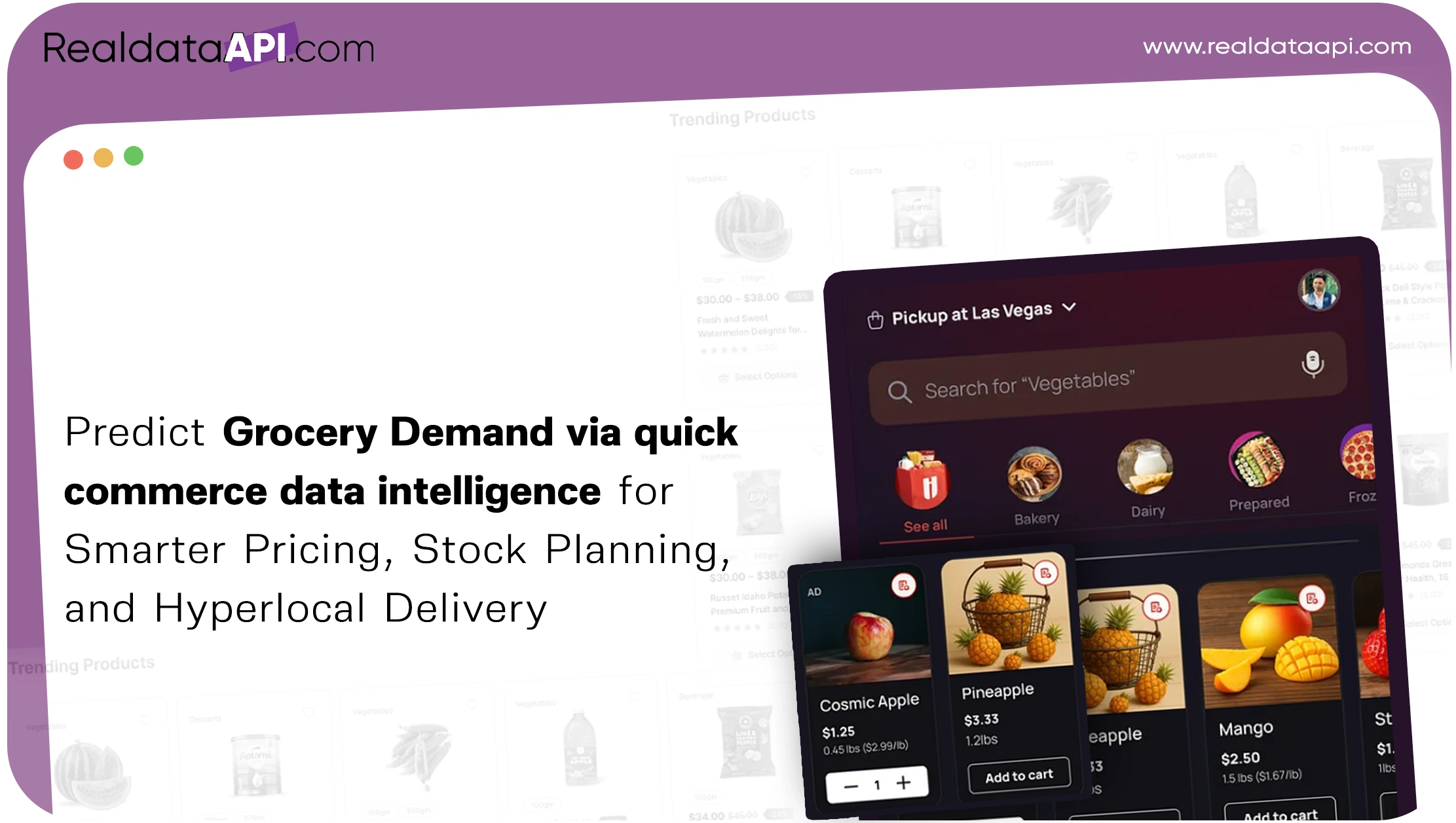
Predict Grocery Demand via quick commerce data intelligence helps grocery retailers, quick commerce platforms, brands, and supply chain managers forecast customer demand, improve inventory planning, and optimize hyperlocal delivery operations. Businesses use real-time analytics, web scraping, and AI-powered forecasting tools to reduce stock shortages and improve customer satisfaction.
According to industry estimates, quick commerce grocery demand in India is expected to grow by more than 35% annually between 2023 and 2026 due to rising consumer preference for instant delivery and mobile-first shopping experiences.
Businesses also rely on Quick Commerce Data Scraping API solutions to collect structured datasets related to pricing, delivery time, inventory availability, customer behavior, and regional purchasing patterns. These insights help companies improve operational efficiency and gain a competitive advantage in the fast-growing grocery delivery ecosystem.
Common Business Challenges Solved:
- Inventory shortages
- Pricing inconsistencies
- Hyperlocal demand forecasting
- Delivery delays
- Product assortment optimization
- Seasonal demand fluctuations
How Can Businesses Forecast Hyperlocal Grocery Demand More Accurately?
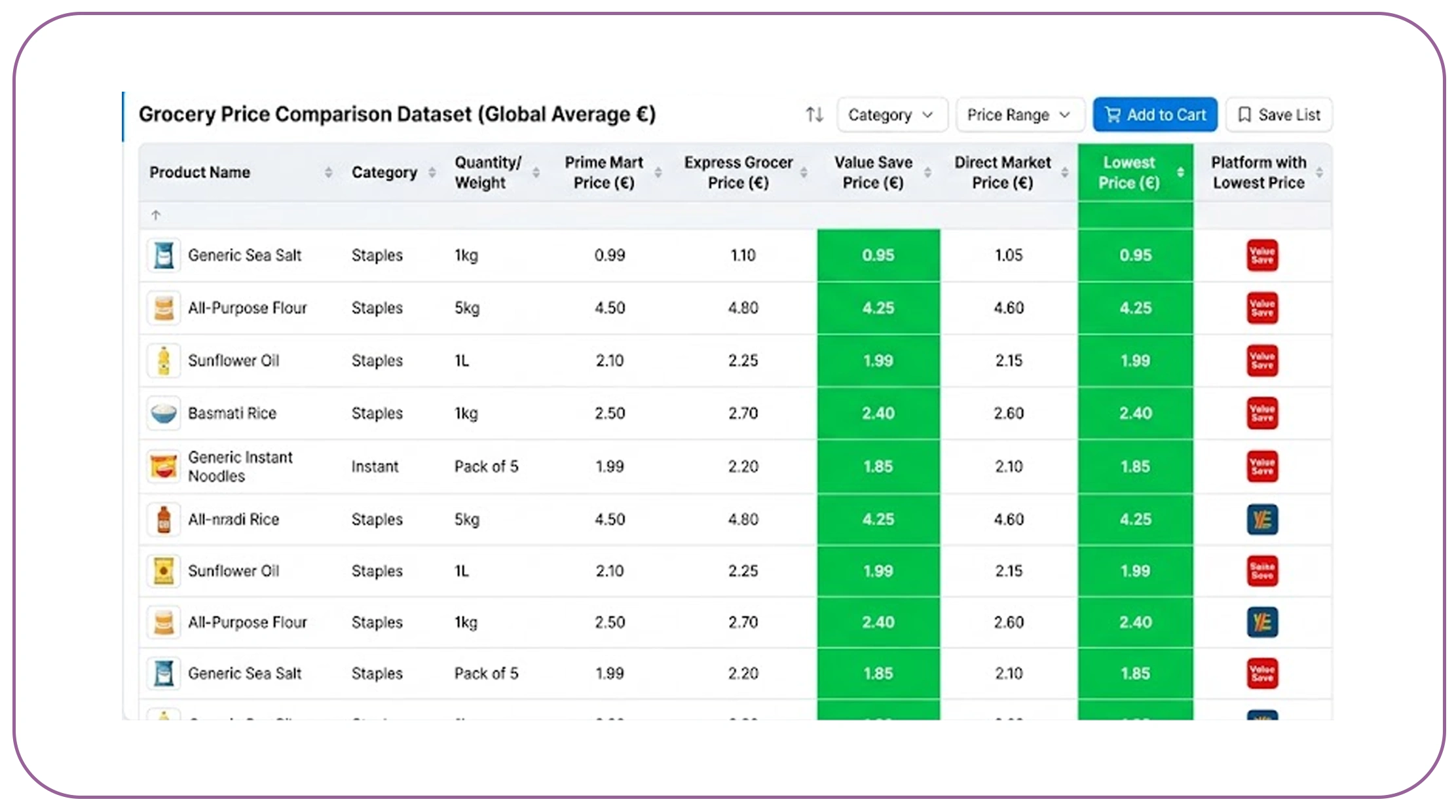
Businesses improve forecasting accuracy by using location-based analytics, historical order patterns, inventory intelligence, and real-time consumer demand monitoring. Modern retailers increasingly depend on hyperlocal grocery demand prediction via quick commerce data scraping to understand customer preferences at the city, neighborhood, and store level.
Hyperlocal forecasting allows businesses to optimize stock allocation, improve delivery speed, and reduce operational inefficiencies. Retailers analyze purchasing spikes, delivery density, and regional product preferences to improve inventory planning across fulfillment centers.
Hyperlocal Grocery Forecasting Trends (2020–2026)
| Year | Avg Daily Grocery Orders | Hyperlocal Delivery Zones | Demand Forecast Accuracy |
|---|---|---|---|
| 2020 | 120,000 | 220 | 68% |
| 2021 | 180,000 | 340 | 73% |
| 2022 | 270,000 | 510 | 78% |
| 2023 | 390,000 | 760 | 83% |
| 2024 | 540,000 | 1050 | 88% |
| 2025 | 710,000 | 1380 | 92% |
| 2026 | 920,000 | 1700 | 95% |
Why Hyperlocal Intelligence Matters:
- Improves delivery efficiency
- Reduces stock wastage
- Supports demand forecasting
- Enhances customer satisfaction
- Optimizes dark store operations
Retailers using predictive intelligence can respond faster to local demand fluctuations and improve operational scalability in highly competitive grocery markets.
Why Is Real-Time Grocery Demand Data Important for Retailers?
Retailers need real-time demand insights to understand customer behavior and maintain inventory efficiency. Businesses increasingly Scrape grocery demand via quick commerce data to monitor order frequency, category-level demand, and customer purchasing trends.
Consumer shopping behavior has shifted rapidly since 2020. Customers now expect faster delivery, accurate product availability, and personalized recommendations. Real-time analytics help businesses adapt quickly to changing market conditions.
Grocery Demand Analytics Overview
| Year | Avg Basket Size (INR) | Mobile Grocery Orders (%) | Repeat Purchase Rate |
|---|---|---|---|
| 2020 | 580 | 56% | 29% |
| 2021 | 670 | 63% | 35% |
| 2022 | 760 | 70% | 42% |
| 2023 | 850 | 76% | 49% |
| 2024 | 930 | 82% | 56% |
| 2025 | 1020 | 87% | 62% |
| 2026 | 1140 | 91% | 69% |
Key Benefits of Real-Time Grocery Data:
- Better pricing decisions
- Faster inventory replenishment
- Improved product recommendations
- Enhanced customer retention
- More accurate seasonal planning
Quick commerce retailers increasingly rely on automated analytics to improve forecasting precision and reduce operational risks associated with inventory shortages and delayed deliveries.
How Does Inventory Intelligence Improve Grocery Operations?
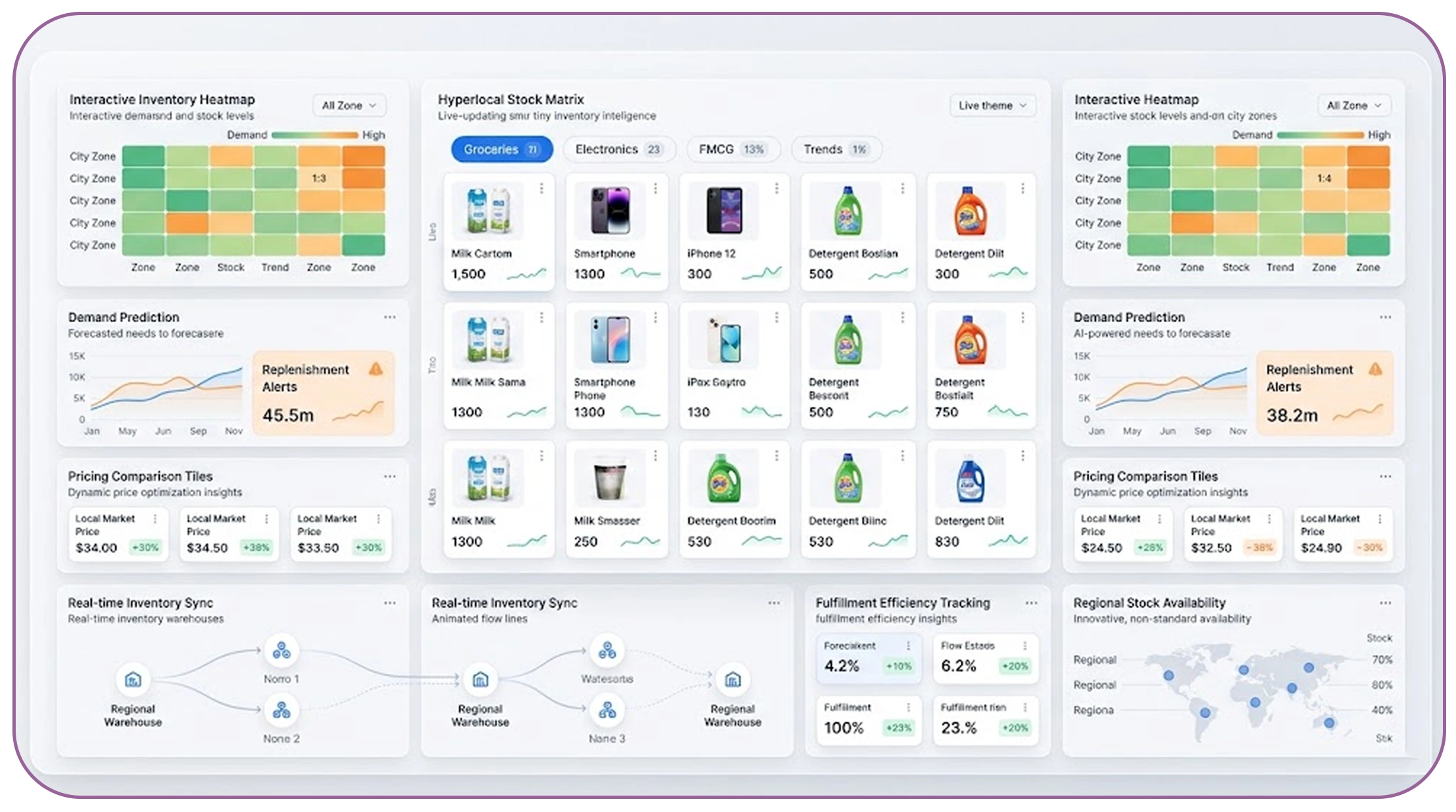
Inventory optimization is critical for maintaining product availability and minimizing losses in quick commerce operations. Businesses use quick commerce inventory optimization data extraction to monitor inventory movement, stock availability, fulfillment performance, and warehouse efficiency.
Modern grocery operations require dynamic inventory planning due to changing customer preferences and high-frequency ordering patterns. Retailers analyze product turnover rates and regional demand shifts to improve stock allocation strategies.
Inventory Optimization Metrics (2020–2026)
| Year | Inventory Accuracy | Avg Out-of-Stock Rate | Fulfillment Efficiency |
|---|---|---|---|
| 2020 | 74% | 18% | 69% | 2021 | 79% | 15% | 74% |
| 2022 | 84% | 12% | 80% |
| 2023 | 88% | 9% | 85% |
| 2024 | 92% | 7% | 89% |
| 2025 | 95% | 5% | 93% |
| 2026 | 97% | 3% | 96% |
Common Inventory Challenges:
- Overstocking
- Product expiration
- Delivery inefficiencies
- Forecasting inaccuracies
- Seasonal stock imbalance
Retailers that use predictive inventory analytics can improve operational efficiency while reducing logistics costs and product wastage. Data extraction technologies also support automated replenishment planning and demand forecasting.
How Can Web Scraping Improve Grocery Demand Forecasting?
Web scraping enables businesses to collect large-scale grocery intelligence from quick commerce platforms in real time. Organizations increasingly use Web Scraping Quick Commerce data for Grocery Demand analysis to evaluate pricing trends, competitor promotions, product assortment, and customer demand fluctuations.
Quick commerce platforms generate massive amounts of operational and consumer data daily. Businesses analyze this information to identify high-demand products, optimize pricing strategies, and improve category planning.
Web Scraping Intelligence Statistics
| Year | Data Points Collected Daily | Grocery SKUs Monitored | Competitor Platforms Tracked |
|---|---|---|---|
| 2020 | 1.2 Million | 90,000 | 5 |
| 2021 | 2.1 Million | 135,000 | 7 |
| 2022 | 3.4 Million | 195,000 | 9 |
| 2023 | 5 Million | 270,000 | 11 |
| 2024 | 7 Million | 360,000 | 13 |
| 2025 | 9.5 Million | 460,000 | 15 |
| 2026 | 12 Million | 580,000 | 18 |
What Data Can Be Scraped?
- Product pricing
- Inventory availability
- Delivery timelines
- Customer reviews
- Product rankings
- Discount trends
Businesses using web scraping solutions gain better visibility into market dynamics and can improve decision-making through continuous competitor monitoring and consumer trend analysis.
Why Are APIs Important for Grocery Intelligence Platforms?
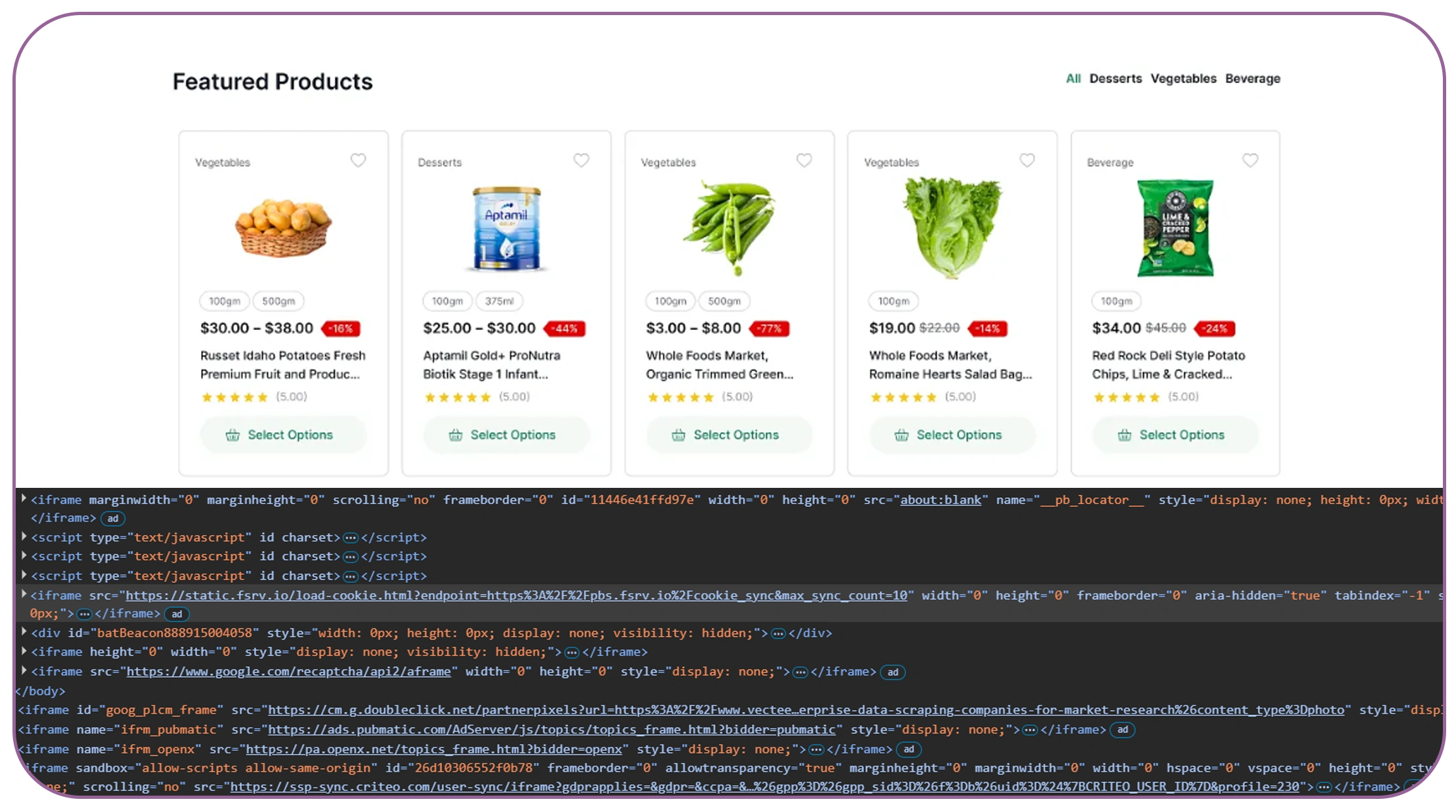
Modern analytics systems require scalable data collection infrastructure to support enterprise-level forecasting and reporting. Businesses increasingly rely on Grocery Data Scraping API solutions to automate data extraction and streamline operational intelligence.
APIs enable organizations to collect structured datasets from multiple grocery platforms while maintaining high accuracy and scalability. Businesses integrate API-driven intelligence into analytics dashboards, forecasting systems, and supply chain management platforms.
API Intelligence Performance Metrics
| Year | API Requests Processed | Automated Reports Generated | Data Accuracy |
|---|---|---|---|
| 2020 | 10 Million | 14,000 | 80% |
| 2021 | 17 Million | 22,000 | 84% |
| 2022 | 28 Million | 35,000 | 88% | 2023 | 42 Million | 51,000 | 91% |
| 2024 | 58 Million | 69,000 | 94% |
| 2025 | 76 Million | 90,000 | 96% |
| 2026 | 98 Million | 118,000 | 98% |
Benefits of Grocery APIs:
- Automated reporting
- Faster data collection
- Scalable analytics
- Real-time inventory monitoring
- Improved forecasting accuracy
Businesses leveraging API-driven intelligence can reduce manual research efforts while improving data-driven decision-making across grocery operations.
What Are the Most Valuable Grocery Data Intelligence Applications?
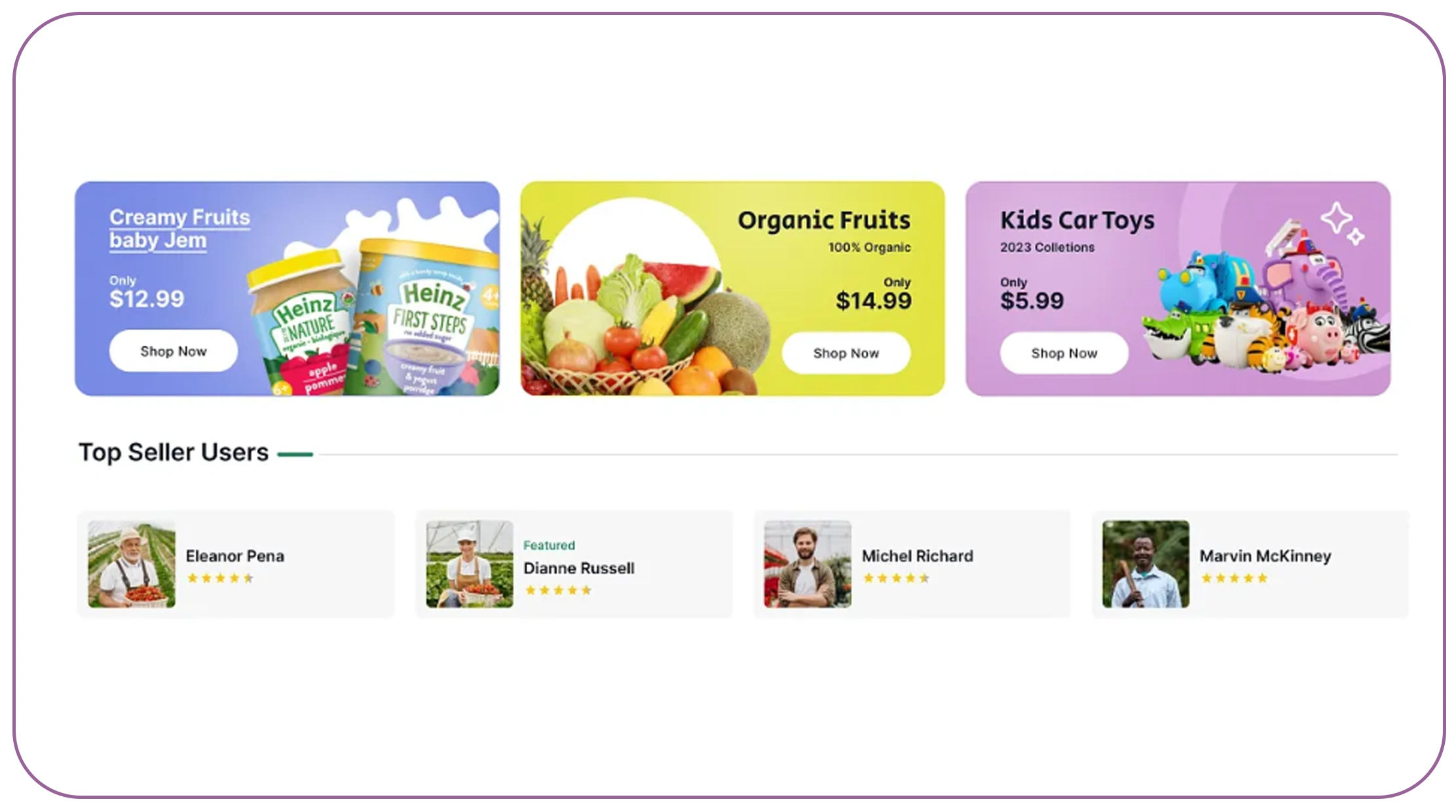
Data intelligence has become essential for modern grocery retail and quick commerce operations. Businesses increasingly explore Top Grocery Scraping API Use Cases to improve operational performance, customer engagement, and competitive positioning.
Organizations use grocery intelligence solutions for pricing analysis, inventory planning, customer segmentation, competitor benchmarking, and logistics optimization. Predictive analytics also supports strategic planning and demand forecasting initiatives.
Grocery Intelligence Use Case Statistics
| Year | Businesses Using Grocery APIs | Avg Forecast Improvement | Customer Retention Increase |
|---|---|---|---|
| 2020 | 1,200 | 16% | 8% |
| 2021 | 2,100 | 21% | 12% |
| 2022 | 3,500 | 27% | 17% |
| 2023 | 5,200 | 34% | 23% |
| 2024 | 7,100 | 41% | 29% |
| 2025 | 9,300 | 47% | 34% |
| 2026 | 12,000 | 54% | 40% |
Popular Grocery Intelligence Applications:
- Demand forecasting
- Dynamic pricing optimization
- Hyperlocal inventory planning
- Delivery performance tracking
- Competitor benchmarking
- Customer behavior analysis
Data-driven intelligence empowers retailers to improve scalability, operational efficiency, and customer satisfaction across rapidly evolving grocery delivery ecosystems.
Why Choose Real Data API?
Businesses need scalable and accurate intelligence solutions to compete effectively in the quick commerce industry. Real Data API delivers advanced analytics, automation, and structured Grocery Dataset solutions for grocery retailers, ecommerce platforms, and market research firms.
Companies also use Real Data API to Predict Grocery Demand via quick commerce data intelligence and improve operational planning through real-time analytics, inventory monitoring, and customer behavior insights.
Key Advantages of Real Data API:
- Real-time grocery intelligence
- Hyperlocal demand forecasting
- Automated inventory monitoring
- Scalable API integration
- Dynamic pricing analytics
- Competitor benchmarking
- Delivery performance tracking
- Advanced forecasting capabilities
Why Businesses Choose Real Data API:
- Faster market insights
- Improved inventory efficiency
- Better customer targeting
- Reduced operational costs
- Smarter pricing decisions
Real Data API helps businesses transform raw grocery data into actionable intelligence for sustainable growth and competitive advantage.
Conclusion
The quick commerce grocery ecosystem is evolving rapidly due to changing customer expectations, faster delivery requirements, and increasing demand for real-time analytics. Businesses that Predict Grocery Demand via quick commerce data intelligence gain a major advantage in inventory optimization, pricing efficiency, delivery planning, and customer engagement.
Advanced web scraping technologies and API-driven analytics provide businesses with the insights needed to forecast demand accurately, reduce operational inefficiencies, and improve customer satisfaction. From hyperlocal intelligence to inventory optimization, data-driven forecasting is shaping the future of grocery retail.
Ready to transform grocery forecasting with real-time quick commerce intelligence? Connect with Real Data API today and unlock scalable data solutions for smarter retail growth!
Latest posts

How Louis Vuitton Fashion Dataset Enables Better Analysis of Luxury Products, Prices, Brands, and Fashion Trends?
How Blinkit Grocery Dataset Enables Smarter Analysis of Products, Prices, Availability, and Quick-Commerce Trends?

How Chanel Fashion Dataset Enables Smarter Analysis of Luxury Products, Prices, Categories, and Fashion Trends?
How Foodpanda Food Dataset Helps Businesses Track Restaurants, Menus, Prices, Ratings, and Food Delivery Trends?







.png)