Introduction
Businesses can reliably collect information from JavaScript-heavy websites by using a browser-based scraping architecture that renders pages, executes client-side scripts, manages sessions, and returns structured content. A Scrape Dynamic Website Data Using a Scraping Browser API workflow is especially useful when conventional HTTP requests return incomplete HTML, blocked responses, or missing product and listing information.
Modern websites increasingly depend on JavaScript frameworks, asynchronous API calls, infinite scrolling, interactive filters, location-based content, and dynamically generated prices. This creates a major problem for companies that need dependable competitive intelligence, product monitoring, market research, or AI-ready datasets. A conventional scraper may retrieve the page source but fail to capture the information visible to a human visitor.
Real Data API helps businesses address this challenge through scalable web data collection workflows designed for dynamic environments. The approach can support use cases such as product monitoring, dynamic pricing, competitor research, inventory tracking, travel intelligence, real estate analysis, and AI data pipelines.
The key is not simply sending more requests. The extraction system must understand how modern websites behave in a browser and collect the rendered information accurately.
What Makes Modern Websites Difficult to Collect Data From?
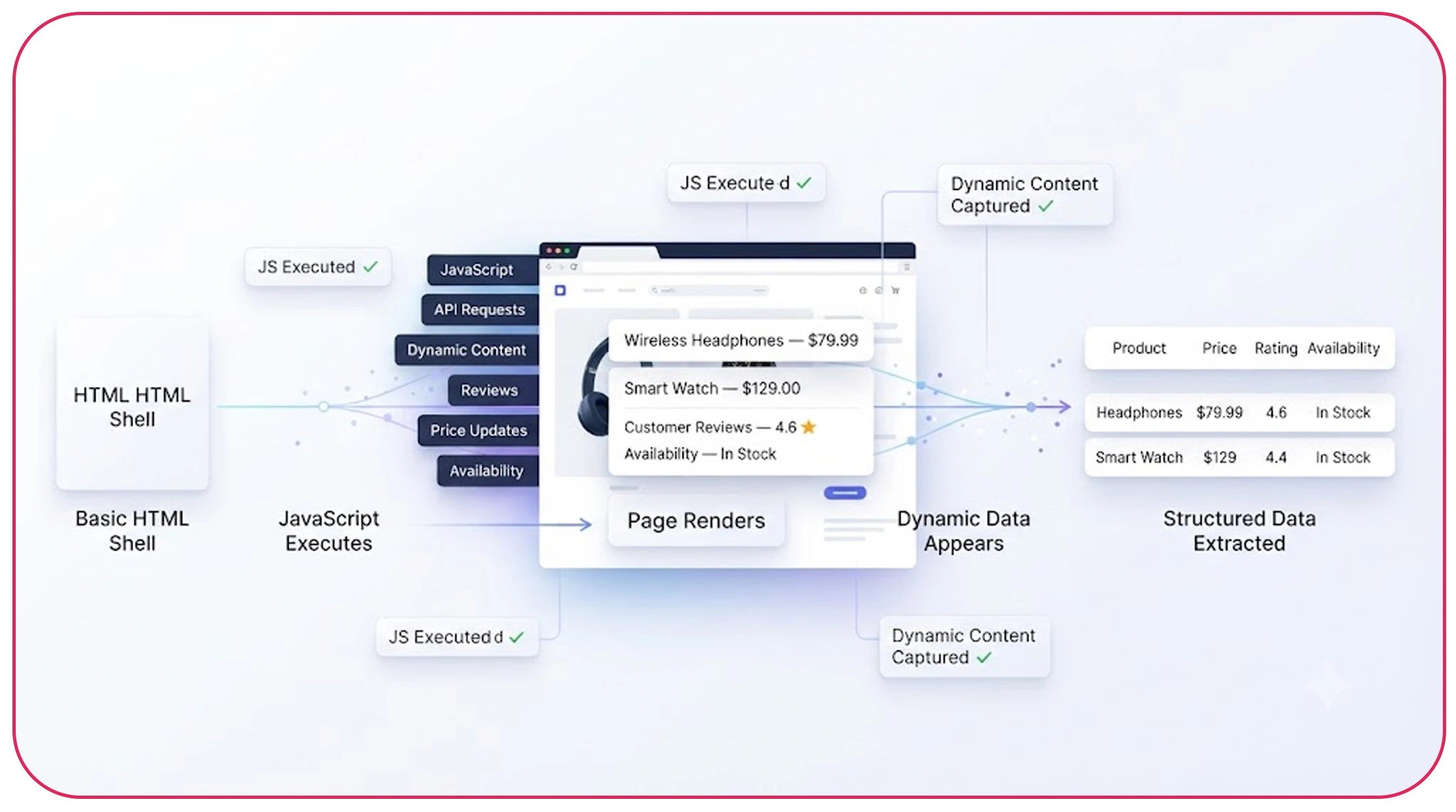
Dynamic websites differ from traditional static pages because the initial HTML may contain only a basic application shell. Product details, prices, reviews, availability, recommendations, and other information can appear only after JavaScript executes.
A browser-based extraction workflow addresses this by loading the page, allowing scripts to execute, waiting for required elements, interacting with the page when necessary, and collecting the resulting information. This creates a closer representation of what an actual visitor sees.
For data teams, the practical benefit is better coverage. Instead of designing separate solutions for every JavaScript behavior, organizations can build a reusable extraction pipeline around browser rendering and structured output.
The following sections explain six important capabilities and how businesses can apply them.
How Can Businesses Handle JavaScript-Heavy Pages More Reliably?
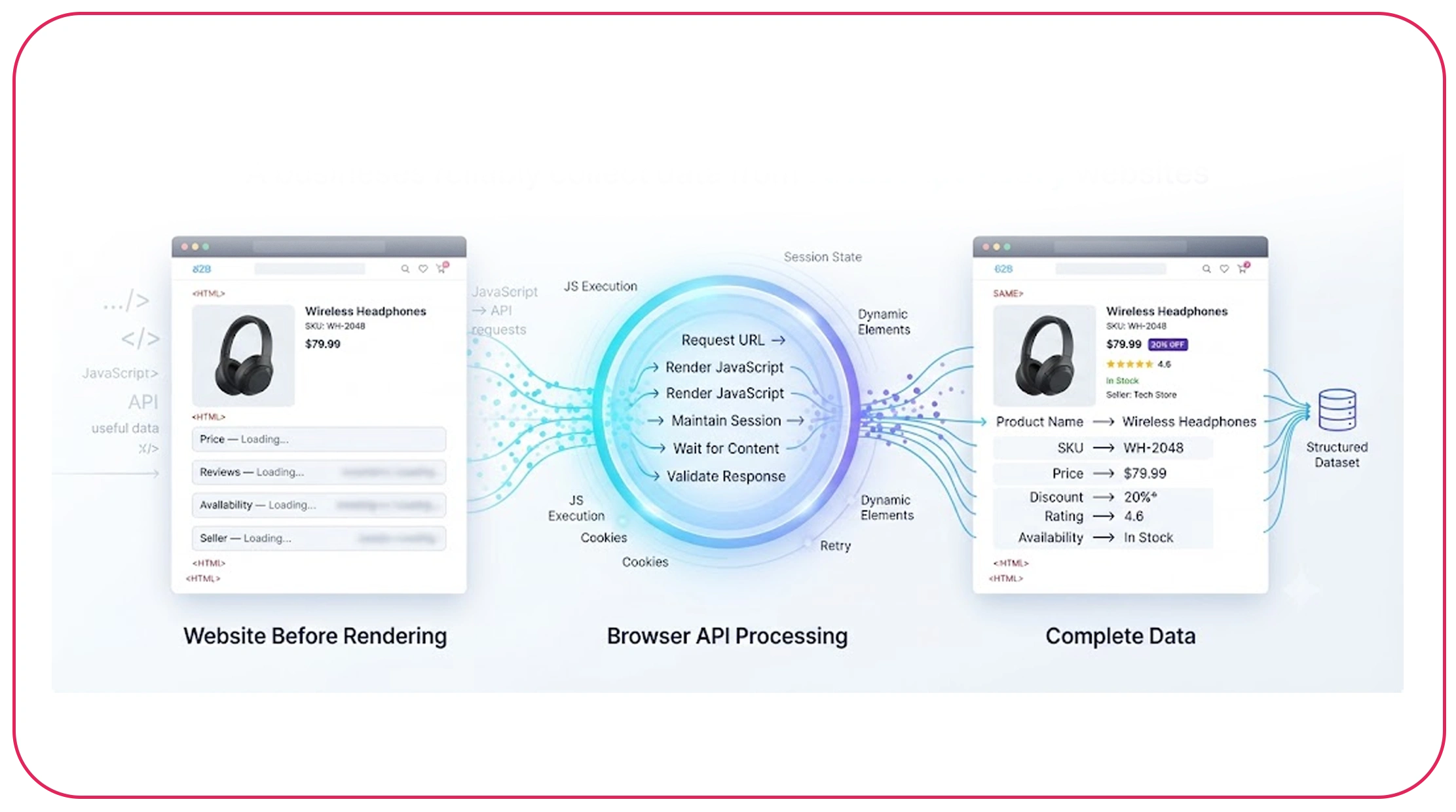
A web scraping API for dynamic websites can provide a practical foundation for collecting information from pages where important content is rendered after the initial request. Instead of treating a webpage as a static document, the extraction workflow treats it as an application that needs to load and execute before useful information becomes available.
This matters for ecommerce stores, travel portals, property marketplaces, job platforms, financial websites, and other environments where page content changes according to scripts, user actions, location, cookies, or session state.
For example, an ecommerce research team may need product name, SKU, price, discount, availability, rating, and seller information. A simple HTML request may capture the product name but miss information loaded after page initialization. Browser rendering can help expose those elements before extraction.
A scalable workflow should also include retry handling, session management, response validation, structured parsing, and monitoring. These controls reduce the risk of silently accepting incomplete datasets.
The table below presents hypothetical planning data, not measured industry statistics. It illustrates how a company might evaluate extraction performance while expanding a dynamic-data project.
| Year | Pages Processed/Month | Dynamic Pages | Successful Extraction Rate |
|---|---|---|---|
| 2020 | 100,000 | 35,000 | 86% |
| 2021 | 180,000 | 75,000 | 88% |
| 2022 | 300,000 | 145,000 | 90% |
| 2023 | 500,000 | 270,000 | 92% |
| 2024 | 800,000 | 470,000 | 94% |
| 2025 | 1,200,000 | 760,000 | 95% |
| 2026 | 1,800,000 | 1,200,000 | 96% |
The important lesson is that scale should be measured alongside extraction quality. Processing more pages has limited value if the returned fields are incomplete or inconsistent.
How Does Real-Time Collection Improve Business Intelligence?
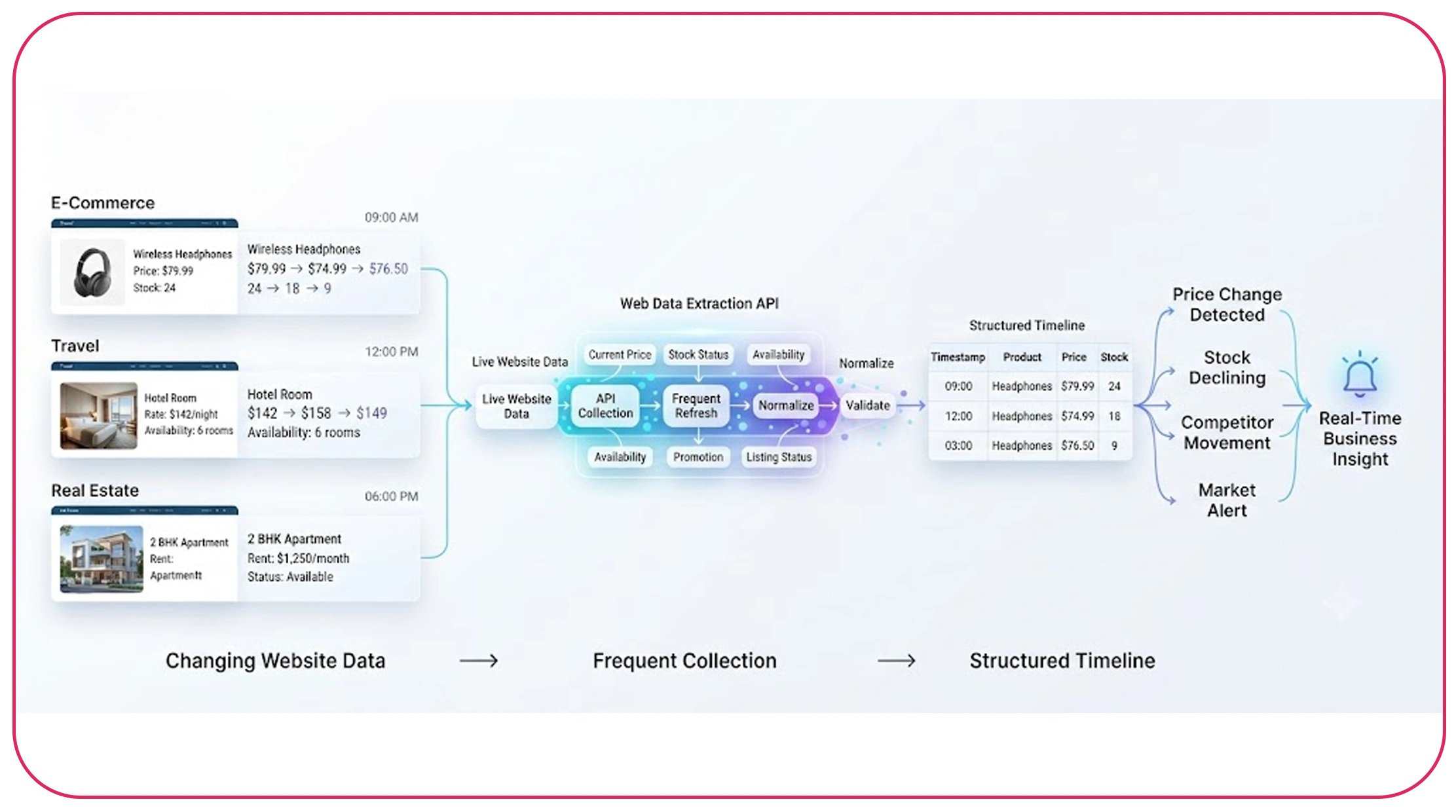
A real-time data extraction API allows organizations to build workflows around frequently changing information instead of relying only on periodic snapshots. This is valuable when prices, stock levels, availability, promotions, rankings, or listings can change several times during a day.
Consider a retailer monitoring competitors. A daily dataset may reveal that a competitor reduced a product price, but it may not show when the change happened or how long the price remained active. More frequent collection creates a better timeline for analyzing market behavior.
The same principle applies to travel and hospitality. Room availability and displayed rates can change based on dates, demand, inventory, and user context. Real estate listings can change status, rent, incentives, and availability. Marketplace sellers can modify prices and stock throughout the day.
A useful architecture separates extraction from analysis. The collection layer retrieves current information, the processing layer normalizes fields, and the analytics layer calculates changes, trends, alerts, and business metrics.
The following hypothetical dataset demonstrates how a company might increase collection frequency over time.
| Year | Collection Frequency | Monthly Records | Example Business Use |
|---|---|---|---|
| 2020 | Weekly | 80,000 | Market research |
| 2021 | Daily | 240,000 | Competitor tracking |
| 2022 | Daily | 650,000 | Price intelligence |
| 2023 | 4× Daily | 1,400,000 | Promotion monitoring |
| 2024 | Hourly | 3,200,000 | Inventory intelligence |
| 2025 | Hourly | 6,500,000 | Automated alerts |
| 2026 | Near-real-time | 12,000,000 | Operational intelligence |
The goal is not maximum frequency for every project. Businesses should select collection intervals based on how quickly the underlying information changes and how much the resulting data improves decisions.
How Can Teams Extract Content That Appears Only After Page Loading?
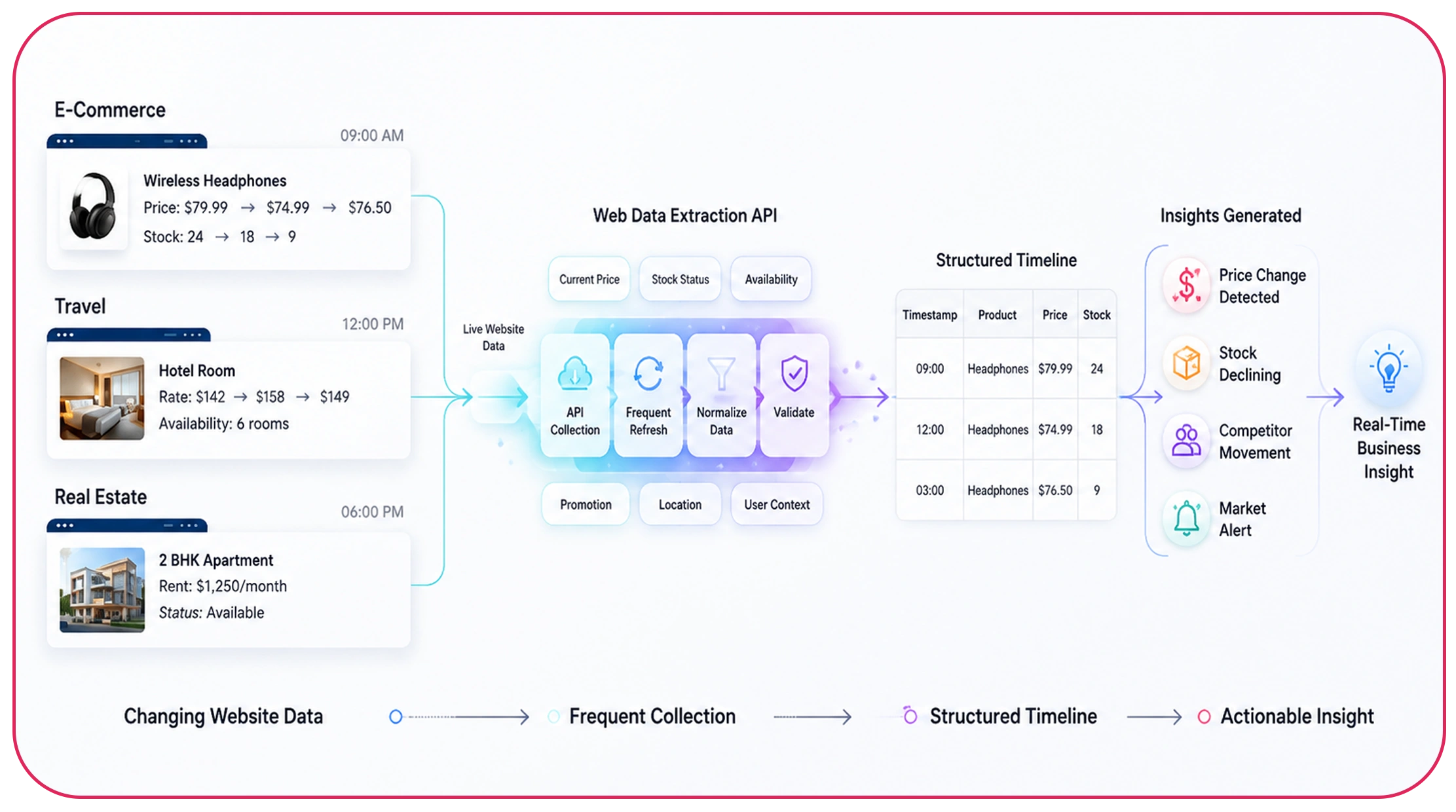
A web data scraper for dynamic websites is useful when the information a business needs becomes visible only after JavaScript execution, scrolling, clicking, filtering, or other browser actions.
One common example is infinite scrolling. A page may initially display 20 products and load additional products when a visitor scrolls. Another example is a filter interface that changes product results without loading a completely new URL. Travel websites may display availability only after dates and destinations are selected.
These workflows require more than downloading HTML. The extraction process may need to reproduce selected browser actions and identify the point at which the required content has loaded.
For business users, this creates several important opportunities. Ecommerce companies can monitor expanded catalogs. Market researchers can collect more complete product assortments. Real estate analysts can capture listings revealed through filters. AI teams can create richer datasets from interactive sources.
The following hypothetical data shows how a project might measure field completeness after introducing browser-based rendering.
| Year | Records Collected | Required Fields | Average Field Completeness |
|---|---|---|---|
| 2020 | 120,000 | 8 | 78% |
| 2021 | 250,000 | 8 | 81% |
| 2022 | 480,000 | 10 | 85% |
| 2023 | 900,000 | 10 | 89% |
| 2024 | 1,600,000 | 12 | 92% |
| 2025 | 2,800,000 | 12 | 94% |
| 2026 | 4,500,000 | 15 | 96% |
These figures are illustrative rather than reported industry benchmarks. The metric that matters is whether the extraction system consistently captures the fields required by the business.
A strong workflow should therefore validate required fields, detect empty responses, record timestamps, normalize formats, and flag unexpected changes in page structure.
What Should a Dynamic Data Pipeline Capture Beyond the Visible Page?
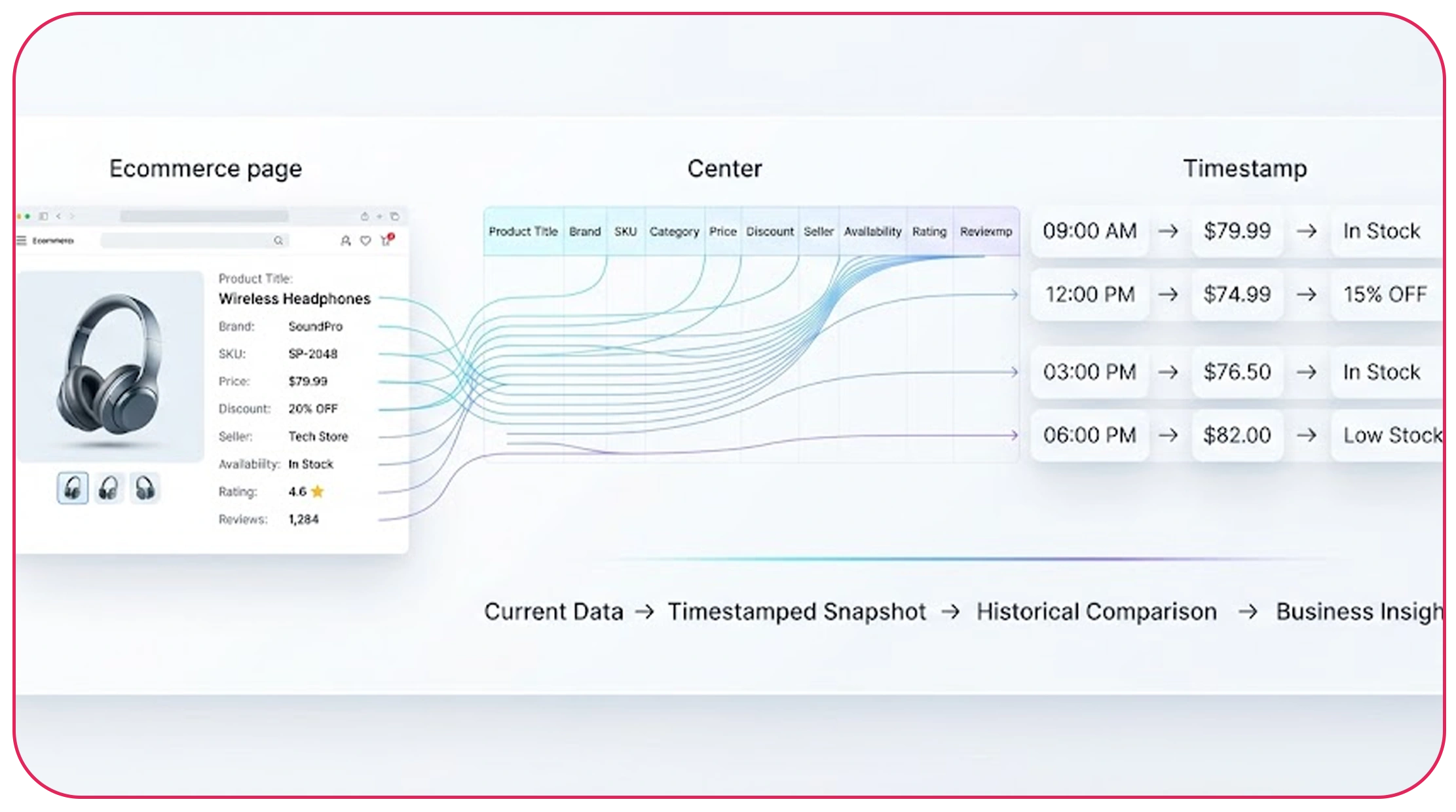
Dynamic website data extraction should be designed around business requirements rather than simply collecting everything visible on a webpage. The objective is to transform changing web content into structured, comparable information.
For product intelligence, useful fields may include product title, brand, SKU, category, price, discount, seller, availability, rating, review count, and timestamp. For travel intelligence, the schema could include destination, property, dates, room type, displayed price, taxes, availability, and booking conditions.
This schema-first approach makes the dataset more valuable because downstream systems know exactly what each field represents. It also makes historical comparisons easier.
A reliable pipeline should preserve collection timestamps. Without timestamps, a business may know the current value but struggle to determine when a change occurred. Historical snapshots can reveal pricing patterns, assortment changes, promotional cycles, and competitor behavior.
The following hypothetical planning table demonstrates how structured data coverage could evolve.
| Year | Data Sources | Structured Fields | Historical Snapshots/Month |
|---|---|---|---|
| 2020 | 25 | 12 | 100,000 |
| 2021 | 40 | 15 | 220,000 |
| 2022 | 65 | 18 | 480,000 |
| 2023 | 100 | 22 | 900,000 |
| 2024 | 150 | 28 | 1,700,000 |
| 2025 | 220 | 32 | 3,200,000 |
| 2026 | 300 | 40 | 5,800,000 |
The table is hypothetical and should be used as a planning example, not as an industry statistic.
For companies building analytics or AI systems, structured historical data is often more valuable than isolated page captures. It allows models and analysts to identify changes rather than merely observe the present state.
How Can Businesses Improve Access to Protected Dynamic Content?
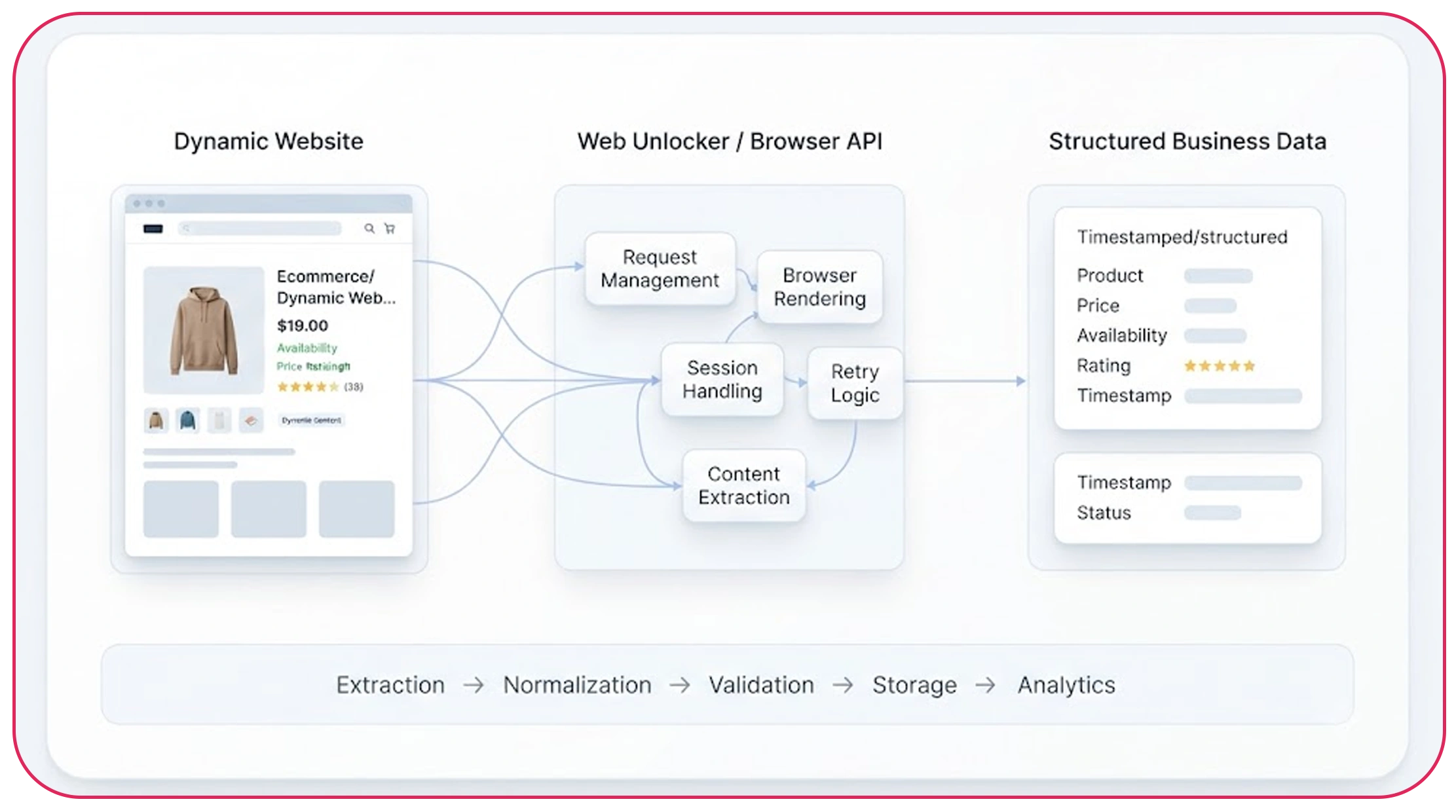
A Web Unlocker API can be incorporated into a broader browser-based data collection architecture when websites use mechanisms that make automated access difficult. At the same time, businesses should design their collection practices around applicable laws, website terms, privacy requirements, and responsible data-use policies.
The broader goal of a Scrape Dynamic Website Data Using a Scraping Browser API strategy is to create a controlled workflow capable of handling rendering, sessions, retries, browser behavior, and structured extraction without forcing internal teams to maintain large browser-automation infrastructures themselves.
For a data engineering team, this can reduce operational complexity. Instead of building and maintaining browser clusters, developers can focus on schema design, data validation, business rules, and downstream integrations.
The architecture can also be separated into several logical layers: request management, browser rendering, content extraction, normalization, validation, storage, and analytics. Each layer can be monitored independently.
The following hypothetical operational model illustrates how a company might track infrastructure requirements as its project grows.
| Year | Monthly Requests | Browser Instances Required | Manual Maintenance Hours/Month |
|---|---|---|---|
| 2020 | 100,000 | 10 | 80 |
| 2021 | 250,000 | 20 | 95 |
| 2022 | 600,000 | 35 | 110 |
| 2023 | 1,200,000 | 60 | 125 |
| 2024 | 2,500,000 | 110 | 145 |
| 2025 | 5,000,000 | 200 | 170 |
| 2026 | 10,000,000 | 380 | 195 |
These figures are purely hypothetical. Actual infrastructure requirements depend on page complexity, rendering time, concurrency, response size, geographic requirements, session behavior, and collection frequency.
The practical takeaway is that browser automation can become an infrastructure problem at scale. A managed API approach can shift more of that operational burden away from the internal engineering team.
How Does Browser-Based Collection Support Large-Scale Data Projects?
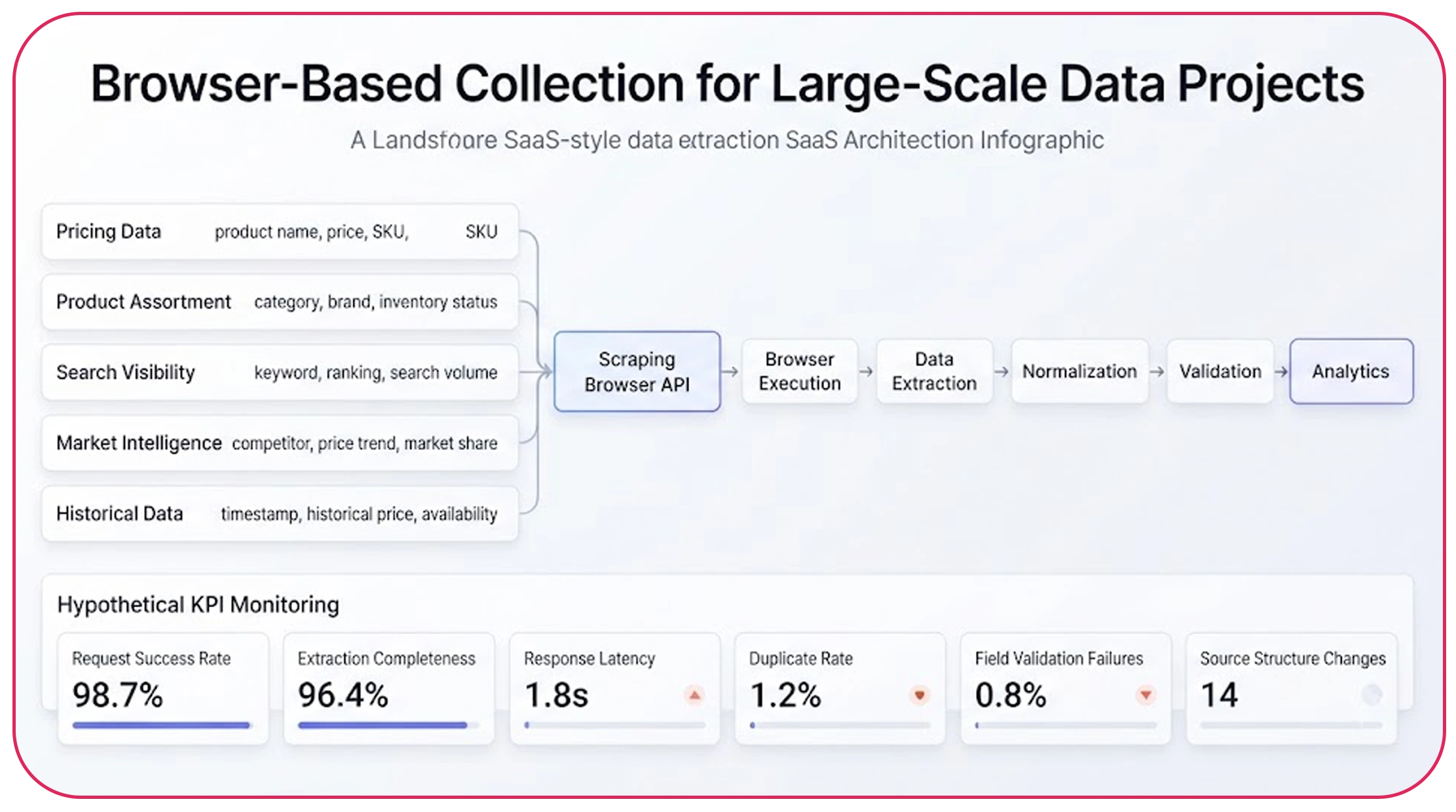
A Scraping Browser API provides an interface for browser-oriented extraction workflows, making it possible to access web pages that depend heavily on client-side rendering and browser execution.
For companies operating at scale, the main benefit is architectural consistency. A common extraction layer can support different data sources while the downstream pipeline remains focused on normalization and analytics.
This is particularly useful for teams serving multiple departments. Pricing teams may need competitor prices. Product teams may need assortment changes. Marketing teams may need search visibility data. Strategy teams may need market-level intelligence. Data science teams may need historical datasets for forecasting and modeling.
The architecture should also include observability. Useful metrics include request success rate, extraction completeness, response latency, duplicate rate, field-level validation failures, and changes in source structure.
The following hypothetical KPI framework illustrates how an organization could monitor a growing extraction program.
| Year | Requests/Month | Success Rate | Validation Coverage | Average Latency |
|---|---|---|---|---|
| 2020 | 150,000 | 88% | 60% | 5.2 sec |
| 2021 | 300,000 | 89% | 68% | 4.8 sec |
| 2022 | 700,000 | 91% | 75% | 4.4 sec |
| 2023 | 1,500,000 | 93% | 82% | 4.0 sec |
| 2024 | 3,000,000 | 94% | 88% | 3.7 sec |
| 2025 | 6,000,000 | 95% | 93% | 3.5 sec |
| 2026 | 12,000,000 | 96% | 96% | 3.2 sec |
Again, these are hypothetical figures intended to demonstrate KPI design rather than claim market performance.
A mature data program should optimize for reliable, useful information rather than request volume alone. High request counts with poor completeness can produce misleading business intelligence.
Why Choose Real Data API?
Real Data API is designed to help businesses turn web-based information into structured datasets without requiring them to build every component of an extraction infrastructure from scratch. For companies dealing with JavaScript-heavy websites, the value comes from combining scalable collection with data quality controls.
A Live Crawler approach can support projects where information changes frequently and historical monitoring is important. Instead of relying on occasional manual research, organizations can establish repeatable collection workflows and send the resulting data into databases, analytics platforms, dashboards, or machine-learning pipelines.
The business case becomes particularly strong when web information directly affects commercial decisions. Retailers can monitor competitor assortment and prices. Brands can identify marketplace changes. Travel companies can study availability and rate movements. Real estate businesses can monitor listings and rents. AI teams can use structured web information as an input to applications that require current external context.
Real Data API can also help teams move from proof-of-concept scraping to production-oriented data pipelines. The focus should remain on clean schemas, predictable outputs, validation, monitoring, and responsible collection.
For buyers, the most important questions are practical: Can the system handle dynamic pages? Can it operate at the required volume? Can data be returned in a usable structure? Can failures be detected? Can historical records be maintained? Can the workflow integrate with existing data infrastructure?
A capable solution should address those questions before scale becomes a problem.
Conclusion
Dynamic websites require a different approach from simple static HTML pages. JavaScript rendering, interactive elements, asynchronous requests, changing page structures, and frequently updated information can make conventional scraping unreliable. A browser-based architecture gives businesses a more practical foundation for collecting and structuring this type of information.
For companies building competitive intelligence, pricing, ecommerce, travel, real estate, market research, or AI data workflows, the priority should be reliable extraction rather than raw request volume. Schema design, validation, historical snapshots, monitoring, and responsible data practices are equally important.
Real Data API can help organizations build scalable data collection workflows around these requirements. By reducing the infrastructure complexity associated with browser-based extraction, teams can focus more on turning web information into useful business intelligence.
The objective is simple: collect the right information, at the right frequency, in a structured format that downstream systems can actually use.
Explore Real Data API and start building a scalable Scrape Dynamic Website Data Using a Scraping Browser API workflow for your next data project!
Latest posts
How Cookpad Recipe Data Scraping for Global Food Trends Helps Identify Emerging Recipes, Ingredients, and Consumer Preferences?
How to Analyze Equity Market Trends Using Mubasher Data Scraping for Smarter Investment Decisions?

How To Identify Grocery Demand Trends And Competitor Gaps With Flaschenpost Scraped Data For Grocery Market Analysis?
How to Extract Meesho product data for seller analytics for Better Business Insights?







.png)