Introduction
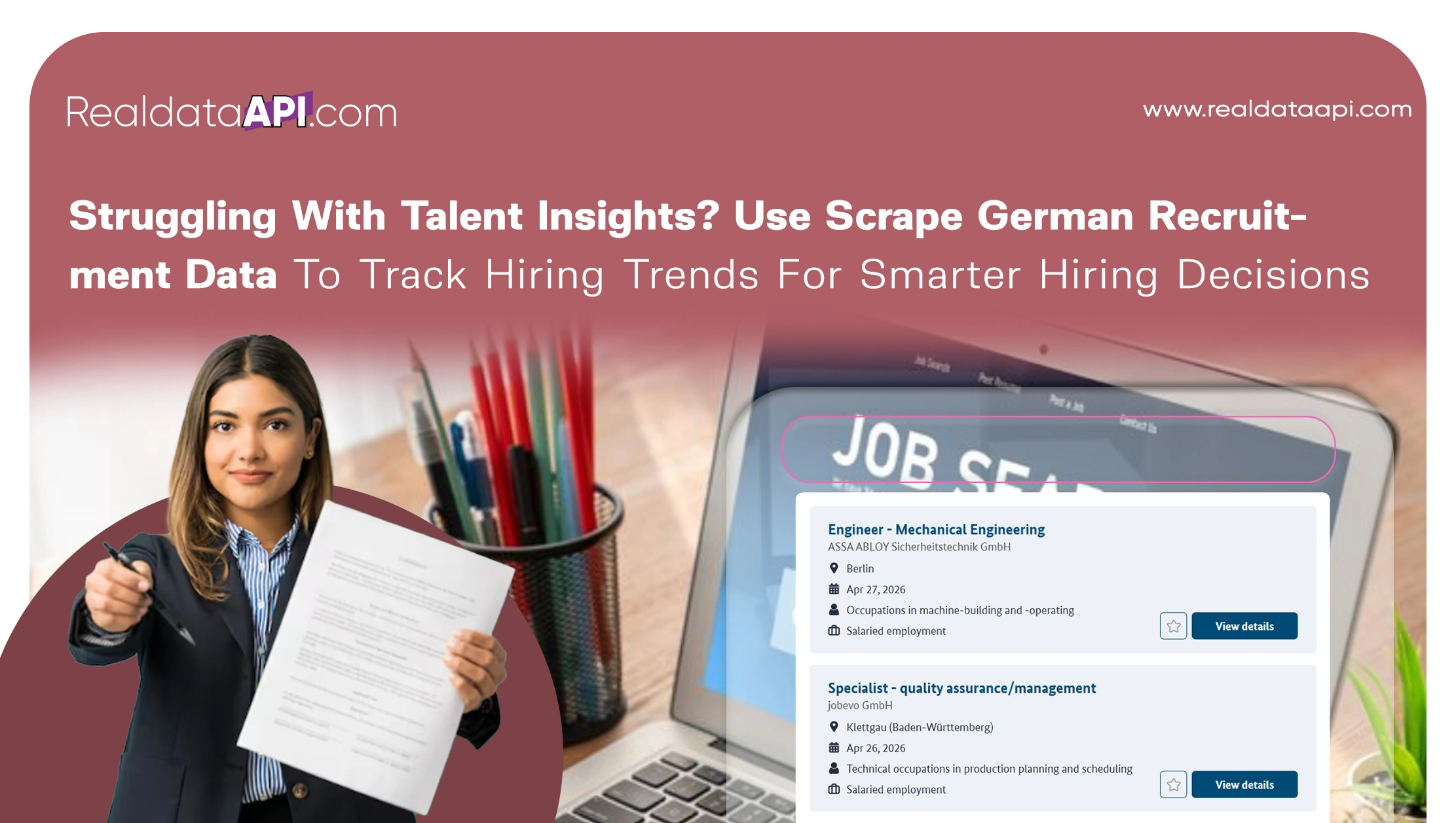
The German job market is evolving rapidly, driven by digital transformation, skill shortages, and shifting workforce expectations. For businesses and recruiters, gaining accurate and timely insights into hiring trends is critical to staying competitive. This is where the ability to scrape German recruitment data to track hiring trends becomes a powerful strategy for data-driven decision-making.
Traditional hiring analysis often relies on outdated or incomplete information, limiting the ability to respond to real-time market changes. With a Recruitment Data Scraping API, organizations can automate the collection of job listings, salary benchmarks, and hiring activity across multiple platforms. This enables companies to understand workforce demand, identify skill gaps, and refine recruitment strategies effectively.
In this blog, we explore how recruitment data scraping transforms talent insights in Germany. Backed by statistical tables from 2020–2026, we highlight how businesses can leverage data to improve hiring decisions, optimize workforce planning, and gain a competitive edge in a dynamic job market.
Shifting Workforce Demand Across Industries
Germany's labor market has seen significant changes, particularly in technology, healthcare, and engineering sectors. Businesses increasingly extract job listings and salary data for hiring trend analysis Germany to understand these shifts and align their hiring strategies accordingly.
Job Demand Trends (2020–2026)
| Year | Tech Jobs (%) | Engineering (%) | Healthcare (%) |
|---|---|---|---|
| 2020 | 28% | 25% | 20% |
| 2021 | 32% | 26% | 22% |
| 2022 | 36% | 27% | 24% |
| 2023 | 38% | 28% | 25% |
| 2024 | 40% | 29% | 27% |
| 2025 | 42% | 30% | 28% |
| 2026 | 45% | 32% | 30% |
The steady rise in tech and healthcare roles reflects the country's digital transformation and aging population.
By analyzing job listings and salary data, organizations can identify high-demand roles and adjust recruitment strategies. This ensures better talent acquisition and improved workforce planning.
Unlocking Competitive Advantage Through Data Intelligence
In a competitive hiring landscape, access to accurate data is a key differentiator. Companies leverage the benefits of web scraping for recruitment data intelligence Germany to gain insights into competitor hiring strategies and market trends.
Recruitment Intelligence Impact
| Metric | Improvement (%) |
|---|---|
| Hiring Accuracy | 25–35% |
| Time-to-Hire | 20–30% |
| Candidate Matching | 30–40% |
Data intelligence enables businesses to benchmark salaries, analyze job descriptions, and identify emerging skill requirements.
With these insights, companies can refine their hiring strategies, attract top talent, and stay ahead of competitors. This approach also improves decision-making and reduces recruitment costs.
Harnessing Job Portal Data for Deeper Insights
Job portals are a rich source of recruitment data. Organizations use recruitment job portals data extraction to gather detailed information on job postings, salaries, and employer activity.
Job Portal Activity Growth (2020–2026)
| Year | Job Listings (Millions) |
|---|---|
| 2020 | 5 |
| 2021 | 6.5 |
| 2022 | 8 |
| 2023 | 9.5 |
| 2024 | 11 |
| 2025 | 13 |
| 2026 | 15 |
The increasing number of job listings highlights the growing demand for talent across industries.
By extracting data from job portals, businesses can gain a comprehensive view of the labor market. This supports better decision-making and enhances recruitment strategies.
Decoding Market Trends for Strategic Hiring
Understanding long-term trends is essential for effective workforce planning. Companies use data to analyze job market trends in Germany and identify patterns in hiring activity.
Hiring Growth Rate (2020–2026)
| Year | Growth Rate (%) |
|---|---|
| 2020 | 4% |
| 2021 | 7% |
| 2022 | 10% |
| 2023 | 8% |
| 2024 | 9% |
| 2025 | 11% |
| 2026 | 12% |
The data shows consistent growth, with fluctuations due to economic and industry-specific factors.
By analyzing these trends, organizations can forecast demand, optimize hiring strategies, and improve workforce planning. This ensures long-term success in talent acquisition.
Leveraging Structured Data for Advanced Analytics
Structured datasets are essential for advanced recruitment analytics. Businesses rely on Recruitment Datasets to gain deeper insights into hiring trends and workforce dynamics.
Data Coverage Expansion (2020–2026)
| Year | Data Sources Monitored |
|---|---|
| 2020 | 50 |
| 2021 | 80 |
| 2022 | 120 |
| 2023 | 160 |
| 2024 | 200 |
| 2025 | 240 |
| 2026 | 300 |
As data sources increase, businesses gain a more comprehensive understanding of the job market.
These datasets enable advanced analytics, including predictive modeling and trend forecasting. This helps organizations make informed decisions and stay competitive.
Scaling Recruitment Insights with Advanced Technologies
Large organizations require scalable solutions to handle vast amounts of data. Many rely on Web Scraping Services USA to automate data extraction and improve analytics capabilities.
Data Processing Metrics
| Metric | Value |
|---|---|
| Data Volume/Day | 500K+ records |
| Processing Speed | Real-time |
| Accuracy Rate | 95%+ |
Advanced technologies ensure efficient data collection and processing, enabling real-time insights.
By implementing scalable solutions, businesses can monitor global hiring trends, optimize recruitment strategies, and improve overall performance.
Enhancing Workforce Forecasting with Predictive Insights
Accurate workforce forecasting is essential for long-term hiring success. Organizations are increasingly using extract job listings and salary data for hiring trend analysis Germany to build predictive models that anticipate future talent demand. By analyzing historical and real-time recruitment data, businesses can identify patterns in job postings, salary fluctuations, and skill requirements across industries.
Workforce Forecasting Trends (2020–2026)
| Year | Forecast Accuracy (%) | Demand Prediction Improvement (%) |
|---|---|---|
| 2020 | 70% | 10% |
| 2021 | 75% | 15% |
| 2022 | 80% | 20% |
| 2023 | 83% | 25% |
| 2024 | 85% | 28% |
| 2025 | 88% | 30% |
| 2026 | 90% | 35% |
The data highlights how predictive analytics has significantly improved forecasting accuracy over time.
By leveraging these insights, companies can plan hiring cycles more effectively, reduce talent shortages, and optimize workforce allocation. Predictive workforce planning also supports budget optimization and ensures alignment with business growth strategies.
Improving Talent Acquisition Strategies with Data-Driven Insights
Modern recruitment requires a strategic approach backed by data. Businesses are leveraging benefits of web scraping for recruitment data intelligence Germany to refine talent acquisition strategies and improve hiring outcomes. By analyzing job market data, organizations can identify the most effective recruitment channels, optimize job descriptions, and target the right candidates.
Talent Acquisition Performance Metrics
| Metric | Improvement (%) |
|---|---|
| Candidate Conversion Rate | 20–30% |
| Recruitment Efficiency | 25–35% |
| Cost per Hire Reduction | 15–25% |
Data-driven recruitment strategies enable businesses to attract high-quality candidates and reduce hiring costs.
With access to comprehensive recruitment insights, companies can continuously optimize their hiring processes and stay competitive in the talent market. This approach ensures better alignment between organizational needs and workforce capabilities, driving long-term success.
Why Choose Real Data API?
Real Data API provides cutting-edge solutions for recruitment data extraction and analysis. With advanced Web Scraping API capabilities, businesses can automate data collection and gain real-time insights into hiring trends.
Our platform is designed to support scrape German recruitment data to track hiring trends, enabling organizations to access accurate and actionable data. From real-time monitoring to historical analysis, Real Data API empowers businesses to transform recruitment strategies and achieve better hiring outcomes.
Key benefits include:
- High-quality structured datasets
- Real-time data access
- Scalable infrastructure
- Seamless API integration
- Compliance-ready solutions
Conclusion
Talent insights are the foundation of effective hiring strategies in today's competitive job market. By leveraging advanced data extraction techniques, businesses can gain real-time visibility into hiring trends, optimize recruitment processes, and stay ahead of competitors.
The ability to scrape German recruitment data to track hiring trends enables organizations to make informed decisions, reduce hiring risks, and build stronger teams. With accurate data and actionable insights, companies can achieve long-term success in workforce planning.
Ready to transform your hiring strategy? Start leveraging Real Data API today and unlock the full potential of data-driven recruitment intelligence!
Latest posts
Indiamart Data Extraction For B2B Market Intelligence - Track Products, Competitors, And B2B Pricing Trends
Vivino Data Extraction For Wine Market Intelligence - Identifying Product Demand, Pricing Trends, and Market Opportunities
How To Overcome Large-Scale Product Data Collection Challenges With Google Shopping Scraper API For Product Data Extraction?

How to Solve Real-Time Route & Fare Tracking Challenges with Rome2Rio Data Scraping for Travel Market Intelligence?






.png)