
Introduction
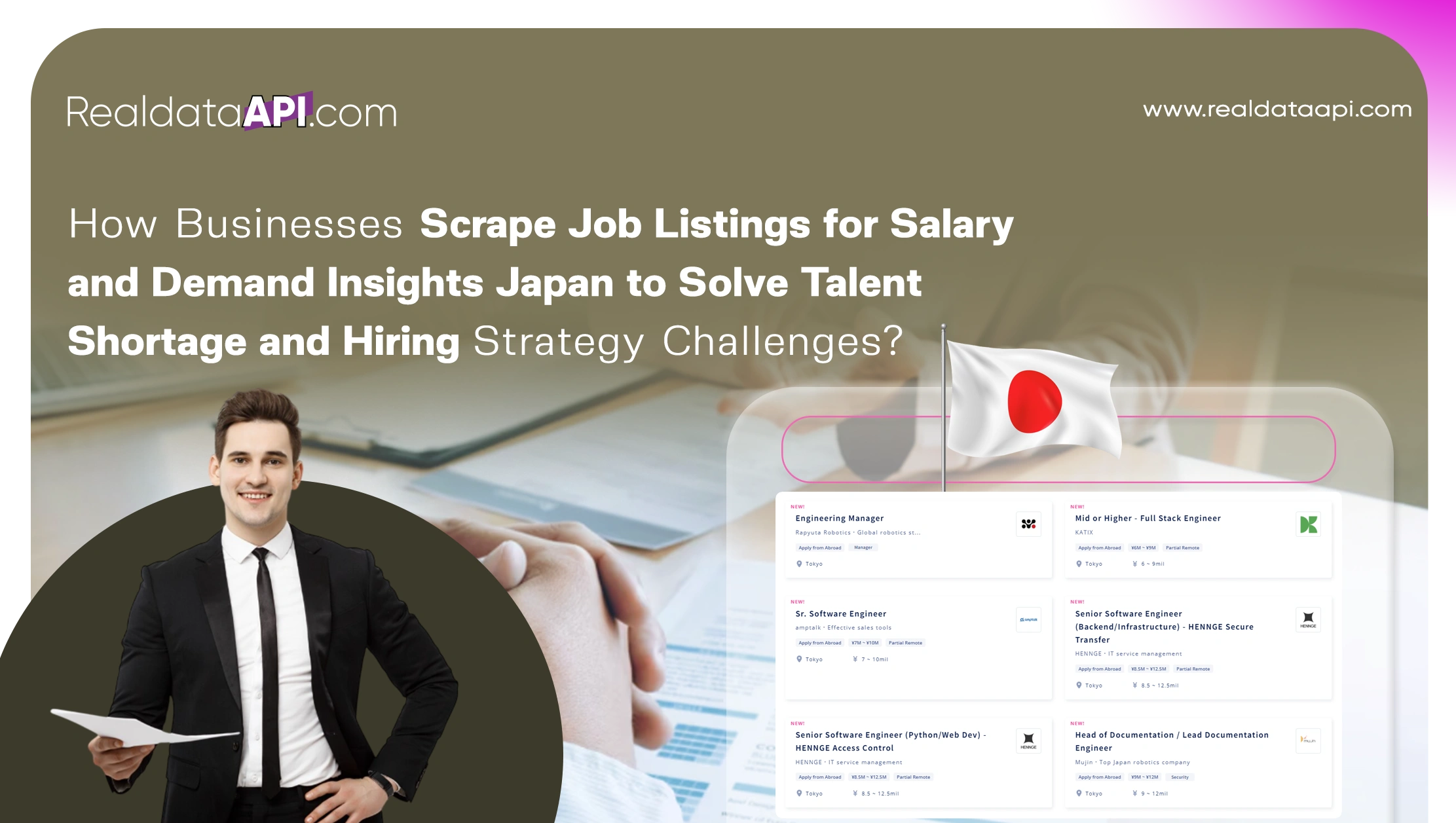
Japan’s labor market is facing increasing pressure due to an aging population, shrinking workforce, and rapidly evolving skill requirements. Organizations across industries—from technology and manufacturing to finance and healthcare—are struggling to attract and retain qualified professionals. To overcome these challenges, companies are turning to data-driven recruitment strategies. One powerful approach is to scrape job listings for salary and demand insights Japan, allowing businesses to analyze thousands of job postings across multiple recruitment platforms and identify emerging hiring patterns.
By collecting and analyzing job listing information, companies gain valuable insights into salary benchmarks, skill demand, industry hiring trends, and regional employment patterns. These insights enable HR leaders and talent acquisition teams to design competitive compensation packages, prioritize high-demand skills, and streamline recruitment strategies. To automate this process, businesses increasingly rely on advanced tools such as Recruitment Data Scraping API solutions that gather job market information at scale and deliver structured datasets for analysis.
According to global labor analytics reports, over 68% of HR teams adopted recruitment analytics tools between 2020 and 2025 to improve hiring decisions and reduce recruitment costs. Access to large-scale job listing data enables organizations to forecast talent demand, identify workforce shortages, and build proactive hiring strategies. With automated data extraction and analytics, businesses can transform recruitment from a reactive process into a strategic, data-driven function that supports long-term workforce planning.
Understanding Salary Benchmarks Across Industries
Accurate salary benchmarking is critical for attracting top talent and maintaining competitive compensation packages. Companies increasingly use tools such as Japan employment market salary data scraper technologies to analyze thousands of job listings and understand how salaries vary across industries, roles, and regions. These insights help HR teams align their compensation strategies with current market expectations.
Between 2020 and 2026, Japan’s job market experienced significant salary shifts due to digital transformation and increasing demand for technology professionals. Businesses that analyzed job listing data were better able to adapt their compensation structures and remain competitive in attracting skilled employees.
| Year | Avg. Salary Growth in Tech Roles | Companies Using Salary Analytics |
|---|---|---|
| 2020 | 3.2% | 35% |
| 2022 | 4.6% | 47% |
| 2024 | 5.8% | 59% |
| 2026 | 6.4% | 71% |
Analyzing job listing salaries also helps organizations detect emerging trends in compensation structures. For example, certain industries began offering higher salaries or remote work benefits to attract specialized talent. By continuously monitoring job listing data, companies can adjust their salary offerings and maintain competitiveness in an evolving employment market.
Access to large-scale salary insights also supports internal workforce planning. HR teams can identify whether their existing salary structures align with market averages or require adjustments to remain attractive to candidates. This strategic use of job listing data helps organizations reduce employee turnover and attract top-tier professionals.
Identifying Workforce Demand Patterns
Understanding workforce demand is essential for strategic hiring and talent development. Businesses conducting workforce salary trend analysis Japan can evaluate how compensation changes correspond with shifts in skill demand across industries.
Job listing data provides valuable insights into which skills are becoming increasingly important in the Japanese economy. For example, roles related to artificial intelligence, cybersecurity, and cloud computing have experienced strong demand growth over the past several years. By analyzing job listings, companies can identify which roles are expanding and plan recruitment strategies accordingly.
| Year | High-Demand Skills (Top 3) | Demand Growth Rate |
|---|---|---|
| 2020 | Data Analysis, Java, Digital Marketing | 12% |
| 2022 | Cloud Computing, AI Development, UX Design | 17% |
| 2024 | Cybersecurity, Machine Learning, DevOps | 23% |
| 2026 | AI Engineering, Data Science, Automation | 29% |
These insights enable businesses to prioritize recruitment for critical roles while also investing in employee training programs to develop in-demand skills internally. Workforce demand analytics also support government agencies and educational institutions in aligning workforce development initiatives with industry needs.
For companies operating in highly competitive industries, understanding demand patterns helps reduce hiring delays and ensures that recruitment resources focus on the most critical roles. Data-driven insights allow HR teams to predict talent shortages before they become severe and take proactive measures to secure skilled professionals.
Unlocking Insights from Job Market Data
Large-scale job listing analysis provides a comprehensive view of employment trends across industries. Organizations increasingly rely on Japan Job listing data Extraction technologies to collect structured data from job portals, recruitment platforms, and company career pages.
This data typically includes job titles, salary ranges, required skills, company information, and geographic locations. By analyzing these datasets, businesses gain a deeper understanding of how hiring trends evolve across the Japanese labor market.
| Year | Job Listings Analyzed (Millions) | Industries with Highest Growth |
|---|---|---|
| 2020 | 8M | IT, Healthcare |
| 2022 | 12M | FinTech, Logistics |
| 2024 | 18M | AI, Renewable Energy |
| 2026 | 25M | Robotics, Automation |
With access to this information, organizations can benchmark their hiring strategies against competitors and evaluate which industries are expanding their workforce most aggressively. Companies can also identify regional employment clusters where demand for specific roles is highest.
By transforming raw job listings into structured data, businesses can conduct advanced analytics that reveal hidden patterns in hiring activity. These insights allow organizations to optimize recruitment campaigns, expand into high-demand markets, and improve workforce planning strategies.
Real-Time Monitoring of Talent Demand
The Japanese job market changes rapidly, especially in technology-driven sectors. Companies that leverage Web scraping Japan Job demand data API solutions gain real-time visibility into hiring activity across multiple platforms. This enables organizations to track job demand trends as they emerge.
Real-time monitoring helps HR teams detect sudden spikes in demand for certain skills or roles. For example, when companies accelerate digital transformation initiatives, demand for IT professionals often increases quickly. Organizations monitoring job demand data can respond immediately by adjusting hiring strategies or increasing recruitment budgets.
| Year | Avg. Monthly Job Posting Growth | Industries Driving Demand |
|---|---|---|
| 2020 | 5% | Manufacturing |
| 2022 | 8% | Technology |
| 2024 | 11% | FinTech |
| 2026 | 14% | AI & Robotics |
These insights also support competitive intelligence. Businesses can track which competitors are expanding their workforce and which roles they prioritize. Understanding competitor hiring activity allows organizations to anticipate market trends and develop strategic workforce plans.
Real-time demand insights ultimately improve hiring efficiency by ensuring that companies focus their recruitment efforts on roles with the highest business impact.
Building Intelligence with Structured Recruitment Data
To transform raw job listings into actionable insights, organizations rely on large-scale Recruitment Datasets containing structured employment information. These datasets allow analysts to evaluate hiring trends, salary distributions, and skill demand patterns across industries.
Structured recruitment data enables businesses to conduct predictive analytics that forecast future hiring needs. For example, companies can analyze historical job posting patterns to estimate which roles will become more important in the coming years.
| Year | Avg. Dataset Size (Job Records) | Companies Using Recruitment Analytics |
|---|---|---|
| 2020 | 2 million | 38% |
| 2022 | 5 million | 49% |
| 2024 | 9 million | 63% |
| 2026 | 15 million+ | 74% |
Large datasets also support machine learning models that predict talent shortages and recommend optimal hiring strategies. By integrating recruitment datasets with internal HR systems, businesses gain a holistic view of workforce dynamics.
Organizations that leverage structured recruitment data are better equipped to anticipate labor market changes, optimize hiring strategies, and reduce recruitment costs.
Scaling Data Collection with Automation
Manual data collection from job portals is time-consuming and inefficient. To scale recruitment analytics, businesses increasingly rely on automated Web Scraping API solutions that gather job listing data continuously.
These APIs enable organizations to collect job listings from multiple recruitment platforms, normalize the data, and deliver structured datasets for analysis. Automation significantly improves the speed and accuracy of recruitment intelligence.
| Year | Companies Using Data Scraping Tools | Data Update Frequency |
|---|---|---|
| 2020 | 31% | Weekly |
| 2022 | 44% | Daily |
| 2024 | 58% | Hourly |
| 2026 | 72% | Real-time |
Automated data collection allows companies to monitor thousands of job postings without manual effort. Recruitment teams can access dashboards showing salary trends, demand patterns, and emerging skills across industries.
By automating data extraction, businesses gain continuous visibility into labor market dynamics and can make faster, more informed hiring decisions. This technology enables organizations to transform recruitment into a data-driven strategic function.
Why Choose Real Data API?
Real Data API provides powerful solutions that help organizations unlock insights from global job market data. Businesses seeking reliable employment intelligence can leverage advanced data extraction capabilities for Market Research and recruitment analytics. Through scalable infrastructure and automated pipelines, companies can scrape job listings for salary and demand insights Japan and gain comprehensive visibility into workforce trends.
Real Data API solutions collect structured job listing data from multiple sources, including recruitment portals, career websites, and industry platforms. This data can be integrated into analytics systems to evaluate salary benchmarks, track skill demand, and forecast hiring needs.
By combining automation with reliable data delivery, Real Data API enables businesses to build smarter hiring strategies, improve workforce planning, and stay competitive in the evolving Japanese labor market.
Conclusion
Japan’s evolving labor market requires businesses to adopt innovative recruitment strategies to overcome talent shortages and hiring challenges. Organizations that scrape job listings for salary and demand insights Japan gain valuable intelligence about salary benchmarks, workforce demand patterns, and emerging skills across industries.
By leveraging automated data extraction and analytics, companies can develop data-driven hiring strategies that reduce recruitment costs, attract top talent, and improve workforce planning. Access to real-time job market insights ensures that organizations remain competitive in a rapidly changing employment landscape.
Start leveraging scrape job listings for salary and demand insights Japan today with Real Data API to gain powerful workforce intelligence and transform your recruitment strategy with data-driven insights.
Latest posts
How Target API Simplifies Product, Price, Category, Inventory & Retail Data Collection for Retail Intelligence
How Pull & Bear Fashion Dataset Solves Fashion Intelligence Challenges Across Products, Prices, Categories, and Apparel Trends?
How Levi's Fashion Dataset Improves Fashion Intelligence Across Products, Prices, Categories, and Denim Market Trends?

How Myntra Fashion Dataset Solves Fashion Intelligence Challenges Across Products, Prices, Brands, and Fashion Market Trends?







.png)



