.gif)
.jpg)

Quick Summary
- Sephora Scraper enables structured collection of product, pricing, brand, rating, and review information for beauty market research and competitive intelligence.
- Sephora Product Data Scraping helps organize large product catalogs into usable datasets for assortment, pricing, customer feedback, and market trend analysis.
Introduction
Beauty retail has become increasingly data-driven as consumers compare products, prices, brands, ratings, ingredients, availability, and reviews across digital channels. Sephora operates more than 2,700 stores across 35 countries and maintains a large e-commerce presence, giving businesses a substantial source of product and market information to analyze. A Sephora Scraper can help businesses systematically collect publicly accessible product information and convert changing marketplace information into structured datasets. Instead of reviewing thousands of product pages manually, organizations can create recurring datasets containing product names, categories, brands, prices, ratings, review counts, product URLs, availability indicators, and other accessible attributes.
Sephora Product Data Scraping with Real Data API can further support historical comparisons by allowing organizations to organize repeated observations over time. These datasets can be used for price benchmarking, assortment monitoring, product discovery, review intelligence, brand comparisons, and category-level research.
The business case is reinforced by the continued expansion of digital beauty commerce. Circana reported that U.S. prestige beauty retail sales reached $36 billion in 2025, growing 4% year over year. In Q1 2026, prestige beauty sales increased another 6% to $8.1 billion, while online sales outperformed physical retail across major prestige categories.
Building a Structured View of the Beauty Catalog
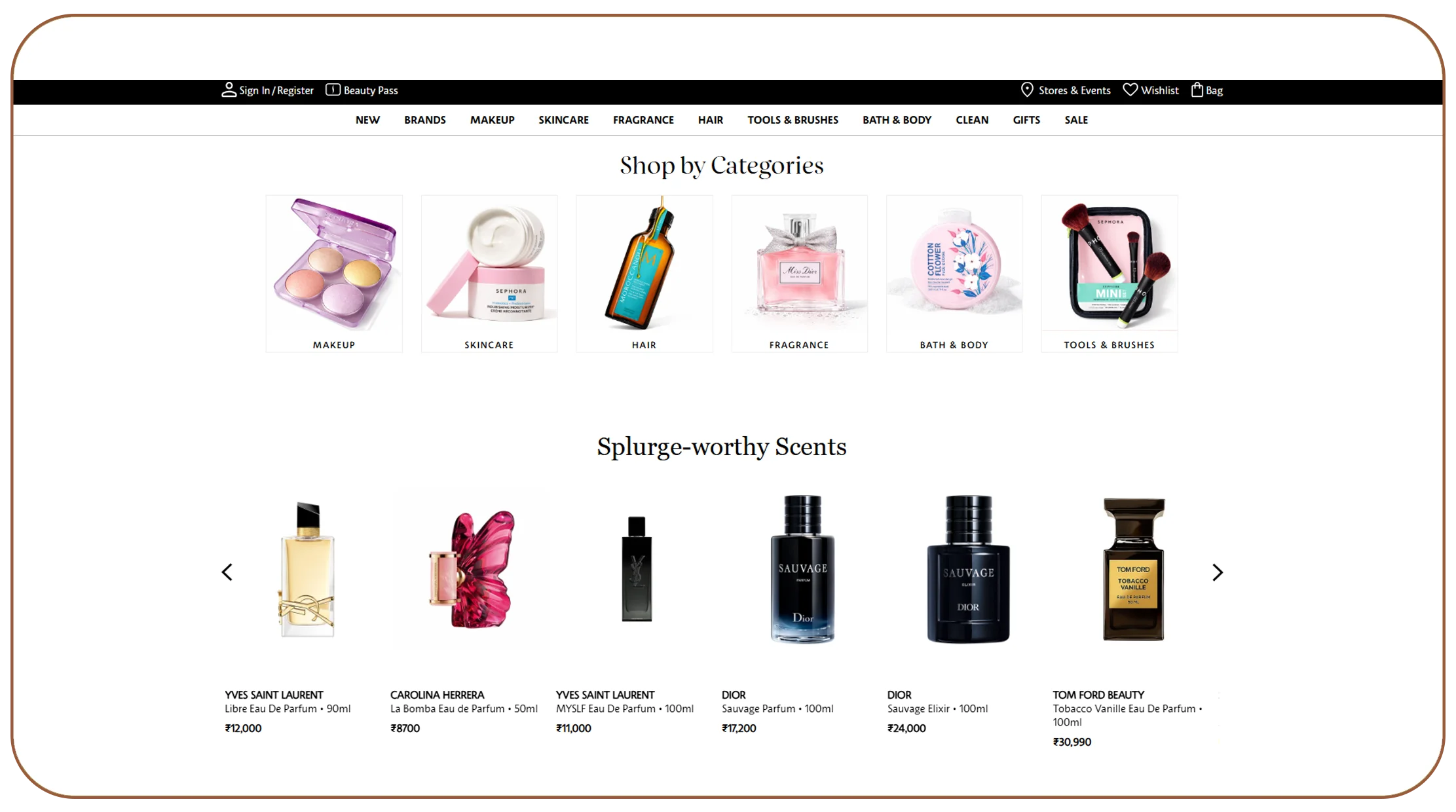
Beauty catalogs contain numerous attributes that can change frequently. Product names, brands, categories, sizes, shades, prices, promotional offers, stock indicators, ratings, and review volumes can all contribute to a more complete market picture.
Sephora beauty product data web scraping can help create a structured product universe by collecting selected attributes from product listings and detail pages. The resulting dataset can be organized by category, brand, product type, price range, rating, availability, and other business-defined dimensions.
Sephora itself states that its assortment contains thousands of products and hundreds of brands. Its product discovery system supports searches for products and brands, while product pages provide information such as benefits, usage tips, formulations, sizes, ingredients, and availability.
| Indicator | Reported data | Business relevance |
|---|---|---|
| Sephora global retail network | 2,700+ stores | Indicates broad market coverage |
| Countries of operation | 35 | Supports geographic analysis |
| Product assortment | Thousands of products | Creates a large monitoring universe |
| Brand assortment | Hundreds of brands | Enables brand-level comparisons |
| Sephora Collection listings observed | 275 results on current page | Illustrates assortment depth |
Source: Sephora corporate and current catalog pages.
From 2020 through 2026, beauty retail moved through several important phases. In 2020, pandemic restrictions accelerated digital shopping behavior and made online product discovery increasingly important. In 2021, LVMH reported a strong rebound for Sephora and continued momentum in online sales. In 2022, Sephora continued investing in an omnichannel strategy while expanding its U.S. partnership with Kohl's. In 2023, the business continued expanding its store network, including its first two U.K. stores. In 2024, LVMH reported continued growth for Sephora and expansion in the United Kingdom and United States. In 2025, LVMH reported Sephora revenue growth and approximately 100 new store openings. In the first half of 2026, LVMH reported Sephora sales of €8.406 billion, up 5% on a comparable basis year over year.
For businesses, this progression highlights why recurring product datasets can be more useful than one-time catalog snapshots. Historical records make it possible to observe changes in assortment, pricing, product launches, availability, and customer engagement.
Turning Customer Feedback Into Measurable Signals
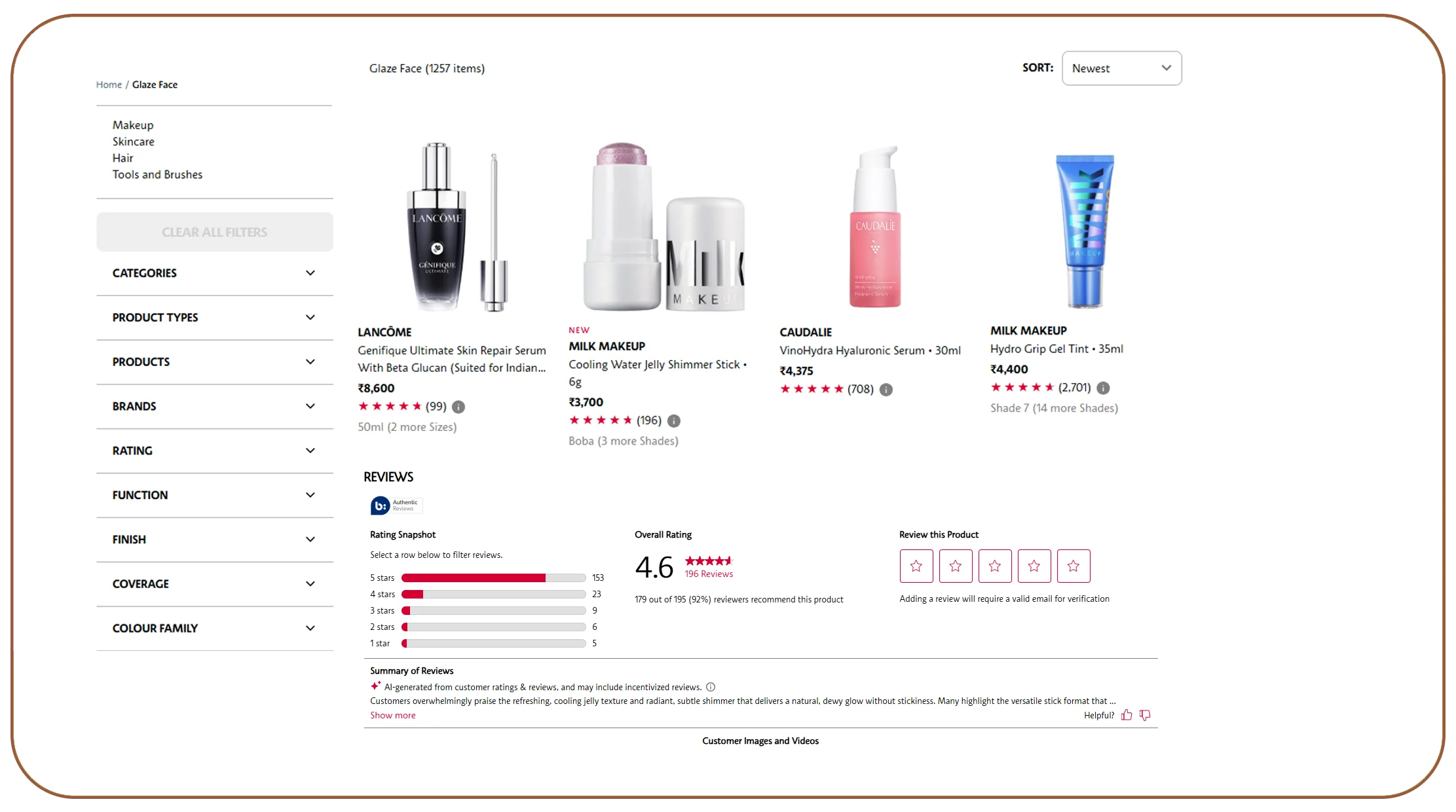
Ratings and reviews provide a customer-facing layer of product intelligence. A product's average rating alone may not explain consumer response; review volume, rating distribution, recurring themes, and changes over time can provide additional context.
extract Sephora rating data workflows can capture rating values and review-related fields that are publicly displayed and permitted for collection. Sephora uses a five-star rating scale and provides ratings and reviews on product pages. Its review guidelines also distinguish between ratings, written reviews, questions and answers, and other submitted content.
| Customer signal | Example measurement | Potential application |
|---|---|---|
| Average rating | 4.5/5 | Product quality comparison |
| Review count | 1,000+ | Customer engagement |
| Rating distribution | 1–5 stars | Sentiment context |
| Review growth | Monthly change | Product momentum |
| Review themes | Ingredient, texture, performance | Consumer research |
A structured review dataset can help analysts separate products with high ratings from products with high engagement. For example, two products could have similar average ratings but substantially different review volumes. Monitoring both measures can provide more context when identifying products that are attracting sustained customer attention.
The 2020–2026 period also demonstrates why review analysis matters. During the early digital-shopping acceleration of 2020 and 2021, consumers increasingly depended on online product information when physical shopping was disrupted. As stores reopened, omnichannel shopping remained important. LVMH described Sephora's continued investment in improving purchasing experiences online and in stores.
By 2024 and 2025, beauty demand remained supported by product innovation and premiumization. Circana reported that U.S. prestige beauty retail sales grew 4% in 2025 to $36 billion, while average selling price increased 1%. In Q1 2026, Circana reported that prestige beauty grew 6%, with online sales outperforming brick-and-mortar across major categories.
For brands and retailers, review data can therefore complement product and pricing datasets. Combining ratings with category, brand, price, and product attributes can support customer-preference research and help identify products that deserve closer commercial analysis.
Build structured beauty-market datasets to monitor product performance, customer feedback, and competitive movements more efficiently!
Get Insights Now!Mapping Brand Assortments and Competitive Positioning
Brand-level intelligence is important in a marketplace where new launches, exclusive products, established labels, and private-label offerings compete for consumer attention.
A structured scrape Sephora brand data API workflow can organize brand names, associated products, categories, pricing information, ratings, review counts, and other accessible fields into a consistent dataset. This makes it easier to compare the assortment depth and positioning of different brands.
Sephora's current brand discovery system provides an alphabetical brand list, while its corporate information describes an assortment combining emerging favorites, established products, Sephora Collection, and exclusive brands.
| Brand-level metric | Example analysis |
|---|---|
| Product count | Assortment breadth |
| Average product price | Price positioning |
| Category coverage | Market presence |
| Average rating | Customer reception |
| Review volume | Engagement |
| New product additions | Launch activity |
From 2020 to 2026, brand competition increasingly intersected with digital discovery, omnichannel retail, social commerce, and product innovation. Sephora expanded its network and continued developing its brand assortment during this period. LVMH reported strong momentum across North America, Europe, and the Middle East, as well as continued expansion of Sephora's distribution network.
In 2023, Sephora's first two U.K. stores opened successfully, while the business continued its partnership with Kohl's in the United States. In 2025, LVMH reported approximately 100 Sephora store openings. By the first half of 2026, LVMH reported 5% comparable sales growth for Sephora and further international expansion, including entry into Belgium and Croatia.
For researchers, brand-level datasets can reveal changes in assortment breadth, category participation, pricing structure, and customer engagement. These measurements can be segmented by skincare, makeup, fragrance, haircare, bath and body, and other categories.
A recurring dataset can also support brand benchmarking. Analysts can compare the number of products a brand offers, its average price points, rating patterns, review volumes, and category distribution. Such comparisons can help businesses understand how different brands are positioned within the same digital retail environment.
Monitoring Price Changes and Promotional Activity
Price is one of the most frequently changing variables in e-commerce. Beauty retailers can introduce discounts, promotions, limited-time offers, bundles, new product prices, and other commercial changes that make historical tracking valuable.
A Sephora price web data scraper can be configured to collect publicly displayed pricing fields at scheduled intervals. Depending on the target dataset, these may include regular price, sale price, discount information, product size, availability, and product identifiers.
| Period | Relevant market indicator |
|---|---|
| 2020 | Digital shopping became more important during pandemic disruption |
| 2021 | Sephora experienced a strong rebound and online-sales momentum |
| 2022 | Omnichannel investment continued |
| 2023 | Selective Retailing revenue reached €17.885 billion |
| 2024 | Sephora revenue reported at €18.262 billion |
| 2025 | Sephora revenue reported at €18.348 billion |
| H1 2026 | Sephora sales reached €8.406 billion, +5% comparable |
The figures above should be interpreted as LVMH-reported Sephora figures for the respective periods; the 2023–2025 figures are annual, while 2026 is first-half data.
Price intelligence becomes more useful when it is connected with product attributes. A $50 skincare product, for example, can be compared against similar products based on brand, category, size, rating, and review volume rather than price alone.
From 2020 through 2026, the importance of value perception also became increasingly visible in beauty retail. Circana reported in 2026 that U.S. beauty growth was shaped by value consciousness, treatment-led demand, and digital acceleration. Prestige sales increased 6% in Q1 2026, while online sales outperformed brick-and-mortar across major prestige categories.
A historical price dataset can help businesses identify recurring discount patterns, detect changes in average selling prices, compare product positioning, and monitor promotional intensity. It can also support internal dashboards that show price movements by brand, category, product, or time period.
For organizations managing large beauty catalogs, automated collection reduces dependence on manual checks and creates a repeatable process for tracking changes.
Creating a Repeatable Monitoring Framework
A Sephora Scraper becomes more useful when it is treated as part of a recurring data pipeline rather than a one-time extraction process. The objective is to create consistent records that can be refreshed on a defined schedule and delivered in a format suitable for analytics.
A typical monitoring architecture can include product discovery, URL collection, data extraction, validation, normalization, deduplication, historical storage, and scheduled refreshes. Businesses can define which categories, brands, product attributes, and geographic markets should be monitored.
| Pipeline stage | Key activity | Output |
|---|---|---|
| Discovery | Identify relevant product pages | URL/product universe |
| Extraction | Collect permitted fields | Raw dataset |
| Validation | Check completeness | Quality-controlled records |
| Normalization | Standardize formats | Consistent dataset |
| Historical storage | Preserve snapshots | Time-series data |
| Analytics | Build comparisons | Business insights |
Between 2020 and 2026, Sephora's operating environment expanded across physical stores, e-commerce, partnerships, and international markets. LVMH reported that Sephora continued expanding its retail network and omnichannel strategy throughout this period.
This expansion increases the importance of consistent data structures. A dataset collected today should remain comparable with datasets collected next month or next year. That requires standardized field names, consistent product identifiers, normalized currencies where appropriate, timestamped records, and clear handling of missing values.
For example, a monitoring system can preserve a product's price at each collection date instead of overwriting the previous value. Analysts can then calculate price changes and identify when a product entered or exited a promotional period.
The same approach can be applied to ratings and review counts. Historical snapshots can show whether customer engagement is increasing, whether ratings are stable, or whether a newly launched product is rapidly accumulating reviews.
Availability monitoring can add another layer. Sephora notes that some products may temporarily go out of stock and that replenishment frequency can vary by product and brand. Tracking these changes can help businesses study product availability alongside price, customer engagement, and assortment.
The resulting data pipeline can support dashboards, competitive research, pricing analysis, category intelligence, and internal reporting.
Connecting Marketplace Data With Broader E-Commerce Intelligence
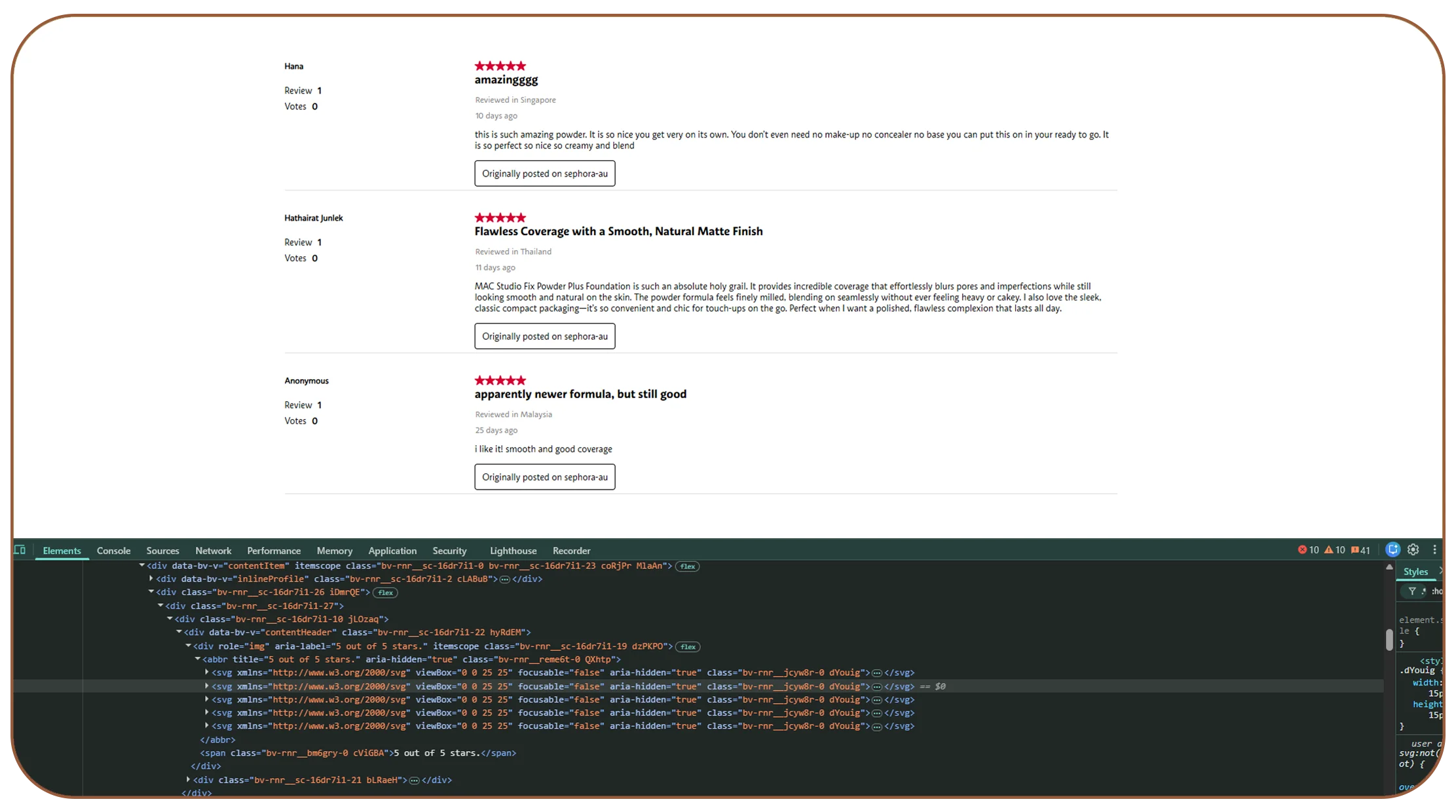
Beauty marketplace information becomes more valuable when it can be connected with broader commercial datasets. A business may want to compare product prices across retailers, analyze brand presence across marketplaces, or combine customer-review trends with category-level sales indicators.
E-Commerce Data Scraping can support this broader approach by collecting structured information from multiple online sources and aligning common fields such as product name, brand, category, price, rating, review count, availability, and product URL.
| Dataset layer | Business question |
|---|---|
| Product data | What products are available? |
| Brand data | Which brands have broad assortment coverage? |
| Pricing data | How are products positioned by price? |
| Rating data | How are customers responding? |
| Review data | Which products generate engagement? |
| Availability data | Which products are currently accessible? |
The 2020–2026 period shows the increasing importance of digital channels in beauty. In 2021, LVMH reported continued growth in online sales alongside a strong rebound for Sephora. In 2022, Sephora continued investing in omnichannel capabilities. In 2023 and 2024, the company continued its physical network expansion while maintaining strong performance. In 2025, Sephora continued growth and opened around 100 stores. In Q1 2026, Circana reported that online sales outperformed brick-and-mortar across major prestige beauty categories.
This combination of physical expansion and digital growth creates a broader need for market visibility. Businesses can use structured datasets to compare assortment changes, monitor pricing, understand review momentum, and identify product-level trends.
Cross-retailer datasets can also provide context that a single marketplace cannot. A product's price, availability, and rating can be analyzed against equivalent records from other retailers where collection is permitted. This can support competitive benchmarking and category research.
A unified data model can further make the information easier to use. Instead of maintaining separate spreadsheets for products, prices, brands, and reviews, organizations can connect these dimensions through product IDs, brand IDs, category fields, and timestamps.
Why Choose Real Data API?
A scalable data partner should provide more than raw extraction. The workflow should support data discovery, structured collection, validation, normalization, scheduling, and delivery according to the analytical requirements of the business.
An Ecommerce Scraping API can provide a programmatic approach to accessing structured e-commerce information and integrating datasets into existing analytics, dashboards, research systems, or internal applications.
For beauty intelligence projects, important capabilities can include:
- Structured product data delivery
- Scheduled data collection
- Product and brand-level monitoring
- Price and promotion tracking
- Rating and review collection
- Data validation and normalization
- Historical dataset management
- Scalable collection workflows
- API-based integration
- Analytics-ready output formats
The right architecture should also account for data quality. Duplicate products, missing fields, changing product URLs, inconsistent prices, and incomplete historical records can affect downstream analysis. Validation rules and standardized schemas help reduce these issues.
Businesses should also define collection requirements carefully, including geographic scope, categories, refresh frequency, fields required, output format, and permitted sources. Collection should comply with applicable website terms, privacy requirements, intellectual-property rules, and relevant laws.
Conclusion
Beauty e-commerce is becoming increasingly dependent on structured market intelligence. Product assortment, prices, brands, ratings, reviews, and availability can change frequently, making recurring datasets valuable for organizations that need current and historical visibility.
A Sephora Scraper can support the collection of structured marketplace information for product research, price monitoring, brand benchmarking, customer-feedback analysis, and competitive intelligence. When combined with historical storage and analytics, these datasets can transform individual product observations into broader market insights.
The 2020–2026 trend demonstrates the continuing importance of omnichannel and digital beauty retail. Sephora has expanded its global retail network, continued investing in digital experiences, and maintained strong growth through 2025 and the first half of 2026. Meanwhile, Circana's 2026 data highlights continued beauty-market growth and the increasing role of online commerce.
Start building structured beauty-market datasets with Real Data API to monitor products, prices, brands, ratings, and reviews with greater consistency and analytical depth!
FAQs
1. How can businesses use Sephora product data for market research?
Businesses can use Sephora Product Data Scraping to organize product names, categories, prices, brands, ratings, reviews, and availability for assortment analysis, benchmarking, and beauty-market research.
2. What information can product monitoring collect?
Sephora beauty product data web scraping can collect publicly displayed product attributes such as names, brands, categories, prices, sizes, ratings, review counts, URLs, and availability.
3. Why monitor ratings and reviews?
Businesses can extract Sephora rating data to compare customer feedback, identify highly reviewed products, monitor rating changes, and support product-performance analysis across beauty categories.
4. Can brand-level information be analyzed at scale?
Yes. Businesses can scrape Sephora brand data API workflows to organize brand names, product counts, categories, pricing, ratings, and review metrics for structured competitive research.
5. What does Real Data API provide for e-commerce projects?
Real Data API can support structured collection workflows, data normalization, scheduled monitoring, and analytics-ready delivery for businesses researching products, pricing, brands, reviews, and market trends.
Latest posts
How to Use Amazon API integration for e-commerce analytics to Track Competitor Prices and Improve Product Performance
How IKEA API for retail market intelligence Helps Retailers Solve Product Data Inconsistency and Pricing Challenges
How Instagram API integration for business analytics Helps Brands Track Engagement and Measure Social Media Performance
How OTT Dataset Updates for Entertainment Analytics Help Streaming Platforms Fix Outdated Content Insights




.png)


