.gif)
.gif)
Quick Summary
- The Swiggy Restaurant Dataset 2026 helps food-tech companies, restaurant chains, market researchers, and analysts understand restaurant listings, menu prices, customer ratings, and competitive positioning.
- Structured food marketplace information supports restaurant benchmarking, pricing intelligence, cuisine analysis, and location-based market research.
- Businesses can use reliable Swiggy Food Data Scraping workflows to transform restaurant information into actionable insights, identify market opportunities, and make data-driven decisions.
Introduction
India's online food delivery industry is becoming increasingly competitive, making restaurant-level intelligence essential for food-tech businesses, restaurant chains, investors, and market researchers. The Swiggy Restaurant Dataset 2026 provides a useful framework for analyzing restaurant names, locations, cuisines, menu items, prices, ratings, and availability indicators. These attributes help businesses understand customer preferences, compare restaurant offerings, and identify competitive opportunities across different locations.
The Indian food delivery market is also supported by increasing digital adoption and changing consumer purchasing habits. According to Swiggy's FY2026 shareholder communication, its food delivery Gross Order Value reached ₹9,005 crore in Q4 FY2026, compared with ₹7,347 crore in Q4 FY2025. This growth highlights why businesses need consistent marketplace intelligence to understand changing demand.
Using Swiggy Food Data Scraping, companies can organize publicly accessible restaurant information into structured datasets for market research, pricing comparisons, menu analysis, and restaurant performance studies. Real Data API helps businesses turn fragmented online information into usable data assets through structured extraction and data processing workflows.
How Can Restaurant-Level Data Reveal Marketplace Growth?
Restaurant marketplace data helps businesses understand how food delivery platforms expand, how restaurant participation changes, and which operational indicators influence market performance. Restaurant listings, cuisine categories, locations, average menu prices, ratings, and availability can be organized to identify patterns across cities and customer segments.
Swiggy's official Q4 FY2026 shareholder report provides useful evidence of this expansion. Its average monthly transacting restaurant partners increased from 251,700 in Q4 FY2025 to 275,400 in Q4 FY2026. During the same period, food delivery monthly transacting users increased from 15.1 million to 18.3 million. These figures indicate growth in both restaurant participation and active customer demand.
Historical performance indicators: 2020–2026
The following table combines disclosed historical annual figures with Q4 operating figures. It does not treat quarterly numbers as annual totals.
| Period | Food delivery GOV | Measurement |
|---|---|---|
| FY2020 | Not available in cited series | No comparable figure |
| FY2021 | Not available in cited series | No comparable figure |
| FY2022 | ₹18,478.83 crore | Annual |
| FY2023 | ₹21,517.08 crore | Annual |
| FY2024 | ₹24,717.44 crore | Annual |
| Q4 FY2025 | ₹7,347 crore | Quarterly |
| Q4 FY2026 | ₹9,005 crore | Quarterly |
Source: Swiggy's Red Herring Prospectus and Q4 FY2026 shareholder letter. FY2020 and FY2021 figures are intentionally omitted because the cited comparable series does not provide them.
A structured Swiggy API Data workflow can help businesses organize restaurant information into consistent fields, including restaurant identifiers, location, cuisine, menu categories, item prices, ratings, and availability. Analysts can then compare restaurant coverage across different locations without relying on disconnected spreadsheets.
For restaurant chains, these insights help identify areas where similar cuisine providers are concentrated. Food-tech companies can also use location-level information to understand marketplace coverage and identify potential gaps in restaurant selection.
The important distinction is between platform-level financial performance and individual restaurant performance. GOV measures marketplace transaction value, not the revenue or profitability of every restaurant. Combining official platform indicators with appropriately collected listing-level information produces a more useful research framework.
Why Is Competitive Benchmarking Important for Food Businesses?
Competition in food delivery extends beyond the number of restaurants listed on a platform. Restaurants compete through cuisine variety, menu presentation, discounts, ratings, delivery availability, and customer value. Understanding these factors requires consistent marketplace observations rather than isolated searches.
The importance of this analysis becomes clearer when examining Swiggy's FY2026 results. Its food delivery GOV reached ₹9,005 crore in Q4 FY2026, representing 22.6% year-over-year growth. Food delivery monthly transacting users reached 18.3 million, while average monthly restaurant partners reached 275,400. These are platform-wide indicators of a large and active marketplace.
Swiggy competitor analysis data can help businesses compare competing restaurants using measurable attributes.
Important comparison parameters include:
- Restaurant presence: Compare the number and distribution of listed restaurants across selected localities.
- Cuisine availability: Identify areas with a strong concentration of North Indian, South Indian, Chinese, Italian, and other cuisine categories.
- Menu positioning: Compare dish names, portion descriptions, meal combinations, and menu categories.
- Price differences: Examine comparable dishes and serving sizes instead of comparing unrelated menu items.
- Customer feedback: Track publicly displayed ratings and review counts as separate indicators.
- Promotional positioning: Observe visible discounts, meal deals, and promotional offers at different collection times.
A practical benchmarking framework should also distinguish independent restaurants from national chains. A large chain may have broader geographic coverage, while a local restaurant may specialize in a smaller cuisine category.
Businesses should avoid treating a higher rating as automatic proof of higher sales. Ratings reflect customer feedback, while actual order volumes and restaurant-level revenue may not be publicly available.
For example, a restaurant research team could compare the visible menu assortment of similar restaurants across two localities. It could then identify differences in pricing, cuisine coverage, and promotional positioning. Repeated observations would help distinguish temporary promotions from longer-term marketplace changes.
This approach gives restaurant owners and market researchers a more structured way to evaluate competitive positioning and plan menu improvements.
How Does Automated Price Intelligence Improve Menu Decisions?
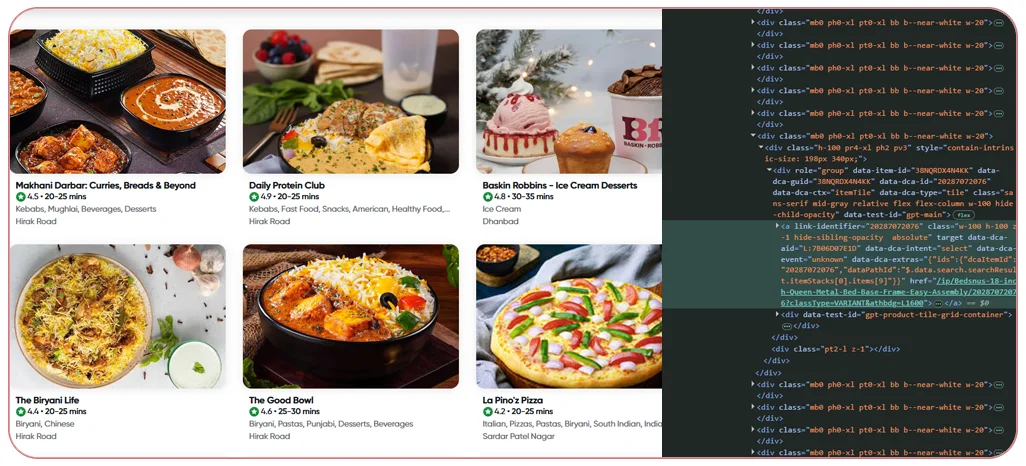
Menu pricing directly influences how restaurants position their products in a competitive delivery environment. A business that understands comparable menu prices can evaluate whether its offerings are positioned above, below, or near competing restaurants.
However, meaningful price comparisons require more than collecting the displayed price of a dish. Researchers must consider portion size, variants, add-ons, taxes, packaging charges, delivery fees, and promotional discounts. These factors can make two apparently similar products commercially different.
A Swiggy pricing web data scraper can support structured observations of publicly displayed menu information, subject to platform permissions and applicable terms.
A useful pricing dataset should contain the following fields:
| Data field | Business application |
|---|---|
| Restaurant name | Identify the listing |
| Restaurant location | Compare local markets |
| Dish name | Match comparable products |
| Menu category | Group similar offerings |
| Listed price | Evaluate menu positioning |
| Discounted price | Examine promotional pricing |
| Portion or variant | Improve price comparability |
| Availability | Identify temporarily unavailable items |
| Collection timestamp | Monitor changes over time |
For example, comparing the listed prices of two similarly sized vegetarian meal combinations provides a better benchmark than comparing a single snack with a complete meal. Product matching should therefore consider dish descriptions, serving sizes, ingredients, and variants.
Swiggy's FY2026 shareholder letter also highlights affordability as an important driver of food delivery growth. Its management discussed selection, speed, and affordability as key elements of its food delivery strategy. This makes menu positioning and promotional research relevant to restaurant businesses.
Businesses should maintain historical price observations instead of replacing previous records with newly collected values. This allows analysts to distinguish permanent menu changes from temporary offers.
Want to turn restaurant pricing information into structured competitive intelligence? Explore Real Data API solutions for organized marketplace data collection and analysis!
Get Insights Now!How Can Grocery Intelligence Expand Food Marketplace Research?
Food delivery and grocery delivery are related consumer convenience categories, but they should not be treated as identical datasets. Restaurant marketplaces primarily contain prepared meals and restaurant menus, whereas grocery marketplaces contain packaged goods, fresh produce, household products, and everyday essentials.
Swiggy operates both food delivery and Instamart. Its FY2026 reporting presents these businesses separately, making it important for analysts to maintain distinct datasets when evaluating their performance. In Q4 FY2026, Instamart reported GOV of ₹7,881 crore, while food delivery reported GOV of ₹9,005 crore. These figures represent separate business segments.
Swiggy grocery data collection services can support research into the grocery segment through structured information such as:
- Product names and categories.
- Brand and manufacturer details.
- Displayed selling prices.
- Pack sizes and product variants.
- Discounts and promotional offers.
- Stock or availability indicators.
- Location-specific product visibility.
- Collection dates and timestamps.
For grocery retailers, this information can help evaluate assortment differences, product positioning, and visible price variations across serviceable locations.
Restaurant and grocery information can also be analyzed separately before combining selected business indicators for broader consumer convenience research. For example, a market researcher may examine restaurant cuisine availability alongside grocery category availability to understand how different convenience services are represented in a particular locality.
The collection process should account for location-based variations. A product available in one delivery area may not appear in another. Similarly, a restaurant menu item may be unavailable even when the restaurant listing remains visible.
Therefore, datasets should include location, collection time, category, and availability status. This makes the resulting information more reliable and prevents analysts from interpreting temporary service conditions as permanent market changes.
Grocery research can broaden a company's understanding of digital commerce, but the resulting findings should remain clearly separated from restaurant-level performance metrics.
What Makes a Structured Restaurant Dataset Useful for Business Intelligence?
A structured dataset converts scattered restaurant information into standardized records that analysts can filter, compare, and evaluate. Instead of manually browsing hundreds of restaurant pages, businesses can work with organized fields and consistent data formats.
A comprehensive Swiggy Food Dataset can include several important information categories:
| Dataset category | Important attributes | Business application |
|---|---|---|
| Restaurant information | Name, location, cuisine, listing details | Restaurant discovery |
| Menu information | Dish names, categories, descriptions | Menu research |
| Pricing information | Listed prices, discounts, variants | Competitive pricing |
| Customer feedback | Displayed ratings, review counts | Reputation analysis |
| Availability | Listing and item availability | Service monitoring |
| Geographic information | City and locality | Regional analysis |
| Historical records | Collection timestamp, previous values | Trend analysis |
What should businesses analyze?
Restaurant distribution: Geographic analysis helps identify areas with different restaurant concentrations. Businesses can compare restaurant coverage across cities and localities to understand where specific cuisine categories are represented.
Menu diversity: Category-level analysis reveals which types of food offerings are visible in a selected marketplace. Restaurant owners can use these observations to evaluate menu differentiation and identify potentially underserved cuisine categories.
Customer feedback: Ratings and review counts can provide useful reputation indicators. However, these should be analyzed separately because a rating alone does not establish sales volume or customer retention.
Price positioning: Standardized menu records make it easier to compare similar dishes across restaurant listings. Historical observations can also help identify price changes and promotional patterns.
Availability monitoring: Restaurant listings and menu items may change over time. Timestamped records help analysts identify when a listing or product was observed and whether it remained available during subsequent collection cycles.
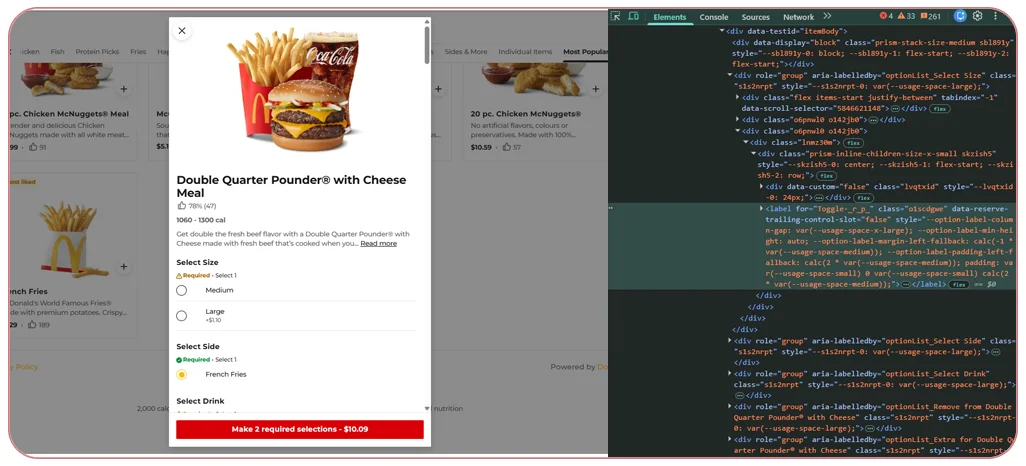
Swiggy's official developer documentation describes restaurant discovery and menu retrieval capabilities. Its menu endpoint supports category-based pagination, dish-level pricing information, availability indicators, and rating-related fields. The documentation also explains that item prices can change depending on variants, add-ons, coupons, and cart conditions.
These details demonstrate why dataset design matters. A reliable data pipeline should retain field definitions, source identifiers, timestamps, and validation rules. It should also distinguish unavailable values from missing information.
For data analysts and food-tech businesses, standardized records make reporting more repeatable. They also make it easier to connect restaurant information with external market research, internal business intelligence systems, and dashboards.
How Can API-Based Workflows Support Continuous Data Analysis?
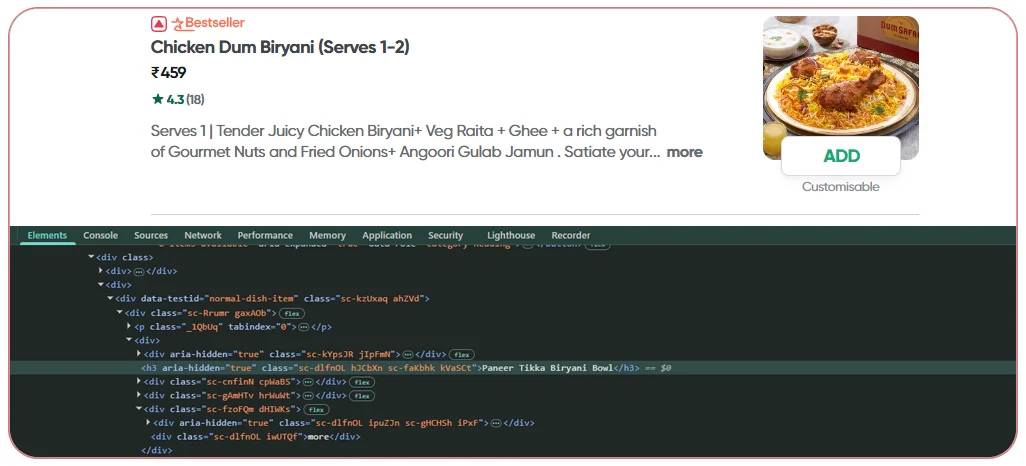
Businesses need consistent data workflows to understand changing restaurant listings, menus, prices, and availability. A one-time dataset may provide a market snapshot, but repeated observations are more useful for identifying changes over time.
The Swiggy API ecosystem provides documented developer capabilities for interacting with food discovery and menu information. Swiggy's official Builders Club documentation describes endpoints such as search_restaurants, get_restaurant_menu, and search_menu. These capabilities are designed for restaurant discovery and menu exploration within the documented authenticated environment.
A practical data processing workflow can follow these stages:
- Define the collection scope: Select the relevant cities, localities, restaurant categories, and menu attributes.
- Identify authorized sources: Determine which documented APIs, permitted integrations, or approved data sources can be used.
- Collect structured information: Capture restaurant and menu records using supported access methods.
- Normalize records: Standardize restaurant names, cuisine labels, prices, categories, and location fields.
- Validate information: Check missing values, duplicate listings, inconsistent formats, and unexpected changes.
- Maintain historical records: Store timestamps and previous observations to support trend analysis.
- Deliver business-ready outputs: Organize validated information into suitable datasets, dashboards, or reporting systems.
Which business metrics can be monitored?
| Metric | What it helps evaluate |
|---|---|
| Restaurant listing count | Marketplace coverage |
| Cuisine distribution | Food category diversity |
| Average listed menu price | Menu positioning |
| Discount frequency | Promotional activity |
| Rating distribution | Customer feedback patterns |
| Menu availability | Visible product availability |
| Listing changes | Marketplace updates |
| Geographic coverage | Regional restaurant presence |
For example, a restaurant chain operating in multiple cities could use location-based observations to compare its visible menu positioning against competing restaurants. The business could then investigate whether differences are associated with cuisine categories, portion sizes, or promotional offers.
It is important to understand that API access is not unrestricted permission to extract or republish all platform information. Businesses should follow the applicable developer documentation, authentication requirements, platform terms, privacy requirements, and permitted usage limits.
The objective should be to establish a dependable and compliant data pipeline rather than simply maximize collection volume. Consistent schemas, transparent collection methods, and quality checks make restaurant intelligence more useful for long-term business decisions.
Why Choose Real Data API?
Real Data API helps businesses convert fragmented digital information into structured datasets that support research, analysis, and strategic decision-making. Restaurant and food marketplace projects require careful planning because menu information, restaurant listings, and displayed prices can change across locations and collection periods.
Key advantages of a structured data solution include:
- Organized information: Standardized fields make restaurant records easier to analyze.
- Data validation: Quality checks help identify duplicates, missing values, and inconsistent records.
- Flexible delivery: Data can be prepared in business-ready formats according to project requirements.
- Market intelligence: Structured information supports pricing research, restaurant benchmarking, and category analysis.
- Scalable workflows: Defined collection and processing pipelines can support expanding research requirements.
- Historical analysis: Timestamped observations help businesses monitor changes across collection periods.
A reliable Swiggy Scraper project should prioritize authorized access, data accuracy, consistent product matching, and clear documentation. These elements help businesses build useful restaurant intelligence without confusing marketplace observations with actual sales or financial performance.
Real Data API focuses on transforming collected information into actionable business datasets that can support food-tech companies, restaurant operators, market researchers, and analytics teams.
Conclusion
Restaurant marketplace intelligence is becoming increasingly important for businesses that want to understand food delivery trends, evaluate competitors, and improve menu positioning. The Swiggy Restaurant Dataset 2026 offers a valuable research framework for studying restaurant listings, cuisine categories, menu prices, customer ratings, and geographic availability.
By combining structured information, historical observations, and reliable validation processes, businesses can identify market opportunities and make better-informed decisions. Restaurant chains can improve competitive positioning, while food-tech companies can strengthen their market research capabilities.
Looking to transform restaurant marketplace information into actionable business intelligence? Connect with Real Data API to build structured, reliable, and business-ready restaurant datasets for your analytics requirements!
FAQs
1. What information does a restaurant dataset provide?
The Swiggy Restaurant Dataset 2026 can include restaurant names, locations, cuisines, menus, prices, ratings, discounts, and availability for structured marketplace research.
2. How does restaurant data collection benefit businesses?
Swiggy Food Data Scraping helps businesses organize restaurant listings and menu information for competitive research, pricing comparisons, cuisine analysis, and market opportunity identification.
3. Why is API-based restaurant information useful?
Swiggy API Data supports structured restaurant discovery and menu retrieval through documented developer capabilities, helping authorized applications organize relevant information efficiently.
4. How can restaurants evaluate their competitors?
Swiggy competitor analysis data helps businesses compare cuisine categories, menu prices, visible promotions, restaurant locations, and customer feedback to understand competitive positioning.
5. Can restaurant pricing changes be monitored?
A Swiggy pricing web data scraper can support timestamped observations of displayed menu prices and discounts, subject to authorized access and applicable platform requirements. Real Data API can help organize the resulting information.
Latest posts
How to Extract Real Estate Datasets from Property Websites 2026 to Solve Property Price Inconsistencies
How Datasets Are Shaping the Future 2026 - Turning Fragmented Business Data into Actionable Market Insights

How Fashion Datasets Are Driving Market Intelligence in 2026 to Identify Consumer Trends and Emerging Fashion Brands
Etsy Product Data Scraping for the USA




.png)


