.gif)
.gif)

Quick Summary
- Truth Social API integration for social media can support structured data workflows, content research, and engagement analysis when access is authorized by the platform.
- Truth Social Media Data Scraping requires particular attention to platform permissions because Truth Social's terms restrict automated collection, systematic data retrieval, and unauthorized commercial use.
Introduction
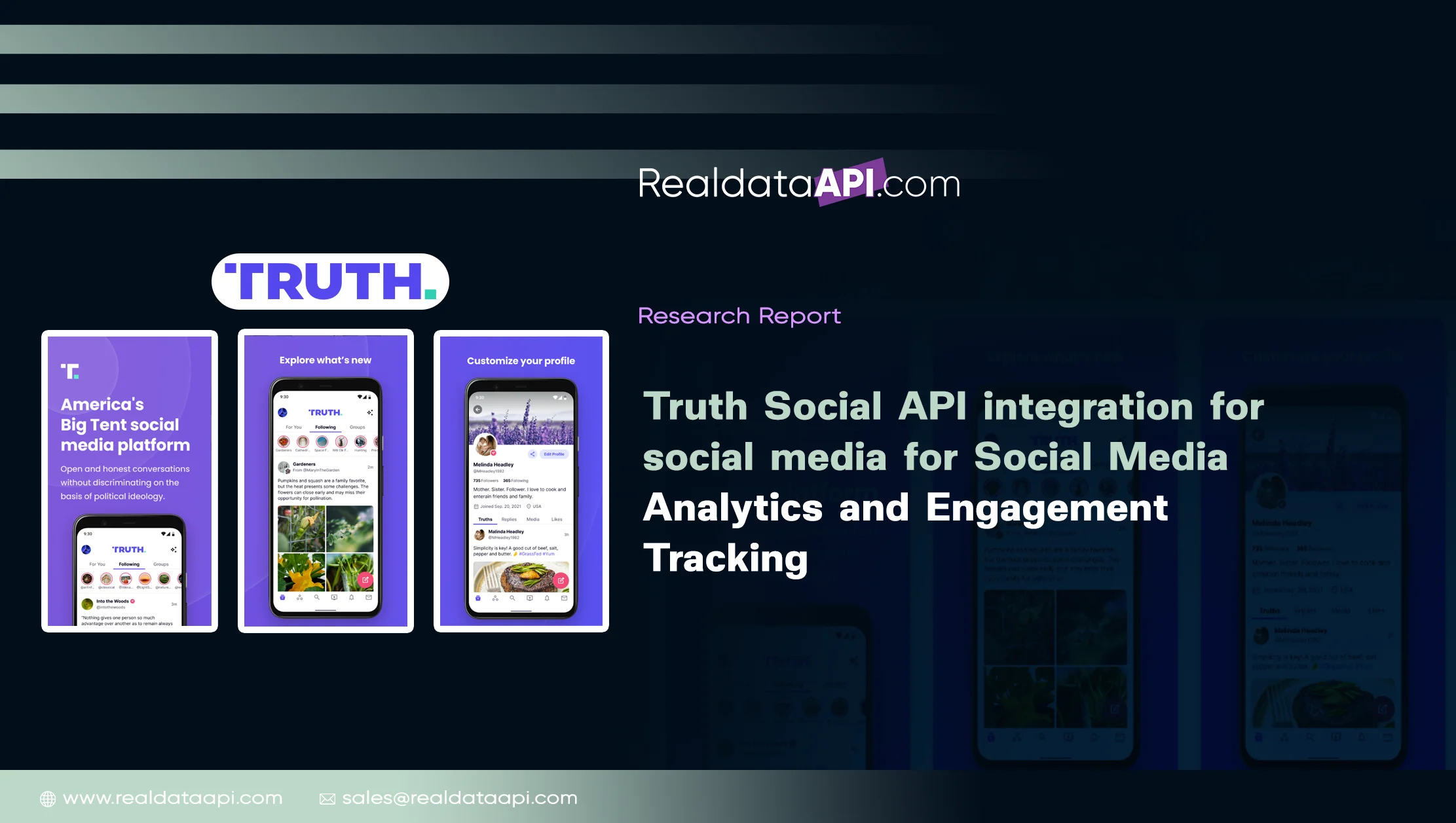
Truth Social API integration for social media can help organizations explore public conversations, analyze content trends, and organize social media information for research and reporting. For marketing intelligence teams, data providers, and social media analysts, structured information can make it easier to study public discussions, identify emerging topics, and understand engagement patterns. Truth Social was generally made available in the first quarter of 2022. Its iOS application launched in April 2022, its web application debuted in May 2022, and its Android application became available in October 2022. The platform subsequently introduced Groups, international availability, and a Discover section featuring trending content.
However, businesses must distinguish between technical feasibility and authorized data access. Truth Social's official Terms of Service restrict automated access, bots, scripts, scraping, data-mining tools, and systematic collection without written permission. They also restrict commercial exploitation of platform content without express prior written permission.
Therefore, a responsible integration strategy should begin with permission verification, documented access arrangements, data minimization, and clearly defined analytics requirements. Truth Social Media Data Scraping should not be treated as automatically permitted simply because information is publicly visible.
For Real Data API, the opportunity lies in helping businesses establish compliant data workflows, organize authorized information, and transform approved datasets into meaningful social media intelligence.
How Has the Platform Developed Between 2020 and 2026?
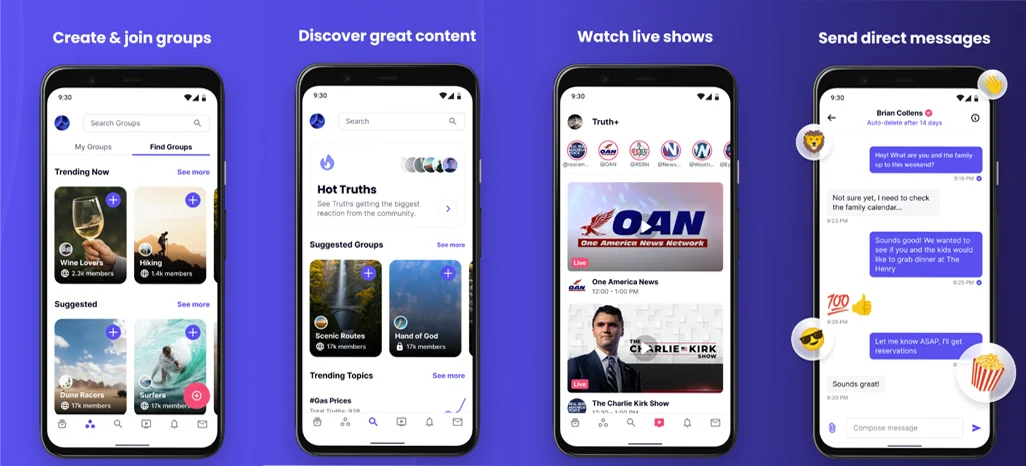
Truth Social's development history provides important context for businesses evaluating its data availability. Understanding the platform's launch, application expansion, and feature releases helps analysts identify which periods can support meaningful historical research.
The platform was generally made available in early 2022, meaning 2020 and 2021 should not be represented as operational Truth Social data periods. Its expansion across iOS, web, and Android created additional access points during 2022. The introduction of Groups in May 2023 expanded its community-oriented functionality, while international availability followed in June 2023.
For businesses researching Truth Social public data scraping, these milestones matter because historical coverage should reflect actual platform availability rather than assumed datasets. Researchers should also distinguish platform launch dates from the availability of individual features.
| Year | Verified platform development | Research significance |
|---|---|---|
| 2020 | Truth Social had not yet launched. | No platform-generated historical dataset. |
| 2021 | The platform was still pre-launch. | No verified operational content history. |
| 2022 | General availability began in Q1. iOS launched in April, web in May, and Android in October. | Initial platform content and account activity. |
| 2023 | Groups launched in May; international availability was announced in June. | Broader community and geographic research. |
| 2024 | TMTG reported approximately 9 million cumulative signups across iOS, Android, and web as of mid-February. | A documented registration milestone, not an active-user count. |
| 2025 | Groups received enhancements, and Truth Search AI entered beta testing in August, according to company disclosures. | New platform functionality and search-related research opportunities. |
| 2026 | TMTG's June 2026 quarterly filing continued documenting the platform's development. | Current research should distinguish verified platform features from unpublished engagement metrics. |
The figures above should not be interpreted as annual active users, daily posts, or engagement rates. In particular, the approximately 9 million figure represents cumulative signups reported by the company, not independently verified active accounts.
For businesses, the practical lesson is to build historical datasets around documented platform milestones. A reliable research project should record publication dates, collection dates, available fields, source permissions, and missing historical periods. This prevents analysts from presenting incomplete coverage as continuous historical intelligence.
How Can Social Conversations Support Better Marketing Decisions?
Social media analytics helps businesses understand what audiences discuss, which topics attract attention, and how conversations change over time. These insights can support content planning, brand research, competitive intelligence, and communication strategies.
Truth Social web scraping for social media analytics is a research concept that requires an important distinction: collecting information through automated website access is not automatically authorized. Truth Social's terms explicitly restrict scraping, automated extraction, and systematic retrieval without the required permission. Therefore, businesses should first establish an approved access arrangement rather than assuming that public visibility grants collection rights.
Once an authorized data source is available, analysts can organize relevant information into measurable categories:
- Content analysis: Categorize posts by topic, subject, publication date, and content format.
- Engagement analysis: Evaluate available interaction indicators, such as likes, replies, and reposts, where the authorized dataset provides them.
- Audience research: Study permitted public account-level information without attempting to identify private individuals.
- Conversation analysis: Group discussions around products, industries, public events, and recurring subjects.
- Competitive research: Compare authorized brand-related conversations across defined reporting periods.
For example, a marketing research team studying public discussions about consumer technology could classify posts by product category, identify frequently discussed features, and compare conversation volumes across reporting periods. These are analytical methods, not claims about measured Truth Social results.
Businesses should also avoid treating likes or reposts as direct evidence of purchase intent. Engagement indicators describe interactions, while commercial outcomes require separate validation.
A useful reporting framework combines topic classification, publication frequency, available engagement indicators, and source-level documentation. This makes research easier to interpret and reduces the risk of misleading conclusions.
How Can Emerging Topics Be Identified and Measured?

Trending topics provide researchers with an opportunity to understand which subjects are attracting attention within a particular period. They can help marketing teams recognize changing conversations, identify relevant themes, and develop timely communication strategies.
Truth Social trending data extraction can be considered for research involving trending subjects, recurring phrases, public discussions, and changes in topic visibility. However, any automated collection must follow the platform's permission requirements.
Truth Social's company disclosures describe a Discover tab designed to help users find trending content. This establishes the existence of a platform feature, but it does not establish that a public third-party trending-data API is available.
For authorized research, analysts can use a structured process:
- Topic identification: Define the subjects, brands, industries, or public events that matter to the research.
- Keyword classification: Group related terms into consistent topic categories.
- Time-based comparison: Compare available content across hourly, daily, weekly, or monthly reporting periods.
- Conversation measurement: Calculate post counts and interaction totals only where complete, authorized records are available.
- Trend validation: Check whether a topic's visibility is sustained or limited to a short-lived event.
- Reporting: Present the results with timestamps, collection coverage, and methodology notes.
The main analytical advantage is consistency. A topic that appears frequently during one reporting period may not remain important in the following period. Comparing multiple time windows helps researchers distinguish persistent interests from temporary spikes.
Businesses can also connect topic analysis with campaign calendars, product launches, and customer feedback research. This can help communication teams prioritize subjects that deserve further investigation.
Explore structured social listening and authorized data research with Real Data API to turn public conversation insights into practical business intelligence!
Get Insights Now!What Should Businesses Know About Real-Time Data Access?
Real-time social intelligence can help organizations monitor changing conversations and respond to relevant developments. However, real-time reporting depends on the availability of an authorized data source, its delivery frequency, and the fields it provides.
A Real-time Truth Social API solution should not be advertised as an officially available platform integration unless the provider can demonstrate valid authorization and current technical documentation. The official materials reviewed for this report establish platform features and usage restrictions, but do not establish a publicly documented third-party developer API with guaranteed real-time access.
Businesses evaluating an integration should verify the following technical requirements:
- Authentication: Confirm the approved credentials, authorization method, and access permissions.
- Data availability: Identify which post, account, timestamp, and engagement fields can legally be supplied.
- Update frequency: Establish whether the provider offers streaming, periodic updates, or historical delivery.
- Data completeness: Understand missing records, deleted content, delayed updates, and coverage limitations.
- Reliability: Monitor delivery failures, duplicate records, and inconsistencies.
- Security: Protect access credentials and restrict internal access to approved datasets.
Real-time systems should also distinguish between event time and collection time. Event time indicates when content was originally published, while collection time indicates when the authorized system received it. Both timestamps are useful when analyzing delays and conversation changes.
For example, a research dashboard could display the latest available approved records alongside their publication timestamps and ingestion timestamps. This would allow analysts to understand how current their dataset actually is.
The objective is not simply to collect information quickly. It is to deliver accurate, traceable, and appropriately authorized information at a clearly documented frequency.
How Can Data Quality Improve Social Media Research?
Social media datasets often contain inconsistent formats, repeated records, incomplete fields, and changing content structures. Without appropriate quality controls, these issues can affect research findings and make comparisons unreliable.
Social Media Data Scraping is frequently discussed as a method of gathering information from online platforms. For Truth Social, however, the official terms impose restrictions on automated collection and systematic retrieval. Commercial research teams must obtain the appropriate written permission or use another authorized data arrangement before collecting platform information.
For an approved data pipeline, quality management should include several important stages.
Standardization: Convert approved records into a consistent structure. Dates, text fields, account identifiers, and available interaction indicators should follow defined formats.
Deduplication: Identify repeated records using stable identifiers or other approved matching rules. Duplicate removal helps prevent inflated content counts.
Validation: Check mandatory fields, timestamp formats, missing values, and invalid records before information enters the analytical database.
Classification: Organize content into meaningful categories, including brand discussions, product-related topics, industry conversations, and customer feedback.
Historical consistency: Maintain consistent reporting periods and clearly document changes in field availability.
Source tracking: Retain source references, collection timestamps, permission details, and processing information for auditability.
A practical dataset quality report can include:
| Quality indicator | What it measures |
|---|---|
| Completeness | Availability of required fields |
| Duplicate rate | Share of repeated records |
| Timestamp validity | Records with usable date and time information |
| Classification coverage | Records assigned to research categories |
| Update freshness | Time between publication and authorized data delivery |
| Source traceability | Records with documented source information |
These are recommended measurement categories, not reported Truth Social performance statistics.
Businesses should also establish retention periods and access controls. Personal information should not be collected merely because it is technically accessible. Data minimization and clear research purposes improve the responsibility and reliability of the overall workflow.
What Makes a Social Media Dataset Useful for Business Intelligence?
A well-organized dataset provides more value than a collection of disconnected posts. Businesses need structured information that can be filtered, compared, validated, and connected with their research objectives.
Social Media Datasets can support multiple business applications when the underlying information is obtained through authorized channels and includes sufficient documentation.
Important dataset components may include:
| Dataset component | Business application |
|---|---|
| Post ID or approved record identifier | Record matching and duplicate detection |
| Publication timestamp | Historical trend analysis |
| Post text | Topic and sentiment research |
| Approved public account reference | Source-level content analysis |
| Available interaction counts | Engagement measurement |
| Content category | Industry and topic classification |
| Source reference | Verification and traceability |
| Collection timestamp | Data freshness analysis |
Not every field will necessarily be available through an authorized Truth Social data arrangement. Businesses should confirm field-level access before finalizing their research requirements.
Different departments can use structured datasets in different ways. Marketing teams can examine content themes and campaign discussions. Research analysts can study changes in public conversations. Brand intelligence teams can evaluate relevant product mentions and compare topic visibility. Data science teams can use properly licensed and documented records for text classification and other analytical workflows.
A strong dataset should also include metadata describing its coverage, collection methodology, update frequency, and known limitations. These details are essential when comparing reports produced at different times.
For example, a dataset covering selected topics should not be presented as a complete record of every public conversation on the platform. Transparent coverage descriptions help decision-makers understand what the numbers represent.
The best approach combines structured records, consistent definitions, quality validation, and clear documentation. This allows businesses to build repeatable research processes rather than relying on isolated observations.
Businesses evaluating social media intelligence solutions need more than raw information. They need structured datasets, consistent delivery, reliable validation, and a clear understanding of data permissions.
Real Data API can support businesses with data-focused research and integration requirements through a structured approach to data preparation and delivery.
Truth Social Web Scraping for Social Media Data should always be evaluated against platform terms, written permissions, and applicable privacy requirements. A responsible data provider should prioritize authorized sources and avoid presenting restricted extraction methods as unrestricted services.
Key areas where Real Data API can support data projects include:
- Structured data delivery: Organizing approved information into formats suitable for analytics, reporting, and business intelligence.
- Data standardization: Applying consistent field structures to simplify analysis and integration with existing systems.
- Data validation: Identifying missing values, duplicates, inconsistent timestamps, and formatting problems.
- Custom dataset development: Aligning approved data fields with specific research objectives and business requirements.
- Integration support: Helping businesses plan data workflows and connect structured datasets with their analytical environments.
- Research-oriented delivery: Supporting historical comparisons, topic classification, and reporting requirements where the necessary information is authorized and available.
For organizations planning a social media intelligence project, the first step should be confirming data access rights, coverage, and technical feasibility. This helps establish realistic expectations before development begins.
Real Data API can help businesses evaluate their data requirements and develop suitable data solutions without compromising transparency or responsible data practices.
Conclusion
Social media intelligence depends on accurate information, consistent research methods, and reliable data access. Truth Social offers features such as Groups and Discover, creating opportunities for researchers to examine platform developments and public conversations.
However, businesses must understand the distinction between publicly visible content and information they are authorized to collect, process, and use commercially. Truth Social's official terms restrict automated access, scraping, and systematic data collection without the required permissions.
Truth Social API integration for social media should therefore begin with access verification, clearly defined analytical requirements, and a suitable data architecture.
Organizations can then focus on structured datasets, topic monitoring, engagement measurement, historical comparisons, and actionable reporting.
Real Data API can help businesses explore their data requirements, organize authorized information, and develop structured data workflows for social media research.
Looking to strengthen your social media analytics strategy? Contact Real Data API to discuss your data requirements and explore reliable, permission-based data integration solutions!
Frequently Asked Questions
1. What is Truth Social API integration for social media?
It refers to connecting authorized Truth Social data sources with analytical systems to organize content, examine conversations, and support social media research and reporting.
2. Is Truth Social Media Data Scraping permitted?
Truth Social Media Data Scraping is restricted under platform terms. Written permission and appropriate legal authorization should be obtained before automated collection or commercial use.
3. What is Truth Social public data scraping used for?
Truth Social public data scraping may describe research into publicly visible conversations, topics, and content, subject to platform permissions and applicable privacy and data protection requirements.
4. How does Truth Social web scraping for social media analytics help businesses?
Truth Social web scraping for social media analytics describes examining authorized content to understand discussion themes, available engagement indicators, and changes in public conversations.
5. Can Truth Social trending data extraction support market research?
Truth Social trending data extraction can support authorized topic research. Real Data API can help businesses evaluate structured data requirements and suitable analytics workflows.
Latest posts

Uber Eats & Deliveroo Restaurant Data Scraping for the UK
Yemeksepeti Restaurant Data API for Turkey: Multi-City Coverage

Dubai Restaurant Menu Intelligence: Business Bay & Hessa Street

How a Travel data scraping API for market intelligence Helps Travel Businesses Solve Inaccurate Pricing and Competitor Tracking Challenges




.png)


