.webp)
TL;DR
- Uniqlo Fashion Dataset helps retailers organize product names, categories, prices, availability, and other attributes for structured fashion intelligence and competitive research.
- Uniqlo Fashion Data Scraping enables businesses to collect recurring online catalog information and identify changes in pricing, assortments, product launches, and category movements.
- Structured fashion data helps analysts convert large product catalogs into actionable insights for assortment planning, pricing strategy, competitor monitoring, and apparel trend analysis.
Introduction
Fashion businesses need timely product and pricing information to understand what consumers are buying, how assortments are changing, and where competitors are gaining attention. Uniqlo Fashion Datasets become significantly more valuable when online catalog information is turned into structured records covering products, prices, categories, descriptions, availability, and other useful attributes.
This is especially valuable for retailers, fashion brands, marketplaces, market researchers, and data-driven merchandising teams that need to monitor a large and frequently changing catalog. Uniqlo Fashion Data Scraping can support recurring collection of product information so analysts do not have to depend on manual research or isolated snapshots.
The scale of UNIQLO also makes structured analysis relevant. Fast Retailing reported 2,519 UNIQLO stores worldwide at the end of FY2025, with UNIQLO sales of ¥2.9363 trillion. By May 2026, its UNIQLO operation had expanded to 2,529 stores.
For businesses evaluating fashion-market movements, the core benefit is straightforward: structured catalog data creates a consistent foundation for comparing products, prices, categories, availability, and changes over time.
How Can Product-Level Information Improve Fashion Analysis?
Scrape Uniqlo product data for fashion analysis programs can help businesses create a structured view of product-level information. Instead of manually checking individual pages, analysts can organize fields such as product name, product URL, category, subcategory, color, size, price, discount, availability, material, and product description.
This structure makes it easier to answer practical business questions. Which categories contain the largest number of products? Which products have changed price? Which colors or sizes are frequently unavailable? Which products are newly introduced? How does the assortment change between seasons?
Useful Product-Level Fields
| Data Field | Fashion Analysis Use |
|---|---|
| Product Name | Product identification |
| Category | Category-level performance analysis |
| Subcategory | Detailed assortment comparison |
| Price | Price benchmarking |
| Discount | Promotion monitoring |
| Color | Color trend analysis |
| Size | Availability and assortment analysis |
| Material | Product positioning |
| Availability | Stock visibility |
| Product URL | Record verification |
2020–2026: The Shift Toward Structured Product Intelligence
Between 2020 and 2026, fashion analysis increasingly moved from occasional manual research toward continuous digital monitoring. The growth of online retail made product pages an important source of market information, while changing consumer behavior increased the need to understand product availability, pricing, and assortment more frequently.
UNIQLO's own reporting illustrates how product selection and seasonal performance can affect results. In FY2026, UNIQLO Japan reported strong sales from year-round products as well as winter ranges, while the company also highlighted products with updated silhouettes and materials.
For analysts, this means product data should not be treated as a static catalog. A historical dataset can reveal when products appear, disappear, change price, receive discounts, or move between availability states. Comparing these changes by category and period can reveal assortment strategies that are difficult to identify through one-time research.
For a fashion retailer, the practical advantage is better decision-making. Product managers can identify gaps in their assortment, merchandising teams can compare category depth, and analysts can monitor competitor positioning. The same structured records can also feed dashboards, machine-learning models, pricing systems, and market-research workflows.
What Can a Digital Collection System Reveal About Fashion Products?
A Uniqlo web data scraper for fashion product analysis can transform online catalog information into structured records suitable for comparison and historical monitoring.
The key value is consistency. A data collection workflow can capture similar fields across thousands of products and organize them into a common schema. This makes it easier to compare products across categories, markets, periods, and price points.
For example, an analyst could create a category-level dataset containing:
- Number of products
- Average listed price
- Lowest and highest price
- Discount frequency
- Product availability
- New product count
- Product assortment by color
- Product assortment by size
- Category share
- Product lifecycle changes
Example Analytical Framework
| Metric | Example Question | Business Decision |
|---|---|---|
| Product Count | How large is each category? | Assortment planning |
| Average Price | What is the typical price point? | Pricing strategy |
| Discount Rate | How often are products discounted? | Promotion planning |
| Availability | Which items are unavailable? | Inventory monitoring |
| New Products | What has recently entered the catalog? | Trend detection |
| Category Mix | Which categories dominate the assortment? | Merchandising |
2020–2026: From Catalog Monitoring to Competitive Intelligence
The 2020–2026 period accelerated the importance of digital product intelligence. Retailers increasingly needed visibility into online assortments because prices, availability, promotions, and product presentations could change faster than traditional market-research cycles.
UNIQLO's global expansion reinforces this requirement. UNIQLO International revenue increased from ¥930.2 billion in FY2021 to ¥1.9103 trillion in FY2025, according to Fast Retailing's reported business-segment figures.
As digital assortments expand across markets, analysts can use historical datasets to compare how products and pricing behave over time. A collection system can identify recurring price changes, new category launches, discontinued products, and differences in assortment depth.
This is particularly useful for fashion brands competing against large international retailers. Instead of asking only, "What is the competitor selling today?", analysts can ask, "How has the competitor's assortment changed over the last six months?" That historical perspective supports stronger decisions around product development, pricing, promotional calendars, category expansion, and seasonal planning.
How Can Current Product Signals Improve Apparel Trend Detection?
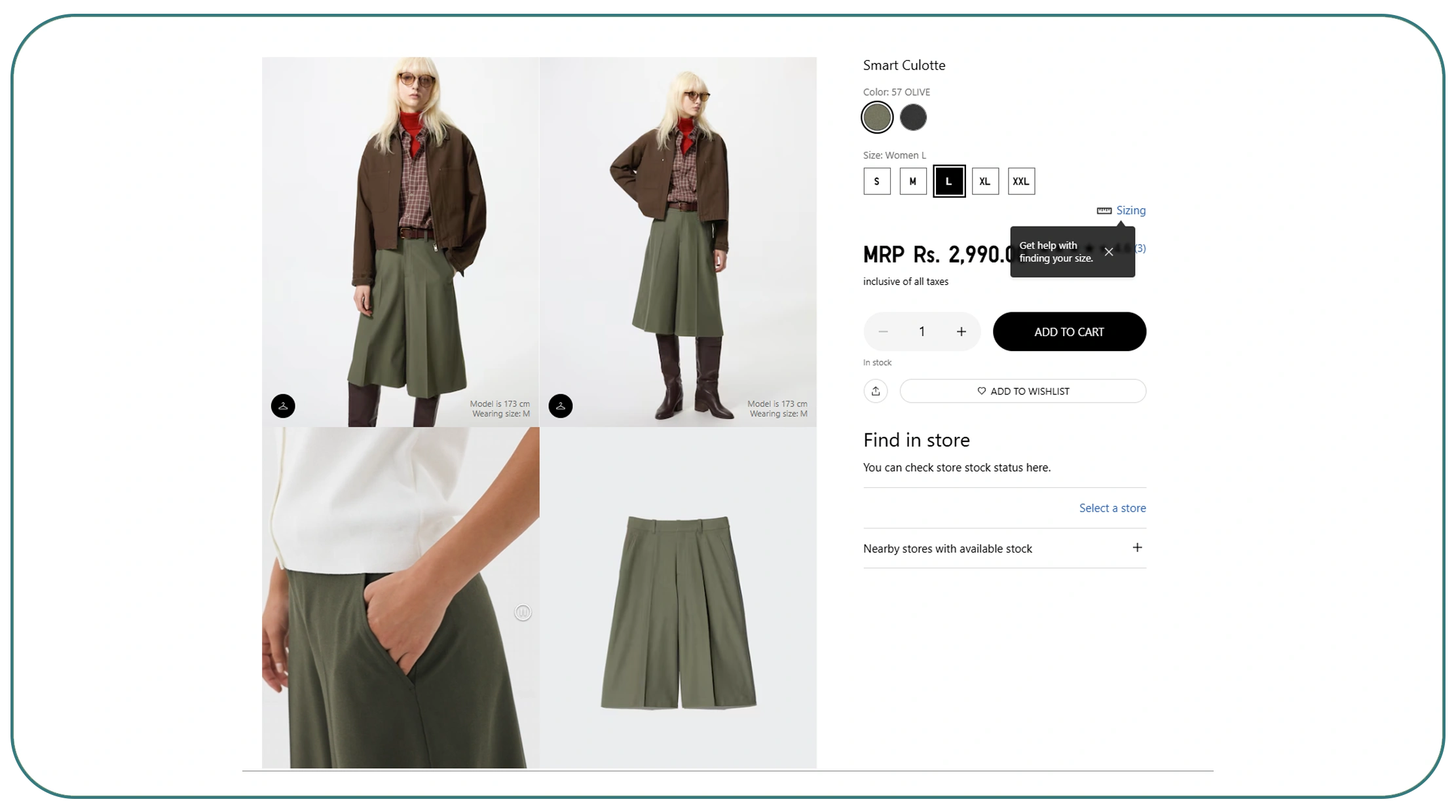
Real-time Uniqlo fashion data for apparel trend analysis can help businesses identify changes while they are happening instead of waiting for periodic market reports.
Trend analysis becomes more useful when multiple signals are evaluated together. Product launches, price movements, category expansion, availability changes, colors, materials, silhouettes, and promotional activity can collectively indicate shifts in merchandising strategy.
Signals Worth Tracking
| Signal | Potential Insight |
|---|---|
| New Arrivals | Emerging assortment direction |
| Product Category Frequency | Category importance |
| Price Changes | Pricing movement |
| Discounts | Promotional pressure |
| Colors | Emerging color preferences |
| Materials | Fabric and functionality trends |
| Sizes | Demand or availability patterns |
| Stock Status | Product popularity or supply changes |
2020–2026: Why Trend Speed Matters
Fashion trends can develop quickly, and digital catalogs provide a recurring stream of observable signals. From 2020 onward, the increased importance of e-commerce made online product information more valuable for competitive and trend research.
By 2026, Fast Retailing was reporting strong global growth for UNIQLO, with UNIQLO International revenue reaching ¥1.834 trillion during the first nine months of FY2026, up 25.9% year over year. The company also attributed performance partly to product launches and continued demand for products with updated silhouettes and materials.
For fashion analysts, these developments demonstrate why trend monitoring should extend beyond social-media signals. Product catalogs themselves contain useful evidence. A sudden increase in products within a category, repeated introductions of similar silhouettes, or a growing presence of a particular material can provide measurable indicators.
Businesses can combine this information with their own sales, search, customer-review, and market data. The resulting model can distinguish between a temporary promotional change and a broader assortment trend.
The actionable outcome is faster response. Merchandisers can adjust product selection, buyers can investigate emerging categories, and marketers can align campaigns with visible changes in the competitive landscape.
Turn changing fashion catalog signals into structured intelligence with Real Data API's scalable data solutions.
Get Insights Now!How Can API-Based Access Support Product and Price Monitoring?
An Uniqlo API for clothing products, prices and categories can provide a structured approach to collecting and integrating catalog information into business workflows.
API-oriented data delivery is particularly useful for teams that already operate analytics platforms, business-intelligence dashboards, pricing engines, or data warehouses. Instead of repeatedly collecting and cleaning information manually, structured data can be integrated into an existing workflow.
Example Data Pipeline
| Stage | Activity | Output |
|---|---|---|
| Collection | Capture catalog information | Raw product records |
| Processing | Clean and normalize fields | Standardized dataset |
| Validation | Check missing or inconsistent values | Quality-controlled records |
| Storage | Maintain historical records | Longitudinal dataset |
| Analysis | Calculate trends and metrics | Business insights |
| Integration | Connect with BI tools | Automated reporting |
2020–2026: The Rise of Automated Retail Data Workflows
During 2020–2026, retailers increasingly moved toward automated data pipelines because manual catalog monitoring does not scale effectively. Large assortments create thousands of individual observations, while prices and availability can change frequently.
Fast Retailing's scale illustrates the challenge. UNIQLO operated 2,529 stores globally as of May 31, 2026, including 785 in Japan and 1,744 internationally.
For data teams, the goal is not simply to collect more information. The goal is to make the information usable. Standardized product IDs, consistent category labels, historical price records, and timestamps allow teams to build repeatable analyses.
An API-driven approach can also reduce the operational burden associated with repeatedly collecting, transforming, and delivering product information. Data can be routed into warehouses, dashboards, notebooks, or internal applications.
The strongest use cases combine API-delivered information with business data. A retailer might compare competitor pricing against its own catalog. A fashion marketplace might monitor category breadth. A research company might calculate historical price distributions. This turns product information into an operational data asset rather than a one-time research file.
What Makes Historical Fashion Data Valuable for Business Decisions?
Uniqlo Fashion Datasets become significantly more valuable when they contain historical observations rather than only current product information.
A single snapshot can show what products and prices look like today. A historical dataset can explain what changed, when it changed, and how frequently the change occurred.
Historical Analysis Examples
| Historical Metric | Business Application |
|---|---|
| Price History | Competitive price benchmarking |
| Product Launch History | Assortment planning |
| Availability History | Stock-pattern analysis |
| Category Growth | Market opportunity analysis |
| Discount History | Promotion analysis |
| Product Lifecycle | Portfolio optimization |
2020–2026: Building a Historical View of Fashion Markets
The 2020–2026 period demonstrates why historical context matters. Fashion retailers have faced changes in consumer behavior, digital shopping adoption, seasonal demand, pricing conditions, and international expansion.
Fast Retailing's reported UNIQLO Japan revenue grew from ¥842.6 billion in FY2021 to ¥1.0261 trillion in FY2025, while UNIQLO International revenue increased from ¥930.2 billion to ¥1.9103 trillion over the same period.
These company-level figures do not directly reveal individual product performance, but they show why detailed product-level datasets can be valuable to analysts studying a rapidly expanding fashion operation.
Historical product records allow analysts to build their own evidence layer. They can determine how many products were available at different points, how price distributions shifted, which categories expanded, and how frequently products entered or exited the catalog.
This is especially useful for buyer personas such as retail strategy managers, category managers, competitive-intelligence analysts, and fashion-market researchers.
The strongest approach is to define the business question first. If the objective is price intelligence, preserve historical prices. If the objective is trend analysis, preserve product attributes and category classifications. If the objective is assortment intelligence, track launches, removals, and category depth.
How Does Automated Collection Improve Fashion Intelligence?
Fashion Data Scraping provides the foundation for collecting large volumes of structured information from digital retail environments. Its value increases when collection is combined with normalization, validation, historical storage, and analytics.
For fashion businesses, automation solves a practical problem: online catalogs change continuously. Manual research may capture only a fraction of the available information and can make historical comparison difficult.
A Practical Intelligence Model
| Layer | Purpose |
|---|---|
| Collection | Capture product information |
| Normalization | Standardize attributes |
| Validation | Improve data quality |
| Historical Storage | Preserve changes |
| Analytics | Identify patterns |
| Visualization | Communicate insights |
| Automation | Repeat the process consistently |
2020–2026: From Scraping to Decision Intelligence
From 2020 to 2026, data collection evolved from simple extraction toward complete intelligence workflows. Businesses increasingly require data that can be connected to internal systems and analyzed over time.
The latest UNIQLO performance data reinforces the need for ongoing monitoring. In the first half of FY2026, UNIQLO Japan revenue increased 7.4% to ¥581.7 billion, while UNIQLO International revenue reached ¥1.2413 trillion, up 22.4%.
For analysts, growth across markets can create more product-level observations to monitor. A scalable collection process can organize those observations into structured records and preserve historical changes.
However, collection alone is not enough. Data quality is essential. Product names should be standardized, prices should be stored consistently, categories should follow a stable taxonomy, and timestamps should be retained.
A mature workflow can then support price benchmarking, assortment comparison, trend detection, competitor monitoring, and category research.
For the buyer persona, this means fewer hours spent manually collecting information and more time spent interpreting market signals. The real business value comes from converting raw catalog changes into measurable insights that can support merchandising, pricing, product planning, and competitive strategy.
Why Choose Real Data API?
Extracting UNIQLO Online Catalog Data for Analytics — Real Data API can support businesses that need scalable, structured, and analytics-ready retail data for competitive research and market intelligence.
The objective should not be to collect data simply because it is available. Data collection should be designed around a measurable business question.
Real Data API can help organizations build workflows around:
- Product and category monitoring
- Price and discount tracking
- Historical catalog analysis
- Product availability monitoring
- Competitive intelligence
- Retail and fashion market research
- Structured data delivery
- Recurring data collection
- Analytics-ready datasets
For fashion businesses, data quality is just as important as data volume. A useful dataset should contain consistent fields, reliable timestamps, normalized values, and enough historical context to support comparison.
A scalable workflow can also help different teams work from the same information. Merchandising teams can study assortment changes, pricing teams can monitor competitive movements, market researchers can identify category patterns, and executives can use dashboards for strategic decisions.
The result is a more connected approach to retail intelligence—one where product data becomes part of an organization's ongoing decision-making process.
Conclusion
A structured fashion data strategy can help businesses move beyond one-time product research. Product names, categories, prices, availability, attributes, and historical changes can collectively reveal valuable signals about assortment strategies and market movements.
The scale of UNIQLO's global operation makes this particularly relevant. With 2,529 UNIQLO stores reported worldwide as of May 2026 and strong revenue growth across international markets, the amount of product and market information available for analysis continues to expand.
The right data workflow should therefore focus on three principles: consistency, historical depth, and actionability. Businesses should collect the fields that directly support their objectives, preserve historical changes, and connect the resulting data to analytics systems.
For retailers, this can support pricing decisions. For fashion brands, it can improve assortment planning. For market researchers, it can provide a structured foundation for competitive intelligence. For data teams, it can create repeatable pipelines instead of manual research processes.
Ready to transform online fashion catalog information into structured, analytics-ready intelligence? Connect with Real Data API to build a scalable fashion data solution tailored to your business needs!
FAQs
What is a fashion dataset useful for?
A Uniqlo Fashion Dataset can organize product names, categories, prices, availability, colors, sizes, and attributes, helping retailers conduct assortment, pricing, competitive, and trend analysis.
Why is automated collection important for fashion research?
Uniqlo Fashion Data Scraping can reduce repetitive manual research and provide recurring observations that help analysts identify catalog changes, pricing movements, product launches, and availability patterns.
How can historical product information support retailers?
Uniqlo Fashion Datasets preserve product and pricing observations over time, allowing businesses to compare category growth, assortment changes, discount activity, and product lifecycle patterns.
What business teams can use fashion data?
Merchandising, pricing, product, market research, competitive intelligence, and executive teams can use structured fashion data for assortment planning, price benchmarking, trend detection, and strategic reporting.
Can Real Data API support online catalog analytics?
Real Data API can help businesses build structured workflows for Extracting UNIQLO Online Catalog Data for Analytics, enabling product, pricing, category, availability, and historical-market analysis.
Latest posts

How Travel Dataset Solves Destination Intelligence Gaps with Flights, Hotels, Prices, Destinations, and Travel Market Trends

How Zomato Food Dataset Helps Businesses Solve Restaurant, Pricing, and Food Delivery Data Challenges

How Apple TV OTT Dataset Helps Solve Movie and Show Performance, Ratings, and Streaming Intelligence Challenges
How Musafir scraper Helps Businesses Extract Travel Information Efficiently?






.png)