
Introduction
Businesses use automotive analytics to predict resale value shifts, optimize inventory pricing, and identify regional EV demand patterns. Today, companies increasingly rely on used EV and hybrid pricing trends via CARFAX data scraping to gain accurate market intelligence, monitor vehicle depreciation, and improve strategic decision-making across the automotive ecosystem.
According to industry estimates, the global used EV market is expected to grow at a CAGR of 17% between 2020 and 2026 due to rising fuel prices, sustainability awareness, and increased EV adoption. Automotive retailers, fleet operators, insurance providers, and market analysts now depend on structured data extraction for real-time pricing visibility.
Using a reliable Web Scraping API, businesses can collect large-scale data points such as:
- Vehicle history records
- Mileage trends
- Dealer pricing
- Accident reports
- EV battery health indicators
- Regional resale demand
These insights help organizations make faster and more accurate pricing decisions while staying ahead of competitors in the evolving automotive market.
How Are Businesses Tracking EV Resale Value Changes Across Markets?
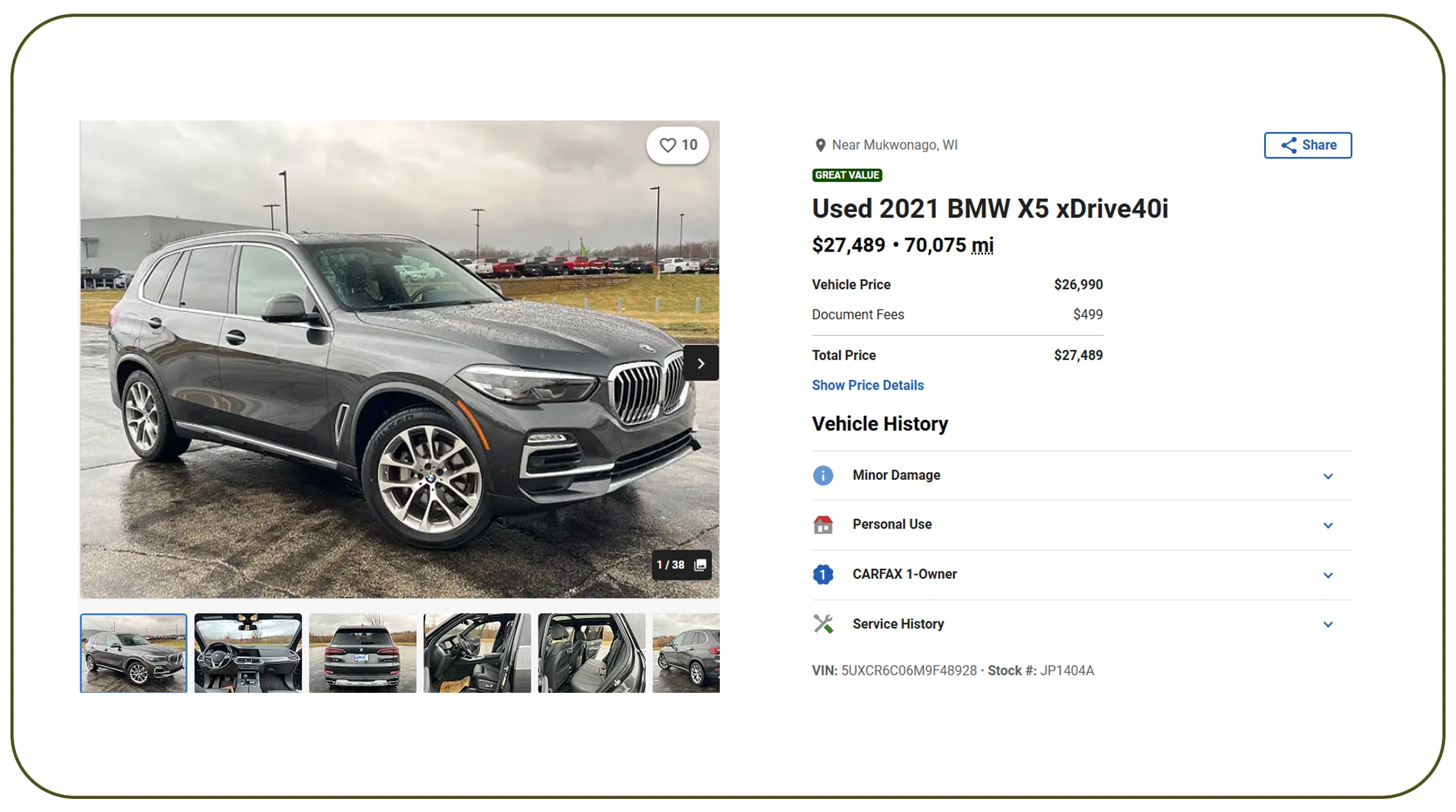
Understanding resale value fluctuations is critical for dealerships and automotive investors. Companies use used car pricing data intelligence using CARFAX vehicle history analytics to evaluate factors influencing used EV and hybrid pricing across different regions and time periods.
Between 2020 and 2026, used EV values experienced major shifts due to:
- Supply chain disruptions
- Battery technology improvements
- Government EV incentives
- Rising fuel costs
- Increased consumer demand
Automotive companies analyze historical pricing records alongside vehicle condition reports to forecast future resale patterns. Businesses also compare hybrid versus fully electric depreciation rates to improve procurement strategies.
Used EV Average Resale Price Trends (2020–2026)
| Year | Average Used EV Price | Hybrid Vehicle Price | Market Growth |
|---|---|---|---|
| 2020 | $21,500 | $18,400 | 8% |
| 2021 | $24,800 | $20,200 | 12% |
| 2022 | $28,700 | $23,900 | 15% |
| 2023 | $31,200 | $25,500 | 18% |
| 2024 | $29,800 | $24,100 | 14% |
| 2025* | $30,900 | $25,600 | 16% |
| 2026* | $32,500 | $27,100 | 19% |
*Projected estimates
Organizations combine resale history with regional demand data to identify profitable vehicle categories. For example, compact EVs showed higher resale stability in urban regions, while hybrid SUVs performed better in suburban markets.
These insights help businesses optimize:
- Vehicle acquisition timing
- Dynamic pricing models
- Trade-in valuation systems
- Inventory planning
What Makes Vehicle Pricing Data Essential for Automotive Competitors?
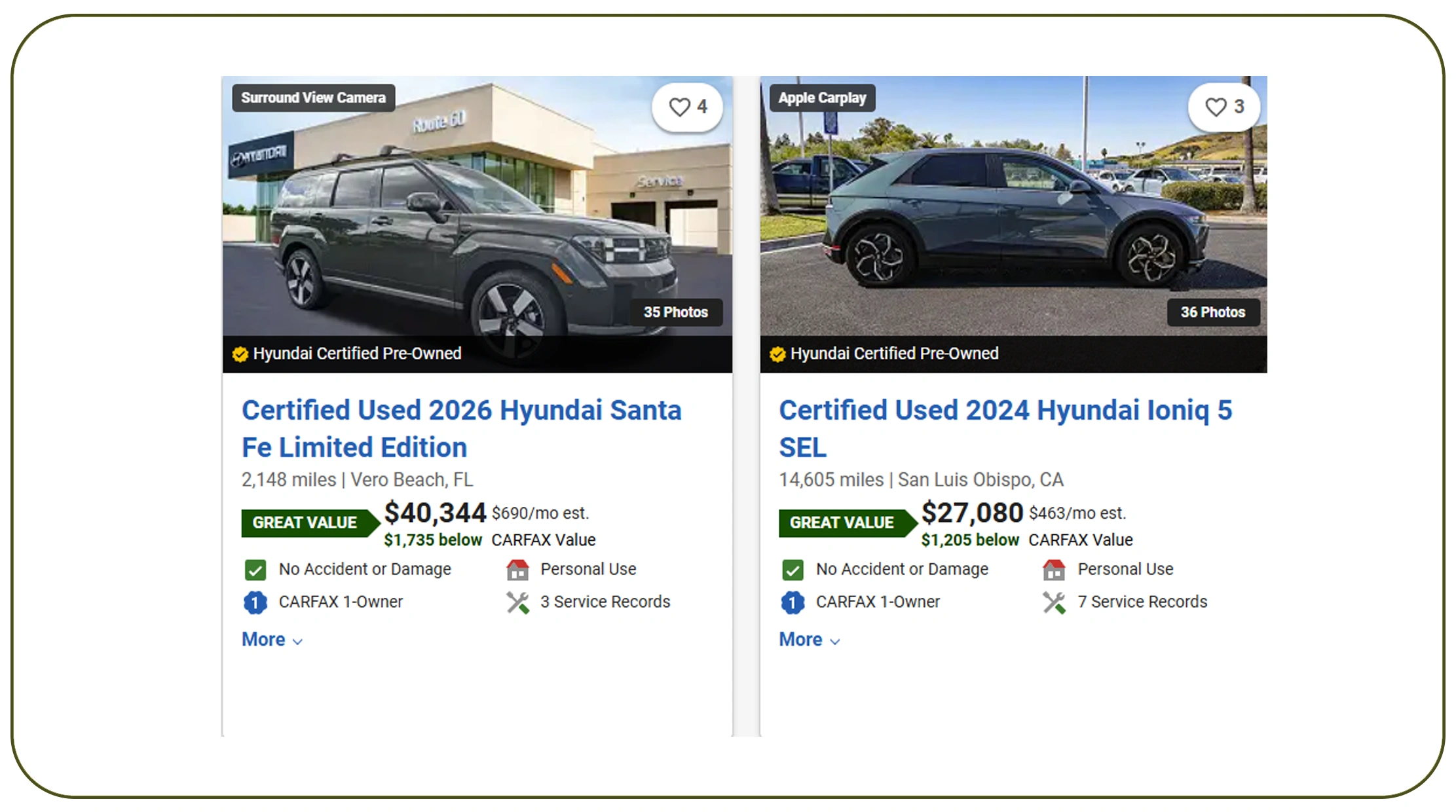
Accurate pricing intelligence allows businesses to react quickly to market changes. A robust CARFAX used vehicle pricing data scraper helps companies gather structured data from thousands of listings and dealership records for competitive analysis.
Businesses track:
- Dealer pricing strategies
- Seasonal demand fluctuations
- EV battery replacement impact
- Vehicle accident history
- Mileage-based depreciation
Automotive marketplaces use this information to benchmark pricing accuracy and identify underpriced inventory opportunities.
Dealer Pricing Benchmark Analysis (2020–2026)
| Year | Avg Dealer Margin | Avg EV Depreciation | Avg Hybrid Depreciation |
|---|---|---|---|
| 2020 | 9% | 18% | 14% |
| 2021 | 11% | 15% | 12% |
| 2022 | 14% | 11% | 9% |
| 2023 | 13% | 10% | 8% |
| 2024 | 12% | 9% | 7% |
| 2025* | 13% | 8% | 6% |
| 2026* | 14% | 7% | 5% |
The automotive industry increasingly uses machine learning models trained on extracted pricing datasets to forecast depreciation patterns. Businesses can identify which brands maintain higher resale values and which regions generate stronger demand.
This pricing intelligence supports:
- Revenue optimization
- Inventory turnover improvement
- Competitive pricing automation
- Better customer acquisition strategies
How Does Automotive Data Extraction Improve Strategic Decisions?
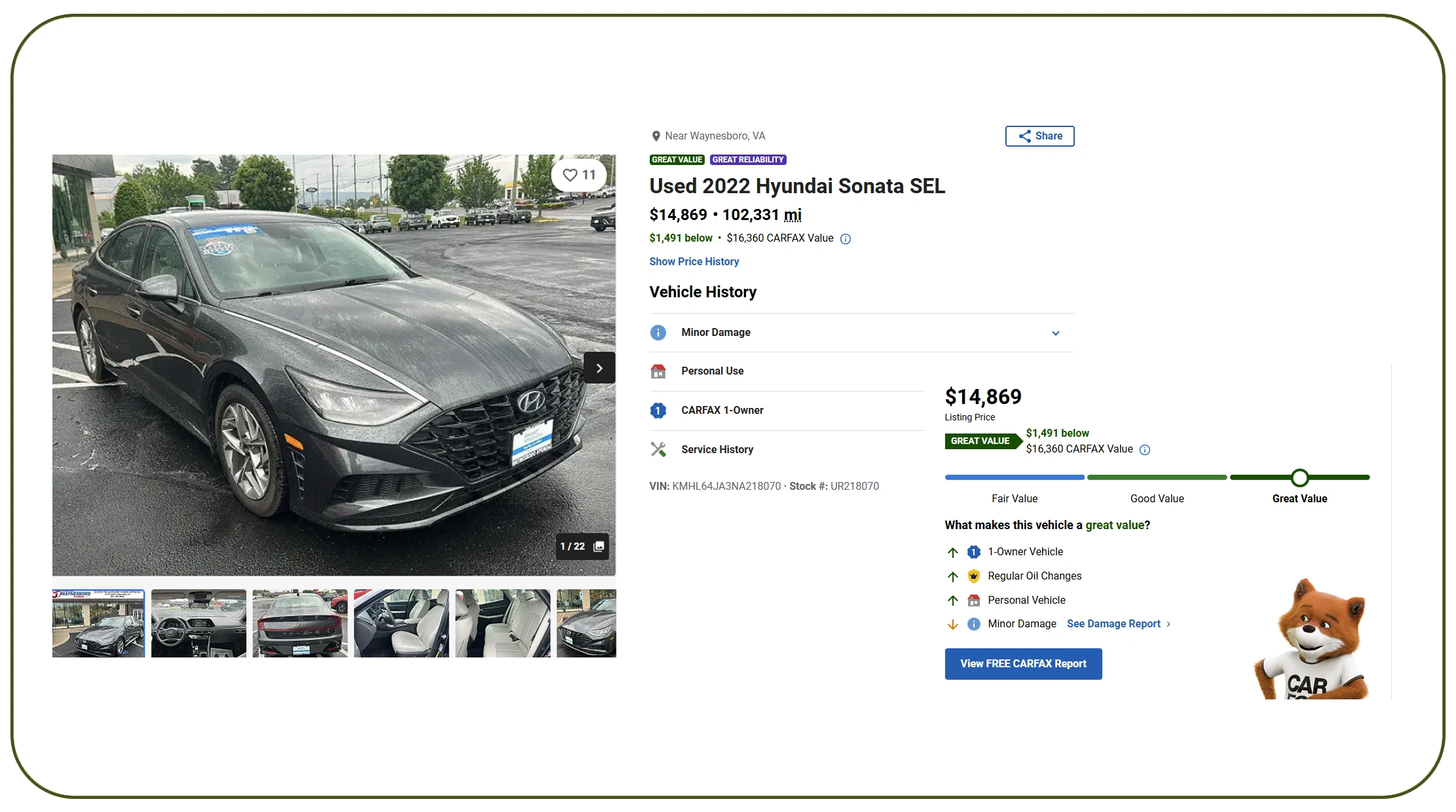
Businesses need accurate analytics to understand changing consumer behavior. Through automotive market insights from CARFAX data extraction, organizations gain visibility into vehicle lifecycle performance and long-term pricing patterns.
Automotive analysts study:
- EV ownership duration
- Trade-in frequency
- Mileage trends
- Battery warranty influence
- Regional adoption patterns
This data helps companies predict future demand for specific EV models and hybrid categories.
EV Consumer Preference Trends (2020–2026)
| Year | Compact EV Demand | SUV Hybrid Demand | Luxury EV Demand |
|---|---|---|---|
| 2020 | 24% | 31% | 12% |
| 2021 | 28% | 35% | 15% |
| 2022 | 34% | 39% | 19% |
| 2023 | 38% | 42% | 22% |
| 2024 | 41% | 44% | 24% |
| 2025* | 45% | 47% | 28% |
| 2026* | 49% | 51% | 32% |
Automotive finance companies use extracted vehicle history data to improve loan risk analysis. Insurance providers also evaluate accident history and maintenance records to calculate accurate premium pricing.
Businesses that use structured extraction pipelines gain advantages such as:
- Faster market forecasting
- Better investment planning
- Improved customer targeting
- Smarter dealership expansion strategies
Why Is Market Intelligence Critical for EV Growth Forecasting?
The automotive industry changes rapidly due to evolving technology and consumer preferences. Strong Market Research helps businesses understand pricing trends, emerging vehicle categories, and long-term EV adoption patterns.
Automotive companies analyze:
- Regional charging infrastructure growth
- Government EV policies
- Fuel price fluctuations
- Used vehicle supply availability
- Battery replacement costs
These variables directly impact resale pricing and vehicle demand.
Global Used EV Market Forecast (2020–2026)
| Year | Used EV Sales Volume | Hybrid Sales Volume | Market Revenue |
|---|---|---|---|
| 2020 | 1.2 Million | 2.4 Million | $42 Billion |
| 2021 | 1.6 Million | 2.8 Million | $51 Billion |
| 2022 | 2.1 Million | 3.2 Million | $67 Billion |
| 2023 | 2.7 Million | 3.8 Million | $81 Billion |
| 2024 | 3.3 Million | 4.2 Million | $96 Billion |
| 2025* | 4.0 Million | 4.9 Million | $112 Billion | 2026* | 4.8 Million | 5.6 Million | $129 Billion |
Businesses use predictive analytics combined with extracted automotive datasets to forecast inventory demand more accurately. This allows dealerships to reduce overstock risk while maximizing profitability.
The growing adoption of AI-powered automotive analytics platforms further improves pricing accuracy and consumer behavior forecasting.
How Do Data Extraction Solutions Improve Operational Efficiency?

Automotive businesses require scalable infrastructure for continuous data collection. Advanced Web Scraping Services help organizations automate vehicle data extraction across multiple listing platforms and automotive marketplaces.
Modern scraping systems collect:
- VIN-specific records
- Dealer inventory updates
- Vehicle mileage data
- Service history
- Pricing fluctuations
- Battery condition information
These systems support real-time analytics pipelines that update dashboards automatically.
Automotive Data Collection Efficiency Metrics
| Year | Manual Collection Time | Automated Scraping Time | Efficiency Gain |
|---|---|---|---|
| 2020 | 18 Hours | 6 Hours | 66% |
| 2021 | 17 Hours | 5 Hours | 71% |
| 2022 | 16 Hours | 4 Hours | 75% |
| 2023 | 14 Hours | 3 Hours | 79% |
| 2024 | 12 Hours | 2 Hours | 83% |
| 2025* | 10 Hours | 1.5 Hours | 85% |
| 2026* | 8 Hours | 1 Hour | 88% |
Automation significantly reduces operational costs while improving data accuracy. Businesses can scale data collection across thousands of listings without increasing manual labor.
Automotive enterprises also integrate scraped datasets into:
- BI dashboards
- CRM systems
- Pricing engines
- Predictive forecasting platforms
What Role Does Automated Scraping Play in Real-Time Analytics?
Real-time analytics is essential for automotive businesses operating in competitive markets. Many organizations now use Instant Data Scraper tools to monitor vehicle pricing changes continuously across marketplaces.
Automated scraping supports:
- Live inventory tracking
- Instant competitor monitoring
- Dynamic pricing optimization
- Real-time demand forecasting
Businesses receive immediate visibility into pricing fluctuations, allowing them to react faster than competitors.
Real-Time Pricing Update Frequency (2020–2026)
| Year | Daily Data Updates | Monthly Listings Tracked | Real-Time Accuracy |
|---|---|---|---|
| 2020 | 2,000 | 500,000 | 72% |
| 2021 | 4,500 | 900,000 | 78% |
| 2022 | 8,000 | 1.4 Million | 84% |
| 2023 | 12,000 | 2.1 Million | 88% |
| 2024 | 18,000 | 3.0 Million | 91% |
| 2025* | 24,000 | 4.2 Million | 94% |
| 2026* | 31,000 | 5.5 Million | 96% |
Real-time extraction systems help businesses:
- Detect pricing anomalies
- Monitor regional inventory shortages
- Forecast demand spikes
- Improve dealership responsiveness
These insights directly improve profitability and customer satisfaction.
Why Choose Real Data API?
Real Data API provides scalable automotive intelligence solutions designed for businesses seeking reliable and accurate market insights. Companies using used EV and hybrid pricing trends via CARFAX data scraping can access structured datasets that improve pricing analysis, forecasting accuracy, and competitive benchmarking.
Key benefits include:
- High-speed data extraction
- Real-time automotive analytics
- Large-scale vehicle history collection
- Custom API integration
- Accurate pricing intelligence
- Enterprise-grade scalability
Real Data API helps dealerships, market analysts, insurers, and automotive platforms transform raw vehicle data into actionable business intelligence.
Conclusion
The automotive industry is rapidly shifting toward data-driven decision-making. Businesses leveraging used EV and hybrid pricing trends via CARFAX data scraping gain stronger competitive intelligence, better pricing accuracy, and faster market forecasting capabilities.
As EV adoption continues to accelerate between 2020 and 2026, companies that invest in automotive data extraction and analytics will stay ahead of competitors and improve operational efficiency.
Ready to unlock real-time automotive intelligence and smarter EV pricing analytics? Contact Real Data API today to scale your automotive data strategy with advanced scraping and analytics solutions!
Latest posts
How KFC food dataset Helps Solve Menu Pricing, Location, and Food Market Trend Challenges
How Walmart E-Commerce Datasets Help Analyze Products, Prices, Reviews & Retail Trends?
How GrabFood Food Dataset Helps Businesses Analyze Restaurants, Menus, Prices, Ratings, and Delivery Trends

How Prada Fashion Dataset Helps Businesses Track Luxury Products, Prices, Categories, and Fashion Trends for Better Market Insights







.png)



