.gif)
.png)
Introduction
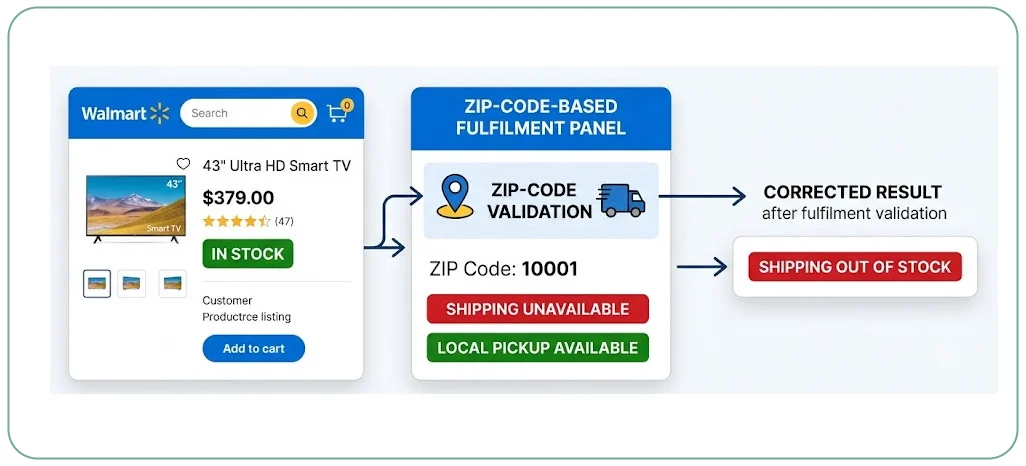
A common complaint from teams that validate orders at checkout: the scraper says a product is in stock, but when the customer is in a particular ZIP code, standard shipping is actually unavailable. The scraper is not lying. It is reading the wrong signal.
The problem
Walmart product pages can show several fulfilment options at once: store pickup, local delivery and shipping from Walmart or a third-party seller. A generic in-stock flag can turn true when any of these is available, for example when a nearby store has the item for pickup. If national mail shipping to your ZIP code is out of stock, a simple scraper still reports the product as available.
Why this matters for checkout validation
If a store such as an online cabinet retailer validates availability at checkout, a false in-stock result leads to cancelled orders, refunds and unhappy customers. The system needs a precise answer to one question: can this item be shipped to this ZIP code right now, and at what price?
The fix: fulfilment isolation
A reliable solution does the following:
- Sets the ZIP code first so the page loads in the right delivery context
- Reads the SHIPPING fulfilment block separately from pickup and delivery blocks
- Returns a clean boolean field such as shipping_available (true or false) instead of one combined in-stock flag
- Returns the current price tied to that same shipping offer
- Handles seller variations, because the price and availability can differ between Walmart-sold and marketplace-sold items
Example response shape
A clean API response can contain: product ID, ZIP code, shipping_available, current_price, fulfilment type, seller name and a timestamp.
For related Walmart product and inventory fields, review the Walmart Data Scraping API.
Performance for checkout use
Checkout validation is low in volume but time-sensitive. A typical profile is a few hundred calls per day with very low concurrency, so the priority is accuracy and fast response for each request rather than bulk throughput. Caching for a few minutes can reduce repeated lookups for the same product and ZIP code.
Quality checks
- Test products that you know are pickup-only
- Compare the API result against a manual check from the same ZIP code
- Monitor for layout changes, since fulfilment blocks are updated from time to time
Common reasons scrapers report the wrong availability
- Pickup is treated as available: a store pickup option makes the general stock flag true even when shipping is not offered.
- Wrong location context: the page loads for a default store or ZIP code, not the one you need.
- Mixed sellers: the product is in stock from a third-party seller, but not from the seller or fulfilment type you want.
- Cached data: an older page version shows stale availability.
- Combined flags: the scraper reads one text label, such as in stock, instead of the status of each fulfilment option.
Step-by-step implementation of a ZIP-level shipping check
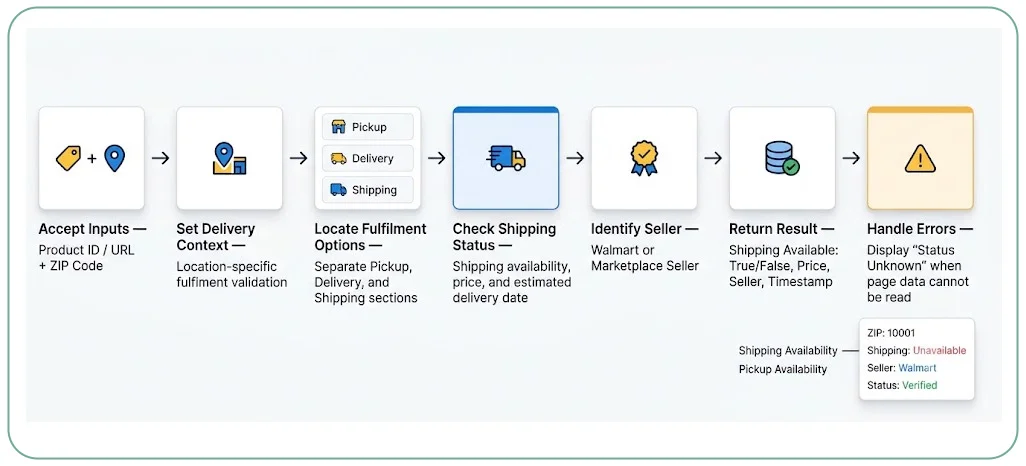
- Accept inputs: a product ID or URL and a ZIP code.
- Set the delivery context: load the page with the ZIP code so fulfilment options are evaluated for that location.
- Locate the fulfilment options: read pickup, delivery and shipping as separate blocks.
- Read the shipping block only: check its status, price and estimated delivery date.
- Identify the seller: record whether the offer comes from Walmart or from a marketplace seller.
- Return a clear result: a true or false for shipping availability, the price, the seller and a timestamp.
- Handle errors: return an unknown status, not a guess, when the page cannot be read.
Edge cases to test
- Items that are pickup-only and have no shipping option at all
- Items with limited quantity, where stock changes within minutes
- Products with variants, such as size or colour, where only some variants ship
- ZIP codes in remote areas with longer delivery times or restrictions
- Pages that show a price range instead of a single price
Why this matters beyond one retailer
The same problem appears on other large retail sites that mix pickup, local delivery and shipping. Any business that needs accurate availability for a specific delivery method, such as home improvement, furniture or grocery sellers, can use the same approach: isolate the fulfilment type, set the location first and return one clear field per fulfilment option.
For location-specific grocery pricing and availability, see the Grocery Scraping API.
Why choose Real Data API for Walmart shipping availability data
Real Data API builds ZIP-level availability checks that read the shipping offer separately from pickup and delivery, and return a clean true or false with price and seller details. A short test against your own product list and ZIP codes shows how closely the results match what customers see at checkout.
FAQs
1. Can the same approach work for other retailers?
Yes. The principle of isolating the fulfilment type applies to most large retailers.
2. Does price differ by fulfilment type?
It can, which is why price should be tied to the shipping offer.
3. How fast can the API respond?
Speed depends on the page and how fresh the result needs to be. Checkout use cases usually prioritise accuracy, with short caching to reduce repeated lookups.
4. Can the API return estimated delivery dates?
Where the shipping block shows them, yes.
5. What happens if the page cannot be read?
The API returns an unknown status with a reason, so your system can retry or fall back instead of relying on a guess.
6. Can this be extended to other sellers or retailers?
Yes. The same fulfilment-isolation approach can be applied to other retailers and marketplaces.
Conclusion
A scraper that says in stock when shipping is unavailable usually reads the wrong signal. By setting the ZIP code first, reading the shipping fulfilment block on its own and returning a clean true or false with price and seller, you can validate availability at checkout with far fewer cancellations and refunds.
Need accurate availability for checkout? Real Data API can build a ZIP-level shipping availability API for you.
Latest posts
Zomato & Swiggy Restaurant Data Scraping: Menu, Cuisine, Address & Dine-In Offers
How to Scrape Blinkit, Zepto & Swiggy Instamart Data (City & Dark-Store Wise)
Walmart, Costco & Whole Foods Grocery Data Scraping: Pricing, Nutrition, Ingredients & Store Availability
Google Maps Business Data Scraping: City-Wise Leads & Multi-Country POI Data



.png)


