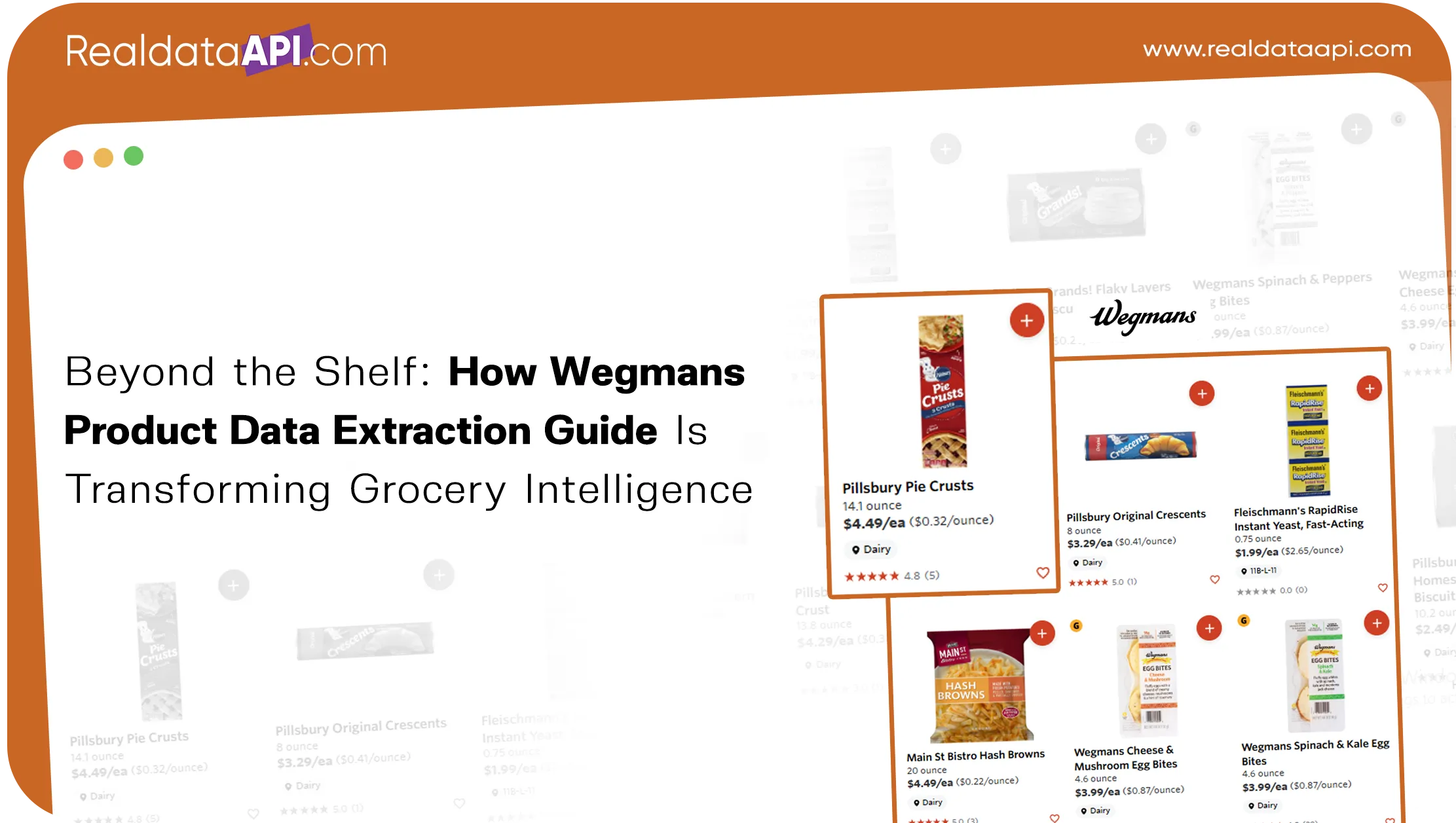
Introduction: The Grocery Data Revolution Is Already Here
Walk into any Wegmans store and you immediately notice the difference — meticulous product curation, detailed nutritional labeling, extensive private-label lines, and staff who actually know what they're selling. That same philosophy carries over to their digital presence. Wegmans.com and the Wegmans app host a remarkably detailed product catalogue spanning tens of thousands of SKUs across grocery, prepared foods, bakery, pharmacy, organic, and specialty departments.
For data professionals, CPG brands, retail analysts, and competitive intelligence teams, this detail is a goldmine.
Wegmans Product Data Extraction Guide means systematically collecting structured information from its digital catalogue — prices, nutritional data, ingredients, product descriptions, availability signals, and promotional mechanics — and transforming it into actionable intelligence. As grocery e-commerce accelerates and price transparency becomes a consumer expectation rather than a differentiator, the businesses that invest in this data infrastructure are pulling ahead of those still relying on manual shelf audits and quarterly reports.
This blog covers what Wegmans Foods Grocery Scraping API looks like in practice, how to think about extracting it at scale, the most valuable real-world use cases, and the platform best suited to power this kind of pipeline.
Why Wegmans? Understanding the Platform's Data Richness
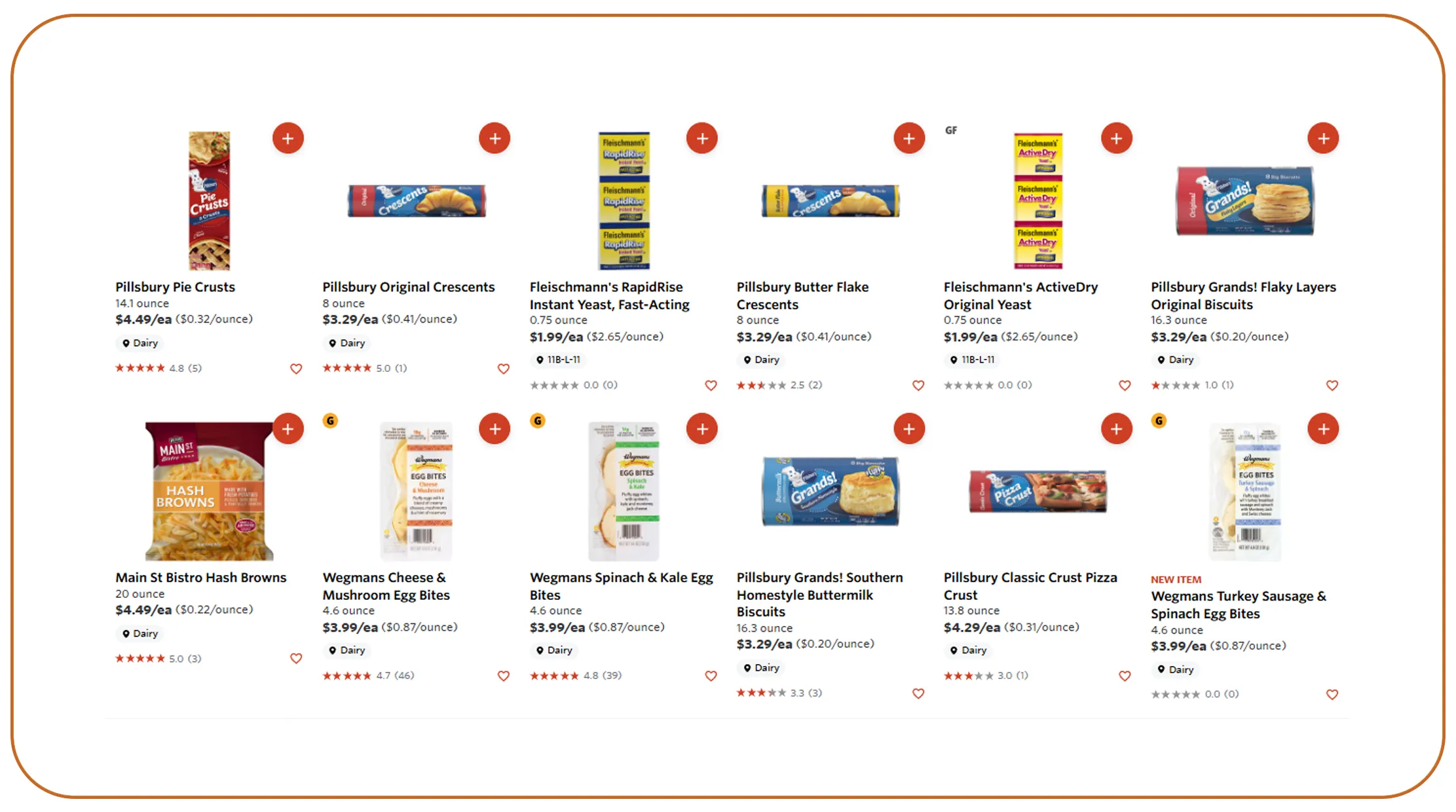
Web Scraping Wegman's Dataset across the Mid-Atlantic and Northeast United States — New York, Pennsylvania, New Jersey, Virginia, Maryland, Massachusetts, North Carolina, and Washington D.C. It consistently ranks among America's most admired grocery chains, frequently topping consumer satisfaction surveys ahead of Whole Foods, Trader Joe's, and Publix.
What makes Wegmans particularly valuable as a data source isn't just its brand prestige. It's the structural depth of the product data it publishes:
Nutritional Completeness — Wegmans product pages typically include full Nutrition Facts panels, not just calorie counts. Macronutrients, micronutrients, serving sizes, and daily value percentages are often available in machine-readable form, making Wegmans one of the most nutrition-data-rich grocery platforms in the country.
Ingredient Transparency — Detailed ingredient lists are published for the vast majority of packaged products, including Wegmans' extensive own-brand lines. This matters enormously for allergen tracking, dietary compliance tools, and formulation analysis.
Private Label Depth — Wegmans operates multiple private-label tiers: the standard Wegmans brand, Wegmans Organic, and various premium sub-lines. These products are often only available through Wegmans channels, making the platform the exclusive data source for this segment.
Category Structure — Wegmans organizes its catalogue with precise category taxonomies that reflect genuine merchandising logic — not just broad department labels, but subcategories (e.g., distinguishing between fresh pasta, dry pasta, gluten-free pasta, and refrigerated filled pasta).
Price and Promotional Data — Wegmans publishes both regular and club card pricing (Shoppers Club), making it possible to track effective net price — not just shelf price — across thousands of products.
The Core Data Fields Worth Extracting
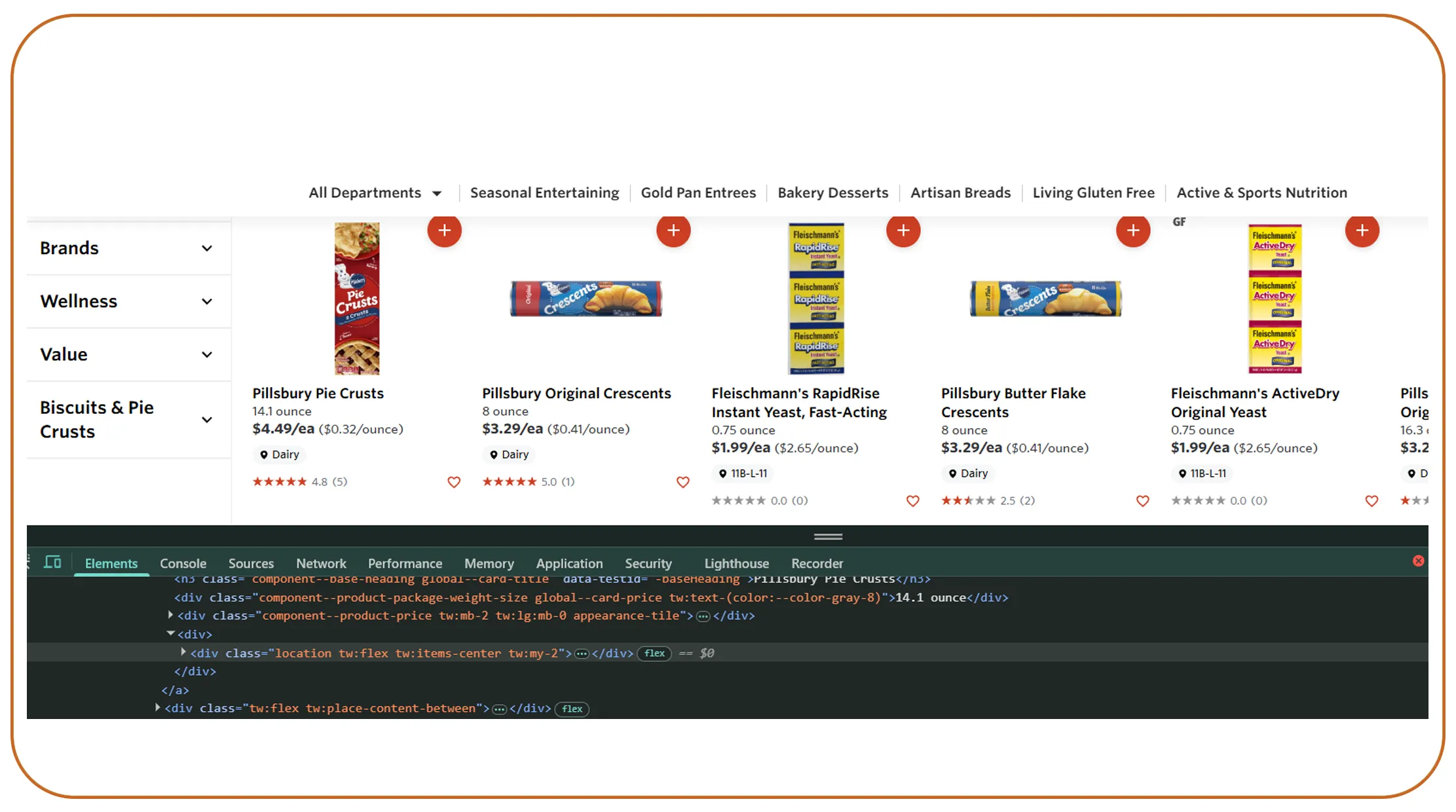
A well-structured Wegmans extraction pipeline captures the following data layers:
Product Identity Data
- Product name and brand
- SKU / item number
- UPC/barcode (where displayed)
- Category and subcategory path
- Product image URLs
Pricing Data
- Regular shelf price
- Shoppers Club price (discounted member price)
- Unit price (price per oz, per lb, per count)
- Promotional flags ("Buy 2 Save", "Weekly Sale", "Digital Coupon")
- Price effective date ranges where available
Nutritional and Ingredient Data
- Full Nutrition Facts (calories, fat, carbohydrates, protein, sodium, fiber, sugars, vitamins, minerals)
- Serving size and servings per container
- Full ingredient list
- Allergen declarations (contains/may contain)
- Dietary certifications (Kosher, Organic, Non-GMO, Gluten-Free, Vegan)
Availability and Fulfilment Data
- In-store availability by location
- Online ordering availability
- Pick-up vs. delivery eligibility
- Out-of-stock indicators
Content and Enrichment Data
- Product descriptions
- Usage suggestions and serving recommendations
- Country of origin
- Storage instructions
- Customer ratings (where available)
Use Cases: Who Extracts Wegmans Data and Why
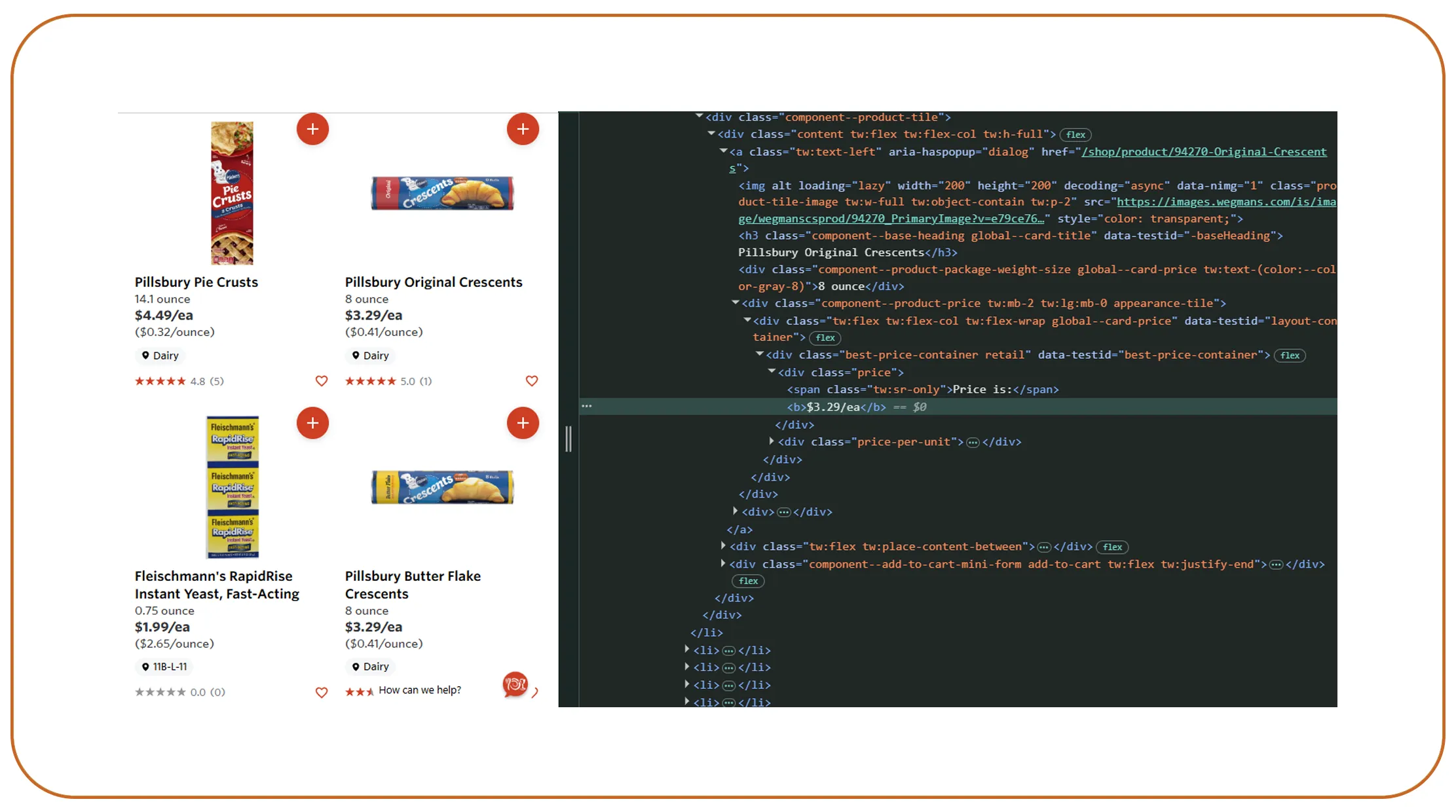
Use Case 1: CPG Brand Competitive Pricing Analysis
A mid-size natural foods brand distributing through Wegmans alongside competing regional and national brands uses Wegmans product data to track how its pricing compares to alternatives in the same subcategory. By extracting shelf prices and Shoppers Club prices across a defined competitive set — say, all organic Greek yogurt products — on a weekly basis, the brand's trade marketing team can see exactly when competitors run promotional events, how deep the discounts go, and how long promotions last.
This informs decisions about when to run their own promotions, whether to request changes to their Wegmans promotional calendar, and how to position their price relative to the premium and value ends of the shelf.
Without automated extraction, this analysis requires sending field sales reps to stores weekly — expensive, geographically limited, and inherently delayed.
Use Case 2: Nutritional Database Enrichment
A diet and nutrition app serving 2 million users needs comprehensive, accurate nutritional data for the specific products its users buy. Wegmans is the primary grocery store for a large portion of its Northeast user base. By extracting nutritional data from Wegmans product pages — including full micronutrient profiles and allergen declarations — the app can ensure that when a user scans a Wegmans-brand product barcode, they get complete, verified data instantly.
This is particularly important for Wegmans' private-label products, which aren't always listed in third-party nutritional databases like USDA FoodData Central or Open Food Facts. Wegmans.com is often the most complete and accurate source for this data.
Use Case 3: Private Label Benchmarking for Retail Buyers
A regional grocery chain developing its own private-label product line in the pasta and sauce category wants to understand how Wegmans has structured its private-label offerings: price tiers, packaging sizes, ingredient positioning (e.g., "no artificial colors," "made with semolina"), and the gap between its standard and organic lines.
Systematic extraction of Wegmans' own-brand pasta and sauce products — capturing product name, price, ingredients, certifications, and packaging size — provides a detailed competitive blueprint for new product development without any primary research fieldwork.
Use Case 4: Retail Availability and Distribution Monitoring
A specialty beverage brand distributing through Wegmans wants to ensure its products are properly listed online, not accidentally removed from the digital catalogue, and correctly priced across all relevant categories. Rather than manually checking every week, the brand's account manager sets up an automated extraction pipeline that monitors its specific SKUs daily, alerting the team if a product goes out of stock online, if the price changes unexpectedly, or if the listing is altered in any way.
This kind of distribution monitoring is standard practice in large CPG companies but is now accessible to mid-size and emerging brands through data extraction tools.
Use Case 5: Allergen and Dietary Compliance Tracking
A corporate catering company serving clients with diverse dietary restrictions uses Wegmans as its primary procurement source. Its operations team needs to quickly verify that ingredients being purchased meet specific dietary profiles — gluten-free, nut-free, halal, or low-sodium.
By maintaining an extracted and regularly refreshed database of Wegmans product ingredient lists and allergen statements, the catering team can run dietary compliance checks in seconds rather than cross-referencing individual product pages manually. When Wegmans updates a product formula (which happens more often than most consumers realize), the extraction pipeline detects the change and flags it for review.
Use Case 6: E-Commerce Price Elasticity Research
An academic research team studying Grocery Delivery Dashboard and consumer response to promotions in the Northeast U.S. market uses Wegmans price data as a longitudinal dataset. By extracting prices and promotional flags across hundreds of products in five categories — dairy, produce, packaged snacks, beverages, and personal care — over a twelve-month period, the team builds a time-series dataset capable of measuring how Wegmans positions promotions across categories, how frequently different product tiers go on sale, and how Shoppers Club pricing compares to standard shelf prices.
This kind of research was previously only possible through expensive proprietary data partnerships. Systematic extraction opens it to a much broader set of researchers and analysts.
Use Case 7: Supply Chain and Out-of-Stock Intelligence
A consumer packaged goods company monitoring retail shelf availability across multiple grocery chains includes Wegmans in its out-of-stock tracking program. By extracting availability status across its product portfolio daily, the brand's supply chain team can detect emerging stock issues before they escalate — identifying whether an out-of-stock is isolated to the digital listing or reflects genuine physical inventory shortfalls, and prioritizing replenishment or reorder actions accordingly.
Challenges in Extracting Wegmans Product Data
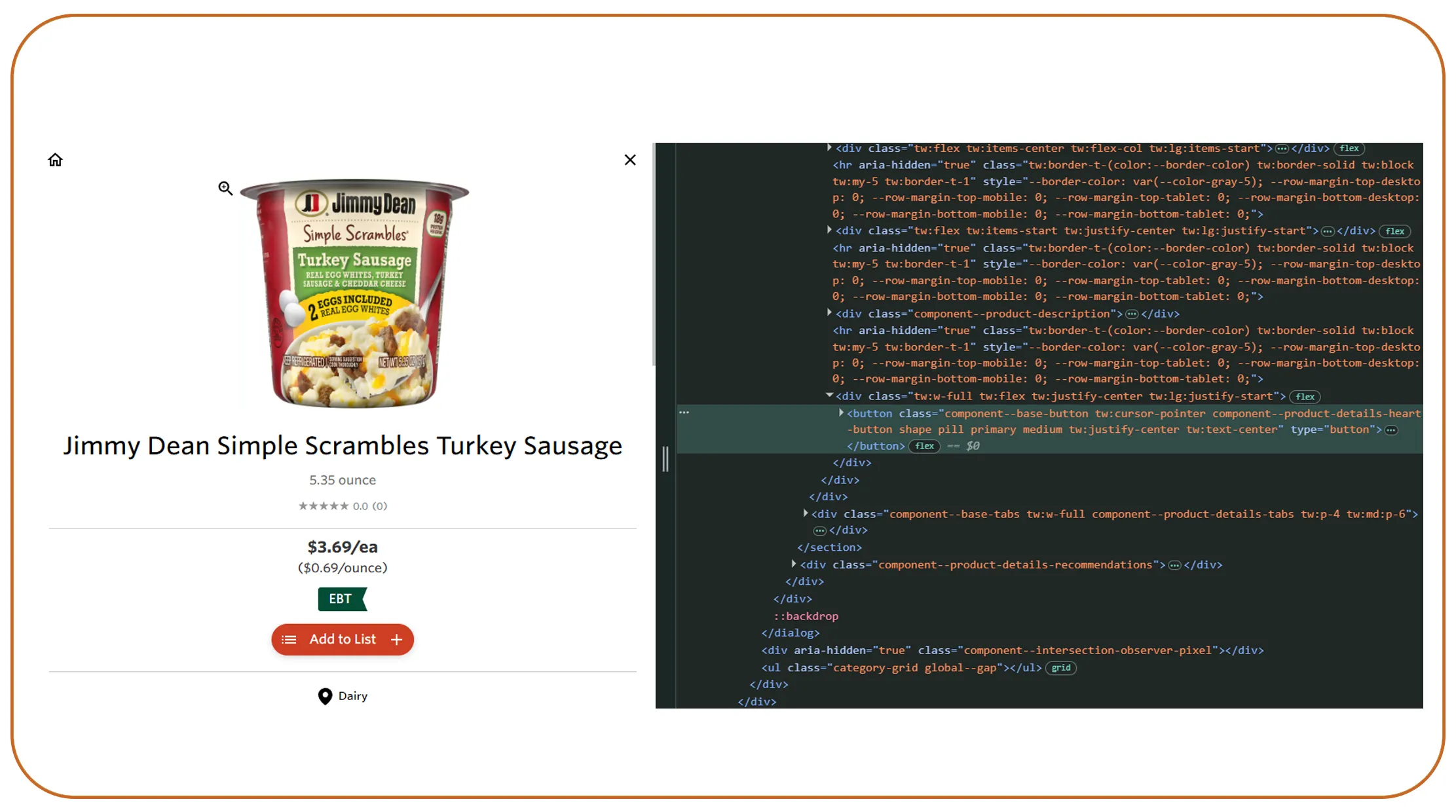
Like most major retailers, Wegmans presents technical and operational challenges for large-scale data extraction:
Dynamic Content Rendering — Product pages load significant content via JavaScript, meaning basic HTML parsing misses key data fields. Extraction pipelines must execute JavaScript and handle client-side rendering reliably.
Store-Specific Pricing — Wegmans prices can vary by store location. A product priced at $4.99 in a Pittsford, NY store may differ from a Chantilly, VA location. Comprehensive extraction accounts for geographic price variation by cycling through multiple store contexts.
Login-Gated Features — Some Wegmans data, particularly Shoppers Club pricing and digital coupon availability, may be partially gated behind user authentication. Ethical data extraction strategies must handle this appropriately within platform terms of service.
Nutritional Data Formatting Inconsistency — While Wegmans publishes detailed nutritional information, formatting varies across product types (packaged vs. prepared foods vs. fresh items), requiring flexible parsing logic to handle heterogeneous data structures.
Frequent Catalogue Updates — Wegmans actively manages its product catalogue, adding seasonal items, reformulating products, and retiring SKUs. A production-grade extraction pipeline must handle these changes gracefully without breaking on new or altered page structures.
Building a Wegmans Data Pipeline: Key Design Principles
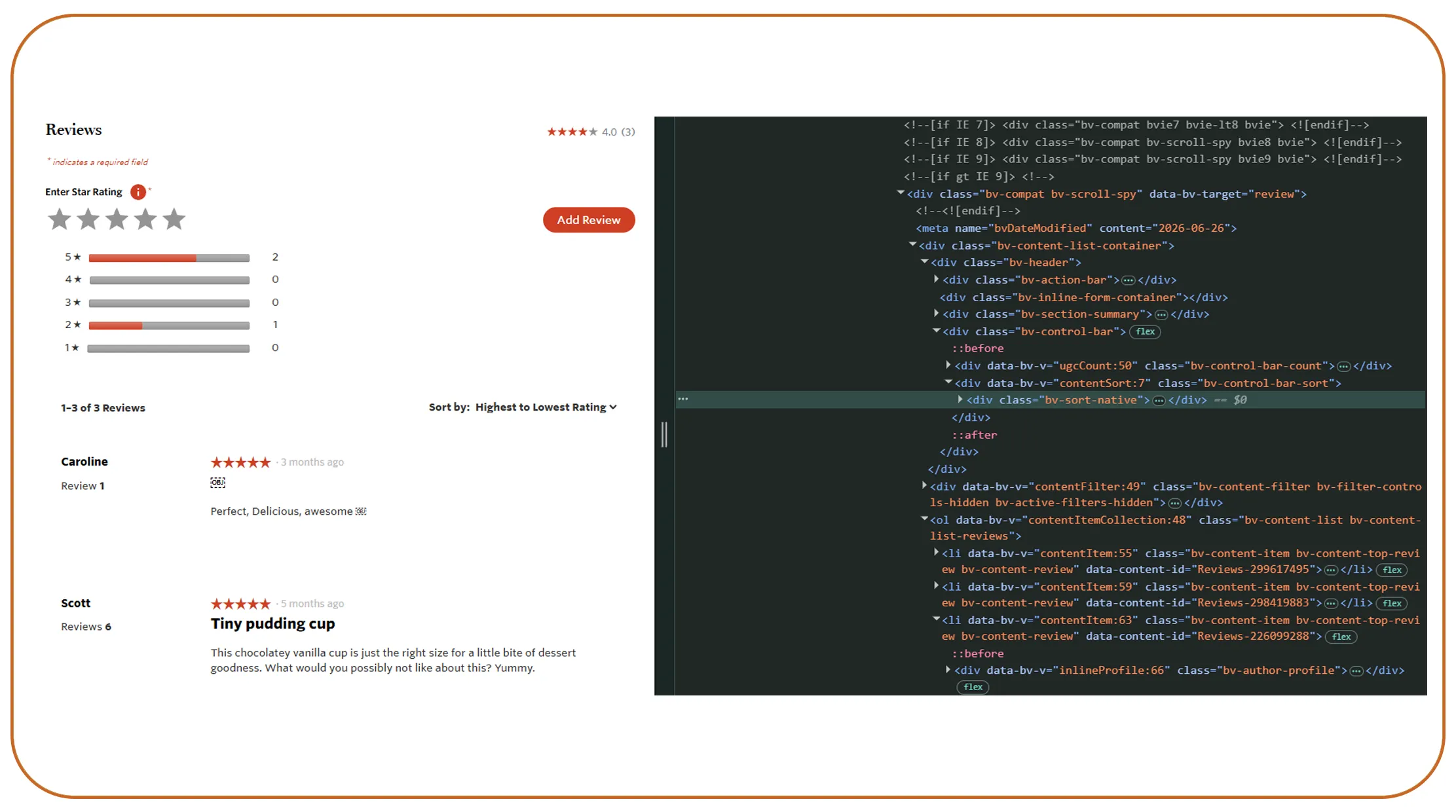
Whether building in-house or using a managed data provider, a reliable Wegmans Grocery Data Scraping API extraction pipeline should follow these principles:
Schema-first design — Define the target data schema before writing any extraction logic. Knowing which fields you need and in what format prevents the common mistake of collecting everything and normalizing nothing.
Incremental and delta-aware — Rather than re-extracting the full catalogue daily, a well-designed pipeline tracks changes and only reprocesses products where data has changed, reducing resource consumption and improving data freshness.
Nutrition data validation — Nutritional values should be validated against known ranges (e.g., calories can't be negative, protein can't exceed total weight) to catch extraction errors before they propagate downstream.
Price history retention — Price data is only valuable longitudinally. Store every extraction run with timestamps so analysts can query price history, not just current price.
Alerting on structural changes — When Wegmans updates its site structure, extraction pipelines can silently fail or return partial data. Monitoring for structural anomalies — unexpected null fields, sudden drop in extracted record count — prevents bad data from entering downstream systems undetected.
Conclusion: Real Data API — Your Gateway to Wegmans Product Intelligence
Wegmans product data is among the most structured, detailed, and analytically valuable grocery datasets available in the American retail landscape. From full nutritional panels and ingredient transparency to real-time pricing and promotional mechanics, the intelligence embedded in Wegmans' digital catalogue touches every function in the CPG and grocery value chain — pricing, product development, compliance, supply chain, and consumer research.
For teams ready to operationalize this intelligence without building and maintaining extraction infrastructure from scratch, Real Data API delivers production-grade Wegmans product data as a clean, structured, continuously refreshed feed.
Real Data API handles the full extraction and normalization pipeline — product identity, pricing (including Shoppers Club), nutritional facts, ingredients, allergen declarations, availability signals, and promotional flags — and delivers it via a single API endpoint ready for integration into your analytics platform, pricing engine, product database, or compliance tool.
Whether you're a CPG brand tracking your competitive shelf position, a nutrition app enriching its food database, a retail buyer benchmarking private-label strategy, or a supply chain team monitoring product availability, Real Data API gives you the Wegmans data you need, at the frequency you need it, without the engineering overhead.
The grocery industry runs on data. The brands and businesses that collect it systematically, refresh it consistently, and act on it quickly are the ones defining the next era of retail intelligence.
Real Data API is where that advantage starts.
Latest posts
Why Brands Use Competitive Data Intelligence to Increase Market Share in Highly Competitive Markets?
How To Scrape Competitor Data To Support Market Entry Strategy And Expansion Planning For Data-Driven Business Growth?
How Hotel Occupancy Intelligence Through Public Data Sources Is Reshaping Revenue Management
The ZIP Code Advantage: How Hyper-Local Amazon Product Data Collection Is Redefining Retail Intelligence

Real Data API stands out as one of the premier global companies specializing in web data Scraping and web extraction.





.png)


Rating 4.7
Rating 4.7
Rating 4.5
Rating 4.7
Rating 4.7


Disclaimer : RealData API functions solely as an independent data infrastructure and technology solutions provider. We build customized automation workflows designed to collect publicly accessible web data based exclusively on client instructions. RealData API neither owns proprietary datasets nor engages in the sale or redistribution of extracted information. Our operations are limited strictly to lawful public web data processing and never involve unauthorized access to restricted systems or private networks. Any company names, trademarks, logos, or brand references displayed on this website are used purely for demonstrative and illustrative purposes to showcase our technical capabilities and do not imply endorsement, partnership, or affiliation. Use of our platform and services remains subject to our Terms of Service.