Quick Summary
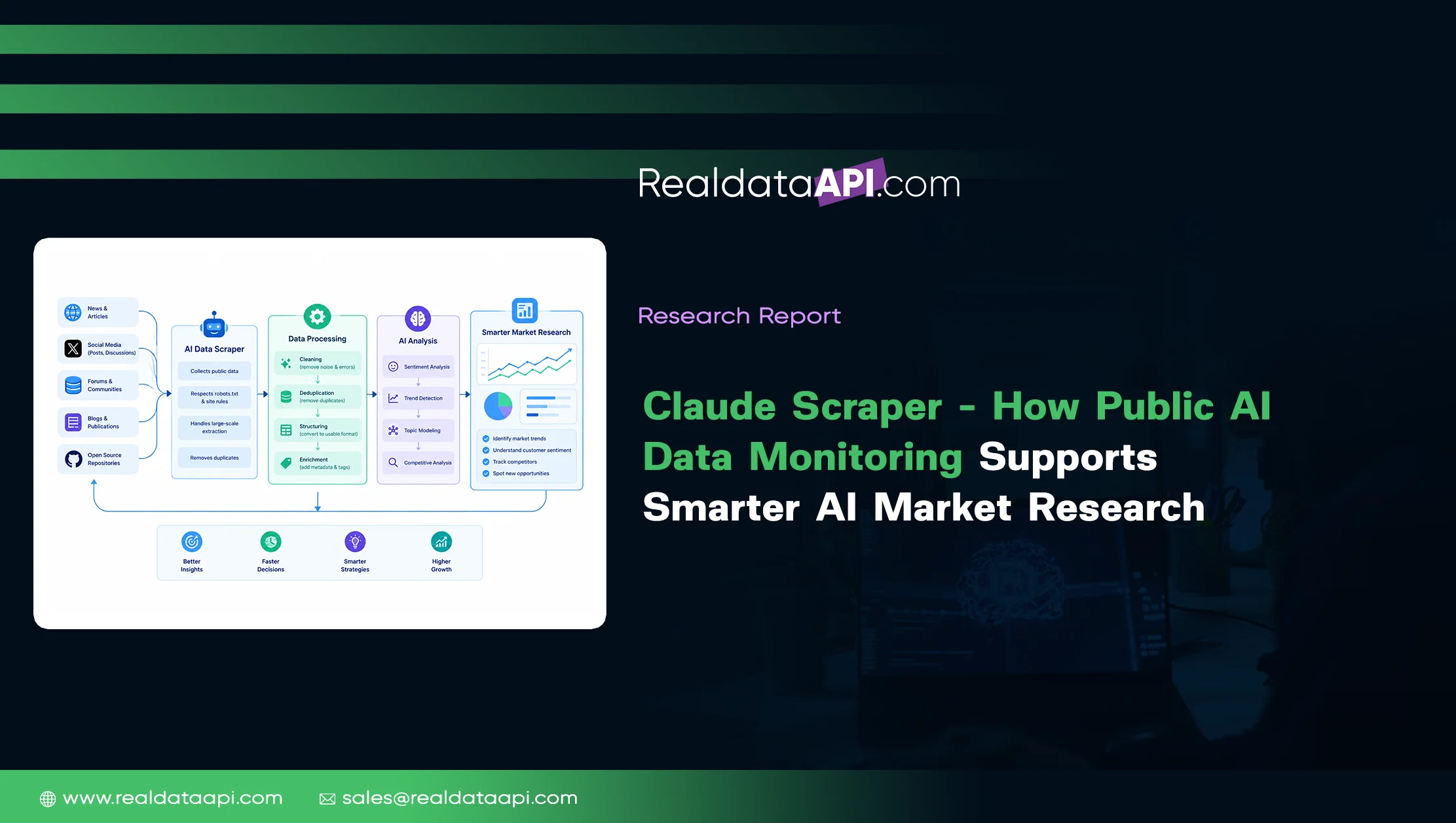
- Claude Scraper can help businesses organize publicly available AI information for market research, competitive analysis, and technology monitoring.
- Claude Web Scraping can support recurring collection of accessible public information, helping researchers identify content patterns, emerging use cases, and changes in the AI landscape.
Introduction
Artificial intelligence has moved from an emerging technology category into a rapidly evolving business ecosystem where model capabilities, applications, user behavior, and developer adoption change continuously. For companies conducting AI market research, relying on occasional manual research can make it difficult to identify meaningful changes across a large volume of public information. Claude Scraper provides a structured approach for collecting publicly accessible information relevant to AI research, provided the collection process respects applicable website terms, privacy requirements, and access restrictions. Claude Web Scraping can be used as part of a broader data pipeline to organize public-facing information into datasets that researchers can analyze over time. Anthropic itself publishes research based on aggregated Claude usage, including an Economic Index designed to understand how people use AI across work and other contexts. Its June 2026 report also describes increasingly granular analysis of Claude.ai, Cowork, Claude Code, and first-party API activity. (Anthropic)
Building a Structured Foundation for AI Intelligence

The growing volume of AI-related information makes structured collection increasingly valuable for researchers, technology companies, investors, and consulting organizations. Claude web scraping for AI data can help organize publicly accessible information into standardized fields for longitudinal analysis. Instead of examining individual pages repeatedly, researchers can build datasets around topics such as publicly presented capabilities, product descriptions, documentation changes, use cases, model announcements, and other accessible information.
| Year | AI Data Research Development | Research Implication |
|---|---|---|
| 2020 | AI adoption accelerated across digital businesses | Greater demand for structured technology intelligence |
| 2021 | NLP and conversational AI gained wider attention | More public AI information became available |
| 2022 | Generative AI entered mainstream discussion | AI market research expanded rapidly |
| 2023 | Generative AI products proliferated | Competitive monitoring became more important |
| 2024 | AI agents and multimodal systems expanded | Researchers tracked more capability dimensions |
| 2025 | Enterprise AI adoption matured | Data-driven benchmarking gained importance |
| 2026 | Agentic workflows and AI ecosystems continued expanding | Recurring AI intelligence became increasingly valuable |
The 2020–2026 period illustrates why AI research cannot depend solely on static reports. Model capabilities, applications, developer ecosystems, and user behavior have changed quickly. Anthropic's own Economic Index shows how detailed AI usage research has become, including analysis of task types, automation versus augmentation, industries, countries, and API activity. Its November 2025 research found that the ten most common tasks represented 24% of Claude.ai usage, while the top ten tasks represented 32% of first-party API enterprise traffic. (Anthropic)
For businesses, a structured public-data pipeline can therefore complement traditional market research by providing refreshed information that can be normalized, compared, and analyzed across time.
Turning Public Information Into Comparable Research Data
The usefulness of public AI information increases when researchers can transform dispersed information into structured records. Businesses seeking to extract Claude public data can design datasets around clearly defined research objectives rather than collecting information indiscriminately. Depending on the publicly accessible source, fields may include page titles, descriptions, categories, feature information, publication dates, product references, publicly stated use cases, and other non-sensitive information.
| Year | Data Collection Focus | Potential Business Use |
|---|---|---|
| 2020 | AI product and research information | Baseline market mapping |
| 2021 | NLP applications and developer tools | Technology comparison |
| 2022 | Generative AI developments | Emerging-market research |
| 2023 | LLM products and applications | Competitive intelligence |
| 2024 | Multimodal and enterprise AI | Product benchmarking |
| 2025 | Agentic AI and coding workflows | Adoption analysis |
| 2026 | AI agents, APIs, and workflow automation | Strategic market intelligence |
The transition from simple web pages to structured datasets is particularly important because AI markets contain fast-changing information. A historical snapshot can help identify when a feature appeared, how a product category evolved, or which use cases became more prominent. However, researchers should distinguish between publicly accessible information and private or user-generated information that may carry additional privacy or contractual restrictions.
Anthropic's 2026 research demonstrates the value of systematic AI usage analysis. Its March Economic Index examined Claude usage during February 2026, while its June report expanded analysis across Claude.ai, Cowork, Claude Code, and first-party API traffic. (Anthropic) This demonstrates a broader market trend: AI intelligence increasingly depends on longitudinal datasets rather than isolated observations.
For research teams, properly structured public information can support dashboards, competitive reports, trend studies, and historical comparisons while reducing repetitive manual collection.
Measuring How AI Markets Change Over Time

AI markets are highly dynamic, making trend identification one of the most important applications of structured data. Claude AI trend data extraction can help researchers build time-series datasets around publicly available information and evaluate how AI capabilities, use cases, products, and developer interests evolve.
| Year | Major Research Theme | Data Opportunity |
|---|---|---|
| 2020 | Conversational AI | Track foundational AI applications |
| 2021 | Language-model experimentation | Monitor NLP use cases |
| 2022 | Generative AI emergence | Benchmark new AI categories |
| 2023 | LLM adoption | Track products and applications |
| 2024 | Enterprise AI | Compare business use cases |
| 2025 | AI agents and coding | Monitor workflow automation |
| 2026 | Agentic and integrated AI | Study broader AI ecosystems |
Trend analysis becomes more valuable when datasets are collected consistently. Researchers can compare records across months or years, identify recurring topics, measure the frequency of publicly presented use cases, and examine how product positioning changes. This can support strategic planning for AI vendors, software companies, investors, agencies, and research organizations.
Anthropic's research provides an example of the depth possible through longitudinal analysis. The November 2025 Economic Index examined more than 3,000 unique work tasks in Claude.ai, with the ten most common accounting for 24% of sampled conversations. The research also found that augmented use represented 52% of Claude.ai conversations in that period, compared with 45% classified as automated. (Anthropic)
These findings illustrate why AI market research benefits from structured datasets capable of capturing changes over time. Rather than treating AI as a static technology category, organizations can monitor its evolving applications and identify areas where adoption, competition, or user behavior appears to be shifting.
Creating Scalable Collection Workflows
As AI research requirements grow, organizations need collection processes that can operate consistently and integrate with analytics systems. A Claude API for data collection can be relevant when an organization needs programmatic interaction with Anthropic's API for its own permitted applications or workflows. Anthropic provides an API platform with usage-based access, model options, developer documentation, and usage reporting. (Anthropic)
| Year | Workflow Priority | Business Requirement |
|---|---|---|
| 2020 | Manual collection | Basic research |
| 2021 | Semi-automated processes | Faster data gathering |
| 2022 | Structured extraction | Consistent datasets |
| 2023 | API-based workflows | Application integration |
| 2024 | Automated pipelines | Recurring collection |
| 2025 | AI-assisted analytics | Faster interpretation |
| 2026 | Integrated intelligence | Continuous market monitoring |
It is important to distinguish between collecting publicly available website information and using an official API. An API is appropriate where an organization has authorized access and wants structured programmatic interaction. Anthropic's documentation states that organizations can create an API Console account, configure API access, and manage usage through the Console. (Claude Help Center)
A scalable workflow can combine permitted public-data collection with APIs, databases, validation layers, and analytics systems. This architecture makes it easier to refresh datasets, detect changes, maintain historical records, and deliver information to dashboards or research applications.
For enterprise teams, scalability also means managing data quality. Deduplication, field normalization, timestamping, validation, and change detection can improve the reliability of AI market datasets and reduce the risk of making strategic decisions based on outdated or inconsistent information.
Improving Monitoring, Benchmarking, and Competitive Research
A dedicated Claude Scraper workflow can help research teams establish repeatable monitoring around publicly accessible information. The primary value is not simply collecting more data; it is creating a structured process through which information can be refreshed, validated, compared, and interpreted.
| Year | Monitoring Priority | Strategic Value |
|---|---|---|
| 2020 | AI category tracking | Market baseline |
| 2021 | NLP developments | Capability benchmarking |
| 2022 | Generative AI | Opportunity identification |
| 2023 | LLM competition | Competitive intelligence |
| 2024 | Enterprise applications | Industry benchmarking |
| 2025 | Agentic workflows | Adoption monitoring |
| 2026 | AI ecosystem development | Strategic forecasting |
A recurring monitoring process can help identify changes in public product descriptions, research topics, developer resources, feature announcements, and other accessible information. Researchers can then compare current records with historical datasets to determine what has changed and when.
The need for this kind of intelligence is reinforced by the growing sophistication of AI usage research. Anthropic's Economic Index now includes country-level, industry-level, use-case, and augmentation-versus-automation analysis. Its June 2026 version also introduced higher-rate sampling and more granular monthly analysis of first-party API activity. (Anthropic)
For organizations conducting competitive research, the objective should be to create a reliable evidence base rather than simply accumulate raw pages. Structured records make it easier to produce market reports, benchmark competitors, identify emerging themes, and support strategic decisions. Collection should always remain limited to information that can be accessed and processed lawfully and in accordance with applicable terms.
Connecting AI Research With Broader Market Intelligence
The AI market increasingly overlaps with software development, customer service, education, productivity, media, finance, and professional services. This makes AI intelligence relevant beyond technology companies. An AI Chatbot is one example of an application category that researchers may monitor when evaluating how conversational AI is being incorporated into products and workflows.
| Year | Application Direction | Market Research Opportunity |
|---|---|---|
| 2020 | Conversational assistants | Early adoption analysis |
| 2021 | Customer-support automation | Enterprise use-case research |
| 2022 | Generative AI assistants | Market expansion tracking |
| 2023 | AI chatbot platforms | Competitive benchmarking |
| 2024 | Multimodal assistants | Capability comparison |
| 2025 | Agentic assistants | Workflow analysis |
| 2026 | Integrated AI agents | Ecosystem and adoption research |
The evolution from basic conversational interfaces toward more sophisticated AI systems creates a larger research landscape. Companies can examine how AI applications are positioned, which industries are adopting them, and which capabilities appear repeatedly across the market.
Anthropic's 2026 Economic Index highlights this diversification. Its research tracks AI usage across work, personal, and coursework contexts and identifies industries with substantial Claude usage. The company also reported that India accounted for 5.8% of Claude.ai use in its November 2025 dataset, making it the second-largest country by share in that analysis. (Anthropic)
For market researchers, combining public product intelligence with broader AI adoption indicators can provide a more complete view of the ecosystem. This can support investment research, technology benchmarking, product strategy, content planning, and competitive analysis.
Turn continuously changing AI information into structured market intelligence with a scalable data collection strategy!
Why Choose Real Data API?
Real Data API helps organizations convert complex web data requirements into structured, analytics-ready datasets. Its Web Scraping Services can support recurring data collection, extraction, normalization, validation, and delivery across diverse business research requirements. For AI market research, this approach can help organizations establish repeatable workflows rather than relying on manual browsing and spreadsheet-based collection.
A well-designed data pipeline can combine source discovery, permitted extraction, data validation, deduplication, historical storage, and structured delivery. This makes datasets easier to integrate with dashboards, research platforms, business intelligence tools, and internal analytics systems.
Real Data API can also design workflows around specific fields and collection frequencies. This allows organizations to focus on the information that directly supports their research objectives instead of collecting unnecessary data. Where APIs or authorized data sources are available, they can also be incorporated into broader data architectures.
The result is a scalable research foundation that can support competitive intelligence, market monitoring, trend analysis, and strategic planning as AI markets continue to evolve.
Conclusion
AI market research increasingly requires continuous observation because products, capabilities, applications, and adoption patterns change rapidly. Structured public-data monitoring can help businesses move beyond one-time research toward repeatable intelligence workflows. A properly designed Claude Scraper solution can organize permitted publicly available information into datasets that support benchmarking, trend analysis, competitive research, and strategic planning.
From 2020 through 2026, the AI ecosystem has progressed from expanding NLP applications to widespread generative AI, enterprise adoption, coding assistants, and increasingly agentic workflows. Anthropic's own research illustrates the growing sophistication of AI measurement, with analysis now covering thousands of work tasks, geographic differences, industries, API traffic, and changing automation patterns. (Anthropic)
For businesses, the opportunity is to build reliable data pipelines that continuously capture relevant market signals while respecting access permissions, privacy, and applicable terms. With structured datasets and consistent monitoring, organizations can make AI research more measurable, comparable, and actionable.
Partner with Real Data API to build scalable AI market data pipelines and turn public information into actionable business intelligence!
FAQs
1. What is Claude Scraper used for?
Claude Scraper can support collection of permitted public information for AI research, helping organizations organize content, monitor changes, compare trends, and build structured datasets for market intelligence.
2. How does Claude Web Scraping support research?
Claude Web Scraping can organize publicly accessible information into structured datasets, enabling researchers to compare developments over time and identify relevant AI market trends more efficiently.
3. What can Claude web scraping for AI data provide?
Claude web scraping for AI data can support structured collection of publicly available product information, research topics, capabilities, use cases, and other accessible fields for analytical workflows.
4. Why extract Claude public data?
Businesses can extract Claude public data to build historical datasets, monitor publicly visible changes, conduct competitive research, and support AI market analysis using structured information.
5. What is Claude AI trend data extraction?
Claude AI trend data extraction focuses on collecting and organizing permitted public information over time so researchers can identify emerging themes, changing capabilities, market movements, and adoption patterns.
Real Data API can help design scalable collection workflows around these requirements while maintaining structured, analytics-ready outputs.
Latest posts
E-commerce data scraper for inventory analysis 2027 - Real-Time Stock Tracking and Demand Forecasting

How Meesho API data extraction for product research Helps E-Commerce Brands Improve Product Selection and Market Intelligence?
How AliExpress API integration for automated data collection Streamlines Product Monitoring, Price Tracking, and Seller Intelligence

How H&M data scraping for fashion retail analytics Enhances Stock Monitoring, Apparel Pricing, and Product Category Insights






.png)