

Quick Summary
- Prom.ua scraper helps businesses turn large volumes of marketplace listings into structured product, pricing, seller, availability, and category intelligence for faster decisions.
- Prom.ua Product Data Scraping supports competitive benchmarking, assortment monitoring, price tracking, seller analysis, and recurring marketplace research across large catalogs.
- The approach helps e-commerce teams replace manual monitoring with repeatable datasets that can feed dashboards, alerts, pricing models, and market intelligence workflows.
Introduction
Prom.ua scraper helps businesses collect structured marketplace information when manual monitoring becomes too slow, inconsistent, or difficult to scale. Prom.ua describes itself as Ukraine's largest marketplace, with more than 120 million products, 60,000 entrepreneurs, and 6 million regular buyers as of 2026. (Prom.ua)
For brands, retailers, distributors, pricing teams, and marketplace analysts, this scale creates a practical visibility challenge. Thousands of sellers can list similar products while prices, discounts, stock conditions, ratings, and product content change over time. Prom.ua Product Data Scraping can convert these marketplace changes into structured records that businesses can compare and analyze.
The core objective is not simply to collect more data. It is to create a reliable view of what products are being offered, how they are positioned, what prices competitors are using, which sellers are gaining visibility, and where assortment gaps exist.
For example, a consumer electronics brand can monitor competing SKUs, compare seller prices, identify recurring promotions, and detect changes in availability. A distributor can analyze category depth and seller coverage before expanding its assortment. A pricing team can use historical observations to distinguish normal fluctuations from meaningful competitive moves.
The result is a marketplace intelligence layer that supports faster commercial decisions without depending on manual spreadsheet research.
How Can Businesses Build a Reliable Marketplace Product Dataset?
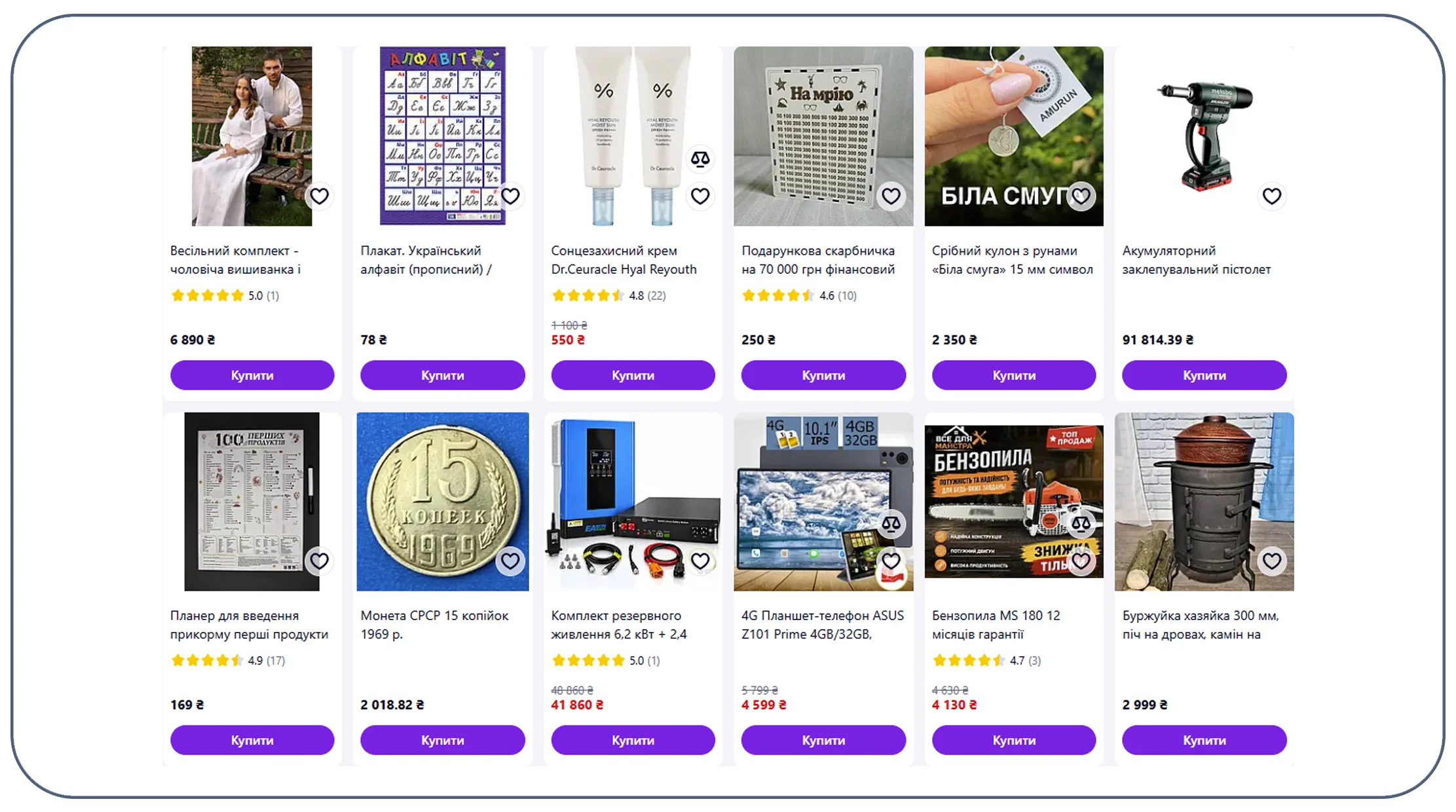
Prom.ua marketplace data extraction becomes valuable when companies need a consistent view of products across categories, sellers, and listing conditions. Instead of checking individual pages manually, organizations can establish recurring collection workflows around defined categories, product URLs, search terms, or seller pages.
A useful dataset can include product title, product ID or SKU where available, category, brand, seller, current price, old price, discount, availability, rating, review count, product URL, images, specifications, and collection timestamp.
Prom's own marketplace information highlights the breadth of its catalog, while its seller documentation explains that products can be viewed through product listings, categories, searches, and seller pages. (Prom.ua)
| Data field | Business use |
|---|---|
| Product name | Catalog matching |
| Brand | Brand-level analysis |
| SKU/product ID | Product identification |
| Category | Assortment analysis |
| Seller | Seller benchmarking |
| Current price | Price comparison |
| Discount/old price | Promotion analysis |
| Availability | Stock visibility |
| Rating | Seller/product quality signal |
| Review count | Customer engagement |
| Product URL | Record traceability |
| Timestamp | Historical comparison |
A strong workflow should also normalize currency, units, category names, seller names, and product identifiers. Deduplication is important because the same product can appear across multiple seller listings.
2020–2026 Market Evolution
From 2020 onward, marketplace intelligence has increasingly moved from occasional research toward recurring monitoring. During the early 2020s, businesses often relied on periodic competitive checks because catalog sizes were easier to manage manually. As online assortments expanded, the operational burden increased.
By 2026, Prom reports more than 120 million products and 60,000 entrepreneurs, illustrating why scale matters for data operations. (Prom.ua)
The practical shift is from collecting isolated product records to maintaining historical datasets. Teams can compare today's observation with previous observations and identify changes instead of simply storing the latest value.
For decision-makers, this means product intelligence becomes a time-series capability. The dataset can answer not only "What is listed?" but also "What changed, when did it change, and how frequently does it change?"
What Product Attributes Should Companies Track for Competitive Intelligence?
extract Prom.ua product information workflows should be designed around the commercial questions the dataset needs to answer. Collecting every visible field without a clear analytical purpose can increase processing costs while making the final dataset harder to use.
For product intelligence, companies generally need a combination of identity, commercial, seller, availability, and customer-feedback attributes.
Product identity fields establish whether two marketplace listings represent the same product. Commercial fields help pricing teams compare offers. Seller information helps identify competitive concentration. Availability fields reveal whether products remain purchasable. Ratings and reviews can provide additional signals about customer perception.
Prom states that product and seller reviews are available on the platform, while sellers have dedicated pages containing their products and related information. (Prom.ua)
| Attribute group | Examples | Primary decision |
|---|---|---|
| Identity | SKU, product ID, model | Product matching |
| Catalog | Title, category, specifications | Assortment intelligence |
| Commercial | Price, discount, previous price | Pricing strategy |
| Seller | Seller name, profile, rating | Competitor analysis |
| Availability | In stock, unavailable | Supply visibility |
| Reviews | Rating, review count | Customer perception |
| Content | Images, descriptions | Catalog quality |
| Location | Market or regional information | Regional analysis |
For brands, normalized product attributes also support assortment-gap analysis. If a competitor repeatedly lists products that a brand does not carry, the difference can become a signal for category expansion.
For retailers, historical product information can support category reviews. Analysts can identify which brands are frequently represented, which price bands have dense competition, and which products experience recurring availability changes.
2020–2026 Market Evolution
The 2020–2026 period has seen marketplace analysis become increasingly attribute-driven. Earlier competitive research often concentrated on product names and headline prices. More advanced workflows now combine price, seller, availability, ratings, reviews, specifications, and promotional signals.
This matters because a low price does not automatically represent the strongest competitive offer. A product with a lower price but poor availability may have less commercial significance than a slightly more expensive product that remains consistently available.
Likewise, a product with thousands of reviews may carry a different competitive weight from a newly listed product with limited customer history.
The analytical opportunity is therefore to create a multi-dimensional product record rather than a simple price list. That record can support ranking models, category intelligence, seller benchmarking, and automated alerts.
How Can Product-Level Monitoring Improve Assortment and Market Intelligence?
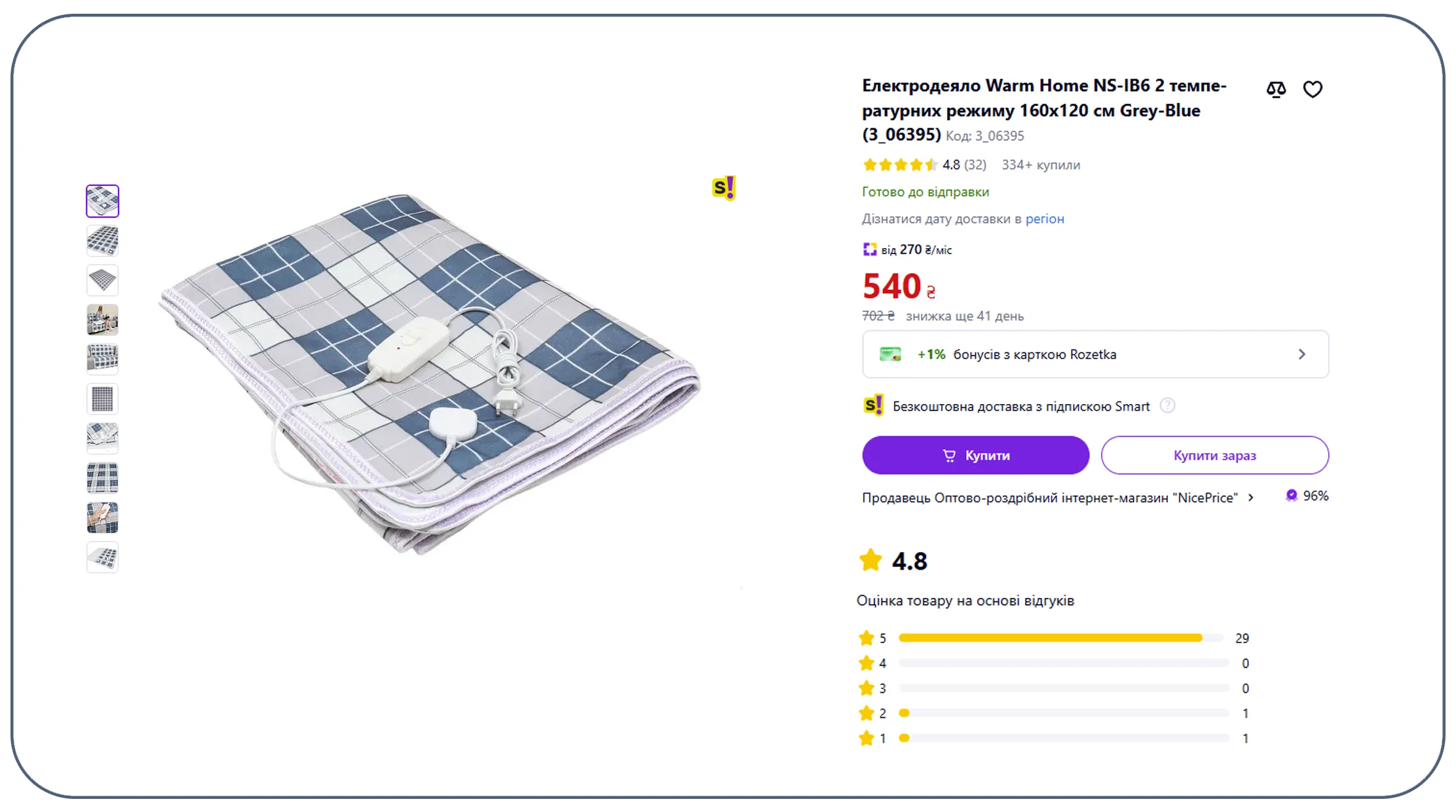
scrape Prom.ua product data programs can help businesses understand marketplace assortment at a level that manual research rarely supports efficiently. The objective is to establish repeatable observations across defined categories and then compare those observations over time.
Consider a retailer monitoring 5,000 relevant products. A manual team might capture selected prices once per week. A structured workflow can instead maintain a broader historical dataset and record changes according to a defined schedule.
The business value comes from comparison.
For example, an assortment team could calculate:
- Number of competing brands per category
- Number of sellers per product
- Median and minimum observed price
- Discount frequency
- Availability rate
- New product additions
- Products disappearing from listings
- Average review volume
- Seller concentration
- Category-level price dispersion
| KPI | Example calculation | Business question |
|---|---|---|
| Price index | Brand price ÷ market median | Are we competitively priced? |
| Seller count | Unique sellers per product | How crowded is the listing? |
| Availability rate | Available observations ÷ total observations | How consistently is supply visible? |
| Discount frequency | Discounted observations ÷ total observations | How promotional is the market? |
| Assortment overlap | Shared products ÷ competitor products | Where do we compete directly? |
| New listing rate | New products per period | How quickly is assortment changing? |
The important principle is to preserve historical observations. A current snapshot shows the market at one moment; a time series shows market behavior.
2020–2026 Market Evolution
Between 2020 and 2026, e-commerce assortment analysis has shifted toward continuous observation. Marketplaces now contain extensive product catalogs and multiple sellers, making one-time competitive studies less representative of actual market behavior.
Prom's current public information lists more than 120 million products and 60,000 entrepreneurs, reinforcing the scale at which marketplace analysis may operate. (Prom.ua)
For businesses, the implication is straightforward: product intelligence should be designed as an ongoing data pipeline rather than a one-off research project.
A recurring dataset can identify product launches, assortment changes, price movements, and seller changes before these signals become obvious in manual reviews.
Build a scalable marketplace monitoring workflow that converts Prom.ua listings into structured, decision-ready intelligence!
Get Insights Now!How Can Businesses Monitor Marketplace Prices More Effectively?
Prom.ua data price monitoring helps pricing teams move beyond occasional competitor checks toward systematic price intelligence. The central objective is to observe comparable products at defined intervals and preserve each observation for historical analysis.
A pricing dataset should ideally contain product identity, seller, current price, previous price where visible, discount, availability, timestamp, and product URL.
Price observations can then be transformed into useful indicators such as minimum market price, median market price, average price, price range, discount frequency, and seller-level price position.
| Metric | What it measures | Pricing application |
|---|---|---|
| Minimum price | Lowest observed offer | Competitive floor |
| Median price | Middle market position | Benchmarking |
| Price range | Spread between offers | Market dispersion |
| Discount rate | Frequency of discounted listings | Promotion analysis |
| Price change | Difference from prior observation | Movement detection |
| Seller price rank | Relative position | Competitive positioning |
The strongest workflow does not automatically recommend price changes based on one observation. Instead, it creates evidence for pricing managers.
For instance, if three major sellers reduce prices within 24 hours, the event may deserve immediate review. If one seller briefly changes price and returns to its previous level, the signal may have less strategic importance.
2020–2026 Market Evolution
Pricing intelligence has become increasingly dynamic through 2020–2026. Online sellers can adjust prices, discounts, and promotional messaging quickly, making static competitor reports less useful.
Prom itself emphasizes price comparison as a key marketplace behavior and says shoppers can compare offers from multiple sellers. (Prom.ua)
This creates an opportunity for brands to establish historical price baselines. Instead of asking whether a competitor is cheaper today, analysts can evaluate how often the competitor is cheaper, by how much, and under what conditions.
A mature monitoring model can also segment products by category, brand, seller, or price band. This helps prevent broad market averages from hiding important SKU-level differences.
How Does Automated Marketplace Monitoring Support Faster Decisions?
A Prom.ua Scraper can support recurring collection workflows where teams need consistent observations across large product or seller sets. The value comes from combining automated collection with validation, normalization, storage, and analytics.
Automation should not mean collecting data without controls. A production workflow should define target URLs or search paths, collection frequency, required fields, error handling, duplicate detection, and validation rules.
For example, if price is suddenly captured as a text string rather than a numeric value, validation should flag the record instead of allowing corrupted data into the analytics layer.
| Stage | Function | Output |
|---|---|---|
| Target definition | Select categories/products/sellers | Monitoring universe |
| Collection | Retrieve permitted marketplace information | Raw records |
| Parsing | Identify required attributes | Structured fields |
| Validation | Check missing or abnormal values | Quality-controlled data |
| Normalization | Standardize formats | Consistent dataset |
| Storage | Preserve historical records | Time-series database |
| Analytics | Calculate market KPIs | Intelligence layer |
| Alerts | Identify meaningful changes | Action signals |
Prom also provides sellers with tools for managing products, orders, and prices, as well as integrations and bulk product import capabilities. (Prom.ua)
For external competitive intelligence, the same principle applies from an analytical perspective: structured information becomes more useful when it can be refreshed and compared consistently.
2020–2026 Market Evolution
From 2020 through 2026, automation has become increasingly important as digital catalogs expand. Manual spreadsheets may work for a small competitor set, but they become difficult to maintain when businesses monitor thousands of products or multiple sellers.
The modern approach is therefore pipeline-based. Collection, quality control, storage, and analysis operate as connected stages.
This also supports faster reporting. Instead of waiting for analysts to manually rebuild a competitor spreadsheet, stakeholders can access updated datasets or dashboards according to the agreed refresh schedule.
The best workflows retain human decision-making. Automation should surface significant changes; commercial teams should decide whether those changes require action.
How Can Seller-Level Data Improve Marketplace Competition Analysis?
seller data using Prom.ua API can be considered as part of a broader seller-intelligence strategy when businesses need to understand who is competing for the same customer demand.
Seller analysis can include seller names, seller ratings, review volumes, product counts where available, category presence, product overlap, price positioning, and observed availability.
Prom maintains seller pages and allows marketplace users to view seller-specific product catalogs. Its seller documentation explains that seller listings can be accessed from product results, categories, and searches. (Prom Support)
| Metric | Insight |
|---|---|
| Seller count | Competitive density |
| Seller rating | Reputation signal |
| Review volume | Customer engagement indicator |
| Product overlap | Direct competition |
| Category coverage | Seller specialization |
| Price position | Competitive strategy |
| Availability | Supply consistency |
| Listing frequency | Marketplace presence |
Seller-level analysis is particularly useful for manufacturers and distributors. If several sellers repeatedly compete on the same products, the manufacturer can identify where channel conflict or price fragmentation may exist.
A marketplace seller dataset can also help category managers identify highly active sellers and understand their assortment strategies.
2020–2026 Market Evolution
From 2020 to 2026, seller intelligence has become more important as marketplaces have expanded the number of businesses competing within the same digital environment.
Prom currently states that approximately 60,000 entrepreneurs operate stores on its marketplace. (Prom.ua)
This scale means that product-level analysis alone may not explain market behavior. Two identical products can have different commercial positions depending on seller reputation, availability, reviews, price, and assortment breadth.
Seller-level historical data therefore adds another analytical layer. Businesses can identify recurring competitors, monitor changes in seller participation, and distinguish isolated listing changes from broader marketplace movements.
The actionable outcome is a competitive map that connects products to sellers and sellers to categories.
Why Choose Real Data API?
Businesses need marketplace data that is structured for analysis rather than simply collected as raw webpage content. Real Data API can support workflows where product, price, seller, category, and availability information must be transformed into usable datasets.
A scalable data solution should accommodate changing monitoring requirements. One business may need a focused list of competitor SKUs, while another may require category-wide monitoring across thousands of listings.
Prom.ua Data Collection can be designed around the business's target fields, collection frequency, validation requirements, and delivery format.
Key Benefits
- Structured marketplace datasets
- Recurring product monitoring
- Price and discount tracking
- Seller intelligence
- Category-level analysis
- Historical data storage
- Data normalization and validation
- Analytics-ready delivery
- Custom field selection
- Scalable monitoring workflows
The biggest advantage is operational consistency. Instead of assigning analysts to repeatedly inspect marketplace pages, organizations can establish a repeatable data workflow and focus human effort on interpreting the resulting intelligence.
For pricing teams, this means more reliable benchmarks. For category managers, it means better assortment visibility. For e-commerce leaders, it means a stronger understanding of competitive marketplace conditions.
Conclusion
Marketplace competition changes continuously. Products are added or removed, sellers change prices, discounts appear, and availability can shift. A structured marketplace intelligence workflow helps businesses turn these changes into measurable signals.
The value of Prom.ua scraper technology is therefore not limited to extracting product fields. It is about creating historical, validated, and comparable marketplace data that supports pricing, assortment, seller, and competitive intelligence decisions.
For businesses operating in e-commerce, the next step is to define the products, categories, sellers, and KPIs that matter most, then build a recurring monitoring workflow around those requirements.
Turn marketplace listings into actionable competitive intelligence—build a scalable Prom.ua data collection workflow with Real Data API today!
FAQs
1. What is a Prom.ua scraper?
A Prom.ua scraper collects permitted marketplace information such as product details, prices, sellers, availability, ratings, and reviews into structured datasets for competitive and market analysis.
2. Why is Prom.ua Product Data Scraping useful?
Prom.ua Product Data Scraping helps brands compare products, monitor prices, analyze assortment, track competitors, and identify marketplace changes without relying entirely on repetitive manual research.
3. What businesses benefit from Prom.ua marketplace data extraction?
Retailers, manufacturers, distributors, marketplaces, pricing teams, and e-commerce analysts can use Prom.ua marketplace data extraction to improve competitive benchmarking and category intelligence.
4. Can businesses extract Prom.ua product information regularly?
Yes. Businesses can extract Prom.ua product information through recurring workflows designed around selected products, categories, sellers, attributes, and monitoring intervals. Real Data API can support structured delivery.
5. What insights can scrape Prom.ua product data provide?
Businesses that scrape Prom.ua product data can analyze product assortment, seller activity, price movements, discounts, availability, ratings, and competitive positioning over time.
Latest posts

How Mercado Libre API Helps Brands Overcome Product Monitoring, Pricing, and Market Visibility Challenges
How Shipt API for grocery data extraction Enables Real-Time Grocery Product, Pricing, and Inventory Intelligence
How real-time food data scraping services Help Food Brands Track Products, Prices, and Market Trends
Why Sainsbury's grocery data web scraper Is Essential for Smarter Grocery Pricing and Product Intelligence






.png)