
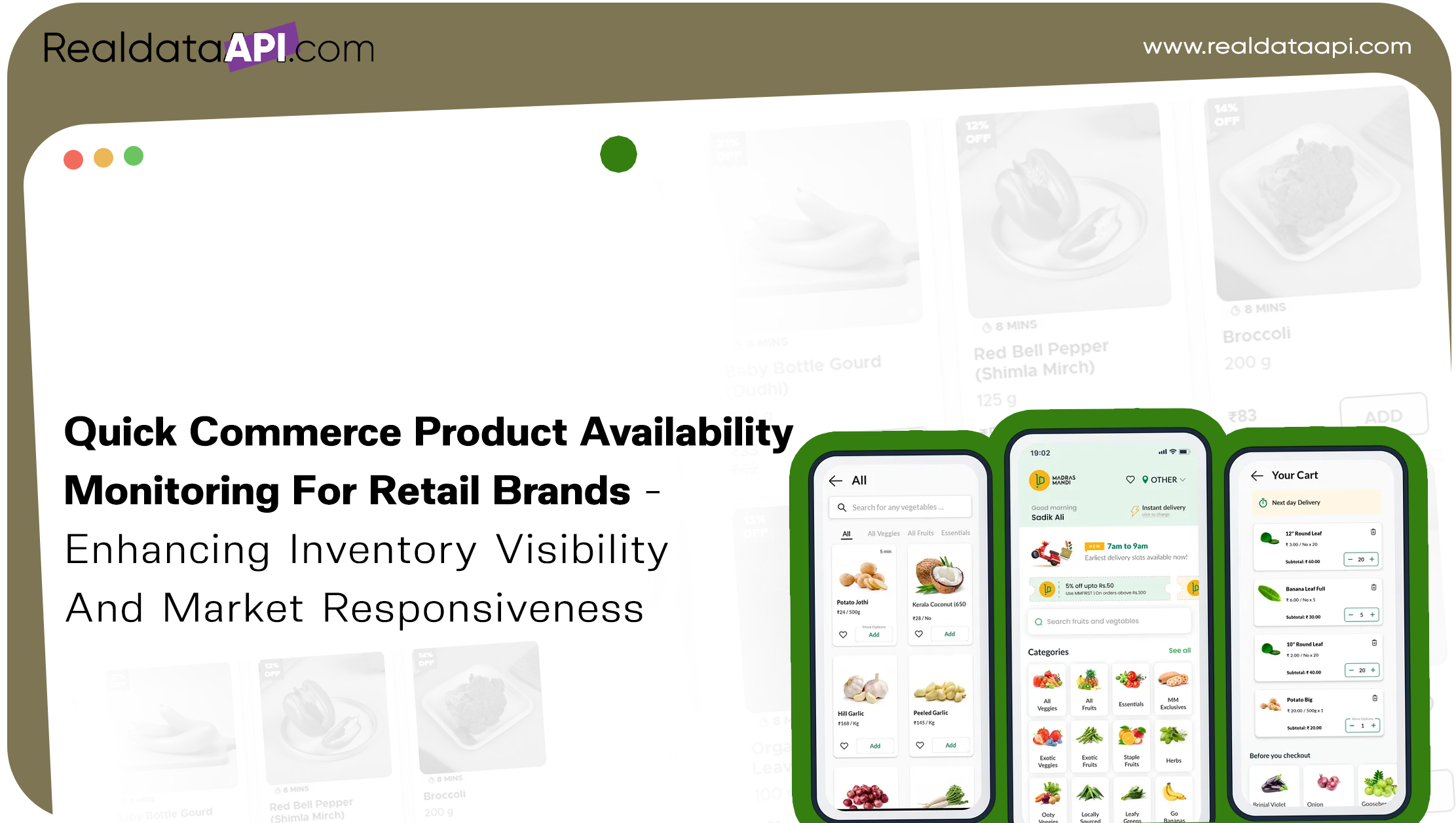
Introduction
Retail brands need continuous visibility into product availability across quick commerce platforms to prevent stockouts, improve customer satisfaction, maximize sales opportunities, and optimize inventory planning. quick commerce product availability monitoring for retail brands enables businesses to track inventory levels, product listings, and stock performance in real time across multiple delivery platforms.
According to industry estimates, stockouts can reduce potential sales by 10-15% annually for FMCG brands operating in online retail ecosystems. Real-time visibility helps brands respond quickly to demand fluctuations and maintain shelf presence across digital channels.
As quick commerce adoption accelerates, brands are increasingly leveraging a powerful Quick Commerce Data Scraping API to collect real-time inventory and availability data from leading delivery platforms. This intelligence enables businesses to identify product gaps, forecast demand, optimize replenishment strategies, and strengthen retailer relationships. For retail brands, maintaining consistent product availability is no longer optional—it is a competitive necessity.
How can brands track inventory visibility across multiple platforms?
Maintaining inventory visibility across several quick commerce platforms can be challenging without automated monitoring systems. Brands increasingly rely on real-time product availability across quick commerce platforms to understand stock levels and ensure products remain accessible to customers.
Product Availability Monitoring Growth (2020-2026)
| Year | Availability Monitoring Adoption (%) | SKU Visibility Accuracy (%) |
|---|---|---|
| 2020 | 24 | 72 |
| 2021 | 32 | 76 |
| 2022 | 43 | 81 |
| 2023 | 55 | 87 |
| 2024 | 66 | 91 |
| 2025* | 76 | 94 |
| 2026* | 85 | 97 |
*Projected Data
Inventory visibility enables brands to:
- Identify stockouts immediately
- Monitor regional inventory levels
- Evaluate product assortment consistency
- Track SKU performance across cities
- Improve retailer collaboration
Real-time monitoring reduces blind spots in inventory management. Brands can quickly detect supply chain disruptions and take corrective action before sales are affected.
This visibility also improves planning accuracy and supports stronger demand forecasting. As platform competition increases, inventory intelligence becomes a critical driver of market responsiveness.
How does availability data improve retail decision-making?
Availability data provides valuable insights into product performance, consumer demand, and operational efficiency. Businesses can Scrape Product availability data on quick delivery apps to understand where products are performing well and where inventory challenges exist.
Retail Intelligence Adoption Trends (2020-2026)
| Year | Brands Using Availability Analytics (%) | Inventory Optimization Improvement (%) |
|---|---|---|
| 2020 | 21 | 12 |
| 2021 | 29 | 18 |
| 2022 | 40 | 25 |
| 2023 | 53 | 33 |
| 2024 | 65 | 42 |
| 2025* | 75 | 49 |
| 2026* | 84 | 57 |
*Projected Data
Availability intelligence helps brands answer important questions:
- Which products experience frequent stockouts?
- Which cities have the highest demand?
- Which categories require replenishment?
- How does availability impact sales performance?
By analyzing product availability patterns, brands can allocate inventory more effectively and improve customer experiences. These insights also help reduce lost sales opportunities caused by unavailable products.
What role does automated inventory intelligence play?
Manual monitoring cannot keep pace with the speed of quick commerce operations. A modern quick commerce inventory data scraper automates inventory collection and provides continuous visibility into stock performance.
Inventory Intelligence Performance (2020-2026)
| Year | Automated Monitoring Adoption (%) | Stock Accuracy (%) |
|---|---|---|
| 2020 | 26 | 78 |
| 2021 | 35 | 82 |
| 2022 | 46 | 86 |
| 2023 | 59 | 90 |
| 2024 | 70 | 94 |
| 2025* | 80 | 96 |
| 2026* | 89 | 98 |
*Projected Data
Automated inventory intelligence delivers several benefits:
- Continuous inventory tracking
- Faster stockout detection
- Reduced manual effort
- Better replenishment planning
- Improved forecasting accuracy
Retail brands can monitor thousands of SKUs simultaneously across multiple marketplaces. This enables faster decision-making and improves operational efficiency throughout the supply chain.
As inventory complexity grows, automation becomes essential for maintaining visibility and responsiveness.
How can brands monitor assortment performance and stock levels?
Product assortment directly influences customer purchasing decisions. Businesses increasingly rely on Web Scraping quick commerce product assortment and stock monitoring to evaluate category performance and assortment effectiveness.
Assortment Monitoring Trends (2020-2026)
| Year | Product Assortment Coverage (%) | Category Monitoring Accuracy (%) |
|---|---|---|
| 2020 | 61 | 74 |
| 2021 | 67 | 78 |
| 2022 | 74 | 83 |
| 2023 | 81 | 88 |
| 2024 | 87 | 92 |
| 2025* | 93 | 95 |
| 2026* | 97 | 98 |
*Projected Data
Assortment monitoring enables brands to:
- Analyze SKU distribution
- Compare category coverage
- Track product launches
- Monitor shelf-share performance
- Identify assortment gaps
These insights help businesses improve merchandising strategies and ensure product visibility across key channels.
Brands that continuously monitor assortments can respond faster to changing consumer preferences and market opportunities.
Why is pricing and availability intelligence important together?
Availability data becomes even more powerful when combined with pricing intelligence. Brands can extract product availability and pricing from grocery apps to gain a complete understanding of market dynamics.
Pricing and Availability Analytics Growth (2020-2026)
| Year | Combined Analytics Adoption (%) | Revenue Impact Improvement (%) |
|---|---|---|
| 2020 | 22 | 10 |
| 2021 | 31 | 16 |
| 2022 | 43 | 24 |
| 2023 | 56 | 32 |
| 2024 | 68 | 40 |
| 2025* | 79 | 48 |
| 2026* | 88 | 55 |
*Projected Data
When pricing and availability data are analyzed together, brands can:
- Detect lost sales opportunities
- Measure promotion effectiveness
- Monitor competitor pricing
- Improve assortment profitability
- Optimize revenue strategies
This comprehensive intelligence supports more informed business decisions and enhances overall market competitiveness.
How can predictive analytics improve future inventory planning?
Forecasting demand accurately is one of the biggest challenges facing retail brands. Organizations increasingly leverage analytics to Predict Grocery Demand via quick commerce data intelligence and prepare for future inventory requirements.
Demand Forecasting Trends (2020-2026)
| Year | Forecast Accuracy (%) | Demand Planning Adoption (%) |
|---|---|---|
| 2020 | 69 | 28 |
| 2021 | 74 | 36 |
| 2022 | 80 | 47 |
| 2023 | 86 | 58 |
| 2024 | 90 | 69 |
| 2025* | 94 | 79 |
| 2026* | 97 | 88 |
*Projected Data
Predictive analytics helps brands:
- Anticipate seasonal demand
- Optimize inventory allocation
- Reduce stockouts
- Improve replenishment cycles
- Enhance supply chain efficiency
Forecasting models powered by quick commerce intelligence enable organizations to stay ahead of demand fluctuations while maximizing product availability.
Why Choose Real Data API?
Real Data API provides advanced quick commerce intelligence solutions designed for brands, retailers, distributors, category managers, and market intelligence teams seeking greater inventory visibility and operational control.
Businesses can leverage Real Data API to scrape Quick Commerce Product Stock Levels across leading delivery platforms while enabling comprehensive quick commerce product availability monitoring for retail brands through automated data collection and analytics.
Key capabilities include:
- Real-time stock monitoring
- Product availability tracking
- SKU-level analytics
- Inventory intelligence dashboards
- Demand forecasting solutions
- Category performance monitoring
- Multi-platform integration
- Automated reporting systems
These solutions empower brands to improve market responsiveness, reduce stockout risks, and optimize inventory performance.
Conclusion
The future of retail success in quick commerce depends on visibility, speed, and data-driven decision-making. quick commerce product availability monitoring for retail brands provides the intelligence needed to maintain inventory accuracy, improve forecasting, monitor stock performance, and respond quickly to changing market conditions.
By leveraging real-time availability monitoring, pricing intelligence, assortment tracking, and predictive analytics, brands can strengthen customer satisfaction while maximizing sales opportunities across digital retail channels.
Ready to improve inventory visibility and eliminate stockout blind spots? Contact Real Data API today to deploy advanced quick commerce product monitoring solutions and gain real-time market intelligence that drives growth and operational excellence!
Latest posts
How Scrape Xiaohongshu Product Trends in Real Time Solves Product Discovery and Competitor Monitoring Challenges?
How to Scrape Taobao Product Data to Solve Pricing, Inventory, and Competitor Monitoring Challenges?
How to Extract grocery product listings Data from SPAR to Build Accurate Grocery Intelligence and Competitive Market Insights?
Scrape Douyin follower growth and engagement data to track influencer performance and trends







.png)