Introduction
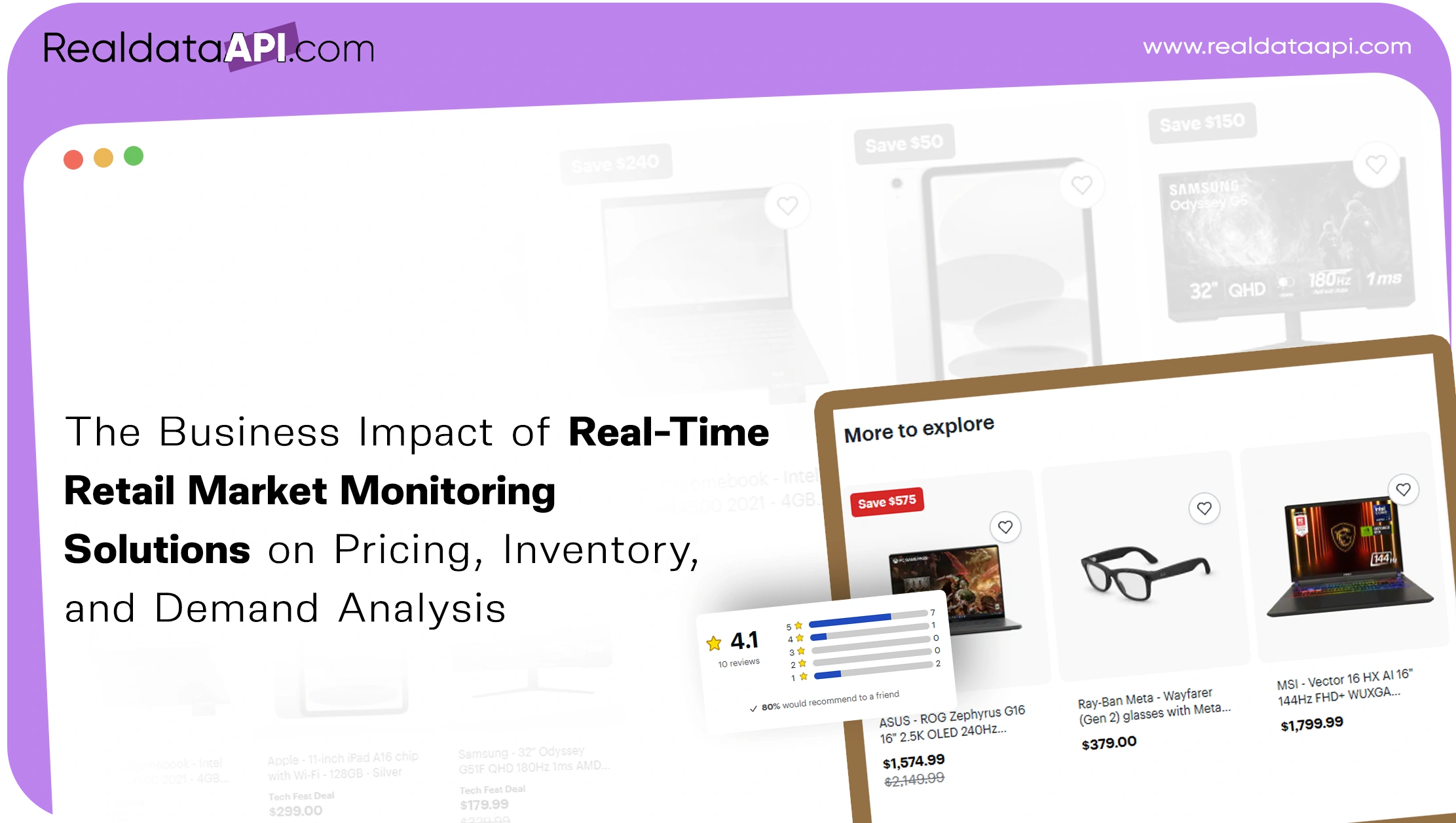
Retailers that use real-time retail market monitoring solutions gain a competitive advantage by tracking competitor pricing, inventory levels, and consumer demand in real time. These insights help businesses optimize pricing, reduce stockouts, improve forecasting accuracy, and increase profitability across online and offline retail channels.
Industry Insight: According to multiple retail industry studies, organizations that implement real-time pricing and inventory intelligence can improve forecast accuracy by up to 30%, reduce stock-related losses by 20%, and enhance revenue growth through faster response to market changes between 2020 and 2026.
For retail executives, e-commerce managers, pricing analysts, and market intelligence teams, staying informed about changing consumer behavior is essential. Modern retailers rely on E-Commerce Data Scraping API technologies to collect large-scale market data from online marketplaces, brand websites, and retail platforms. This data enables businesses to understand pricing fluctuations, promotional strategies, inventory movements, and customer demand patterns.
As competition intensifies, retailers need actionable insights rather than historical reports. Real-time market monitoring transforms raw retail data into strategic intelligence that drives smarter business decisions. From pricing optimization to inventory management and demand forecasting, organizations are increasingly investing in advanced data intelligence platforms to stay ahead in rapidly evolving markets.
How Can Businesses Gain Competitive Visibility Across Retail Markets?
To stay competitive, retailers must continuously monitor competitors' products, prices, promotions, and assortment strategies. This is where businesses scrape retail market data for competitor analysis to identify market opportunities and threats before competitors react.
Retail monitoring platforms provide visibility into competitor activities across multiple channels. Instead of manually reviewing hundreds of websites, companies can automate data collection and analysis at scale.
Retail Market Intelligence Trends (2020-2026)
| Year | Retailers Using Competitor Monitoring | Average Price Updates Per Day |
|---|---|---|
| 2020 | 35% | 2 |
| 2021 | 42% | 3 |
| 2022 | 51% | 4 |
| 2023 | 61% | 6 |
| 2024 | 69% | 8 |
| 2025 | 75% | 10 |
| 2026 | 82% | 12 |
Competitive monitoring enables businesses to:
- Track competitor pricing changes instantly
- Monitor promotional campaigns
- Identify assortment gaps
- Analyze product launches
- Detect market trends early
- Benchmark performance against competitors
Retailers using automated market intelligence systems can react faster to pricing changes and promotional activities. This helps protect margins while maintaining competitiveness. Real-time visibility also supports category management teams in identifying emerging opportunities and adjusting product portfolios accordingly.
The increasing complexity of omnichannel retail environments makes competitor intelligence more valuable than ever. Businesses that leverage market monitoring data can make proactive decisions rather than reacting after market conditions have already changed.
Why Are Modern Retailers Investing in Advanced Data Collection Systems?
Retail markets generate enormous volumes of data every day. Companies increasingly rely on retail data scraping services to collect, organize, and analyze information from diverse online sources.
Traditional market research often provides delayed insights. Automated data extraction solves this challenge by delivering near real-time intelligence.
Growth of Retail Data Collection Adoption
| Year | Companies Using Automated Retail Data Collection |
|---|---|
| 2020 | 28% |
| 2021 | 36% |
| 2022 | 46% |
| 2023 | 57% |
| 2024 | 66% |
| 2025 | 73% |
| 2026 | 80% |
Businesses collect data from:
- E-commerce websites
- Online marketplaces
- Brand stores
- Retail aggregators
- Product comparison platforms
- Consumer review portals
These data sources provide insights into:
- Product availability
- Customer sentiment
- Promotional effectiveness
- Inventory fluctuations
- Assortment strategies
Retail executives use this information to support strategic planning and operational improvements. Automated collection systems also reduce manual effort while improving data accuracy.
As retail competition becomes increasingly digital, businesses need reliable and scalable data acquisition capabilities. Organizations that invest in automated intelligence infrastructure gain a significant advantage in identifying trends, monitoring competitors, and optimizing retail performance.
How Does Dynamic Pricing Improve Revenue and Profitability?
Pricing directly influences profitability. Modern retailers increasingly deploy retail pricing intelligence solutions to monitor market conditions and optimize pricing strategies.
Dynamic pricing enables businesses to respond quickly to changing market circumstances. Rather than relying on static pricing models, retailers can adjust prices based on competitor activity, demand shifts, and inventory levels.
Pricing Intelligence Impact (2020-2026)
| Metric | 2020 | 2026 |
|---|---|---|
| Revenue Improvement | 4% | 15% |
| Margin Growth | 3% | 12% |
| Price Update Frequency | Weekly | Hourly |
| Pricing Accuracy | 68% | 92% |
Key benefits include:
- Improved profit margins
- Increased revenue opportunities
- Faster reaction to competitor pricing
- Better inventory turnover
- Enhanced customer retention
Pricing intelligence platforms continuously analyze thousands of product listings and competitor price points. This enables businesses to maintain optimal pricing across multiple channels.
For example, if competitors lower prices during a promotional event, retailers can immediately evaluate whether matching, undercutting, or maintaining pricing aligns with business objectives.
As retail markets become increasingly dynamic, pricing intelligence has become a critical component of successful revenue management strategies.
What Business Functions Benefit Most from Retail Intelligence Automation?
Many organizations explore Top Ecommerce Scraping API Use Cases to improve decision-making and operational efficiency.
Retail intelligence extends far beyond pricing analysis. Data-driven organizations use retail monitoring platforms across multiple departments.
Primary Use Cases by Business Function
| Business Function | Main Use Case |
|---|---|
| Pricing Teams | Dynamic pricing |
| Merchandising | Product assortment analysis |
| Marketing | Promotion monitoring |
| Operations | Inventory optimization |
| Strategy | Competitive intelligence |
| Supply Chain | Demand forecasting |
Popular applications include:
- Monitoring marketplace performance
- Tracking product availability
- Forecasting seasonal demand
- Analyzing customer preferences
- Measuring promotional effectiveness
- Identifying regional demand patterns
Between 2020 and 2026, retailers significantly expanded their use of automated intelligence systems. Organizations increasingly integrate retail data into analytics dashboards and AI-powered forecasting models.
The result is faster decision-making and greater operational efficiency. Retail teams gain access to actionable insights without spending hours manually collecting information.
As digital commerce continues to expand globally, automated retail intelligence becomes an essential capability for maintaining competitiveness and supporting long-term growth.
How Can Better Data Improve Inventory and Demand Forecasting?
Effective forecasting requires accurate and timely information. Businesses increasingly leverage an E-Commerce Dataset to improve inventory planning and demand prediction.
Modern forecasting models use historical sales data combined with external market signals. These signals include competitor pricing, stock availability, promotions, and consumer behavior trends.
Organizations implementing real-time retail market monitoring solutions gain visibility into demand fluctuations before they significantly impact inventory levels.
Forecasting Accuracy Improvements
| Year | Forecast Accuracy |
|---|---|
| 2020 | 65% |
| 2021 | 68% |
| 2022 | 72% |
| 2023 | 77% |
| 2024 | 82% |
| 2025 | 86% |
| 2026 | 90% |
Benefits include:
- Reduced stockouts
- Lower excess inventory
- Better supplier planning
- Improved customer satisfaction
- Enhanced working capital efficiency
Retailers can identify products experiencing increasing demand and adjust procurement strategies accordingly. Similarly, declining demand patterns can trigger inventory reduction initiatives.
Demand forecasting powered by comprehensive datasets allows businesses to improve operational planning while minimizing inventory-related risks.
The ability to combine internal sales information with external market intelligence creates a more accurate and responsive forecasting framework.
How Is Real-Time Intelligence Shaping the Future of Retail Analytics?
Retail analytics is evolving rapidly. Businesses are increasingly adopting Real-Time Retail Pricing Intelligence API Solutions to support faster and more informed decisions.
Traditional reporting methods often provide insights after opportunities have passed. Real-time intelligence changes this by delivering continuous visibility into market conditions.
Retail Intelligence Technology Adoption
| Year | Real-Time Analytics Adoption |
|---|---|
| 2020 | 22% |
| 2021 | 31% |
| 2022 | 42% |
| 2023 | 55% |
| 2024 | 67% |
| 2025 | 77% |
| 2026 | 85% |
Emerging capabilities include:
- AI-powered forecasting
- Automated pricing recommendations
- Market anomaly detection
- Inventory risk prediction
- Promotion effectiveness analysis
- Competitive strategy monitoring
Retail organizations increasingly integrate market intelligence into enterprise decision-making systems. This creates a unified view of pricing, inventory, demand, and competitor activity.
The future of retail analytics will depend on speed, automation, and scalability. Businesses that embrace real-time intelligence will be better positioned to respond to changing customer expectations and market dynamics.
As competition intensifies, access to timely and actionable market data becomes a strategic advantage rather than a technical capability.
Why Choose Real Data API?
Real Data API delivers scalable and reliable solutions designed to support modern retail intelligence initiatives. Organizations seeking real-time retail market monitoring solutions require accurate, timely, and comprehensive data coverage.
Key advantages include:
- Large-scale retail data collection
- Real-time market monitoring
- Competitor pricing intelligence
- Inventory tracking capabilities
- Customizable data delivery formats
- High-frequency data updates
- Scalable infrastructure
- Enterprise-grade reliability
Real Data API helps retailers, brands, manufacturers, and market intelligence teams transform raw market data into actionable business insights. By providing accurate retail intelligence at scale, businesses can improve pricing decisions, optimize inventory planning, and strengthen competitive positioning.
Whether supporting demand forecasting, competitor monitoring, or pricing optimization, Real Data API enables organizations to make data-driven decisions with confidence.
Conclusion
Retail success increasingly depends on speed, visibility, and data accuracy. Real-time retail market monitoring solutions empower businesses to monitor competitors, optimize pricing, improve inventory management, and enhance demand forecasting. Organizations that leverage real-time market intelligence gain stronger competitive positioning, improved operational efficiency, and greater revenue opportunities in today's rapidly evolving retail environment.
Ready to transform your retail strategy with actionable market intelligence? Contact Real Data API today and discover how advanced retail data solutions can help your business stay ahead of the competition!
Latest posts
How Scrape Xiaohongshu Product Trends in Real Time Solves Product Discovery and Competitor Monitoring Challenges?
How to Scrape Taobao Product Data to Solve Pricing, Inventory, and Competitor Monitoring Challenges?
How to Extract grocery product listings Data from SPAR to Build Accurate Grocery Intelligence and Competitive Market Insights?
Scrape Douyin follower growth and engagement data to track influencer performance and trends






.png)