Introduction
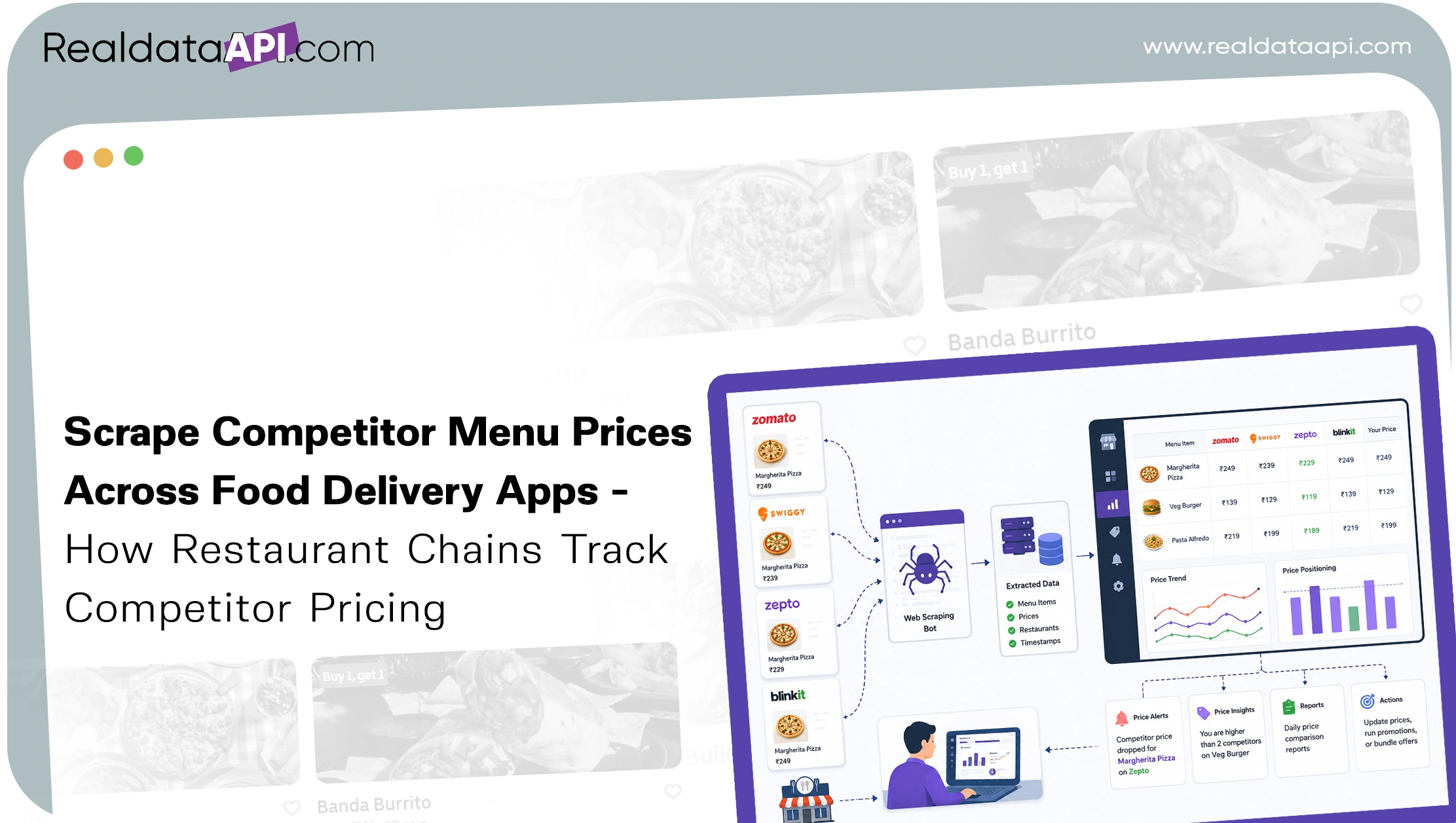
Restaurant chains use pricing intelligence to stay competitive in rapidly changing food delivery markets. By leveraging Scrape competitor menu prices across food delivery apps, brands can monitor competitor prices, discounts, combo offers, and menu changes in real time. This helps businesses optimize pricing, improve margins, and respond quickly to market trends.
Industry Insight: According to industry estimates, online food delivery revenue is expected to exceed $1.8 trillion globally by 2026, while more than 70% of restaurant operators report adjusting menu prices multiple times per year to address competition and changing costs.
Modern restaurant brands increasingly rely on Food Data Scraping API solutions to collect menu data from delivery platforms, analyze pricing trends, and identify opportunities for growth. Whether operating a single location or managing hundreds of outlets, access to accurate competitor pricing data enables smarter decisions and stronger market positioning.
What Makes Pricing Intelligence Essential for Restaurant Success?
Restaurant operators face constant pressure from changing customer preferences, delivery platform commissions, and competitor promotions. Accurate market visibility helps businesses make informed decisions instead of relying on assumptions.
One of the most effective approaches is Restaurant menu data intelligence for competitive pricing. By collecting menu information from multiple food delivery platforms, brands can benchmark prices against competitors across different regions and cuisine categories.
| Year | Restaurants Using Competitive Pricing Analytics | Average Menu Updates Per Year |
|---|---|---|
| 2020 | 28% | 3 |
| 2021 | 34% | 4 |
| 2022 | 42% | 5 |
| 2023 | 51% | 6 |
| 2024 | 58% | 7 |
| 2025 | 64% | 8 |
| 2026 | 71% | 9 |
Businesses can identify:
- Overpriced menu items
- Undervalued products
- Promotion opportunities
- Regional pricing differences
- Emerging market trends
This visibility helps chains maintain competitiveness while protecting profitability. Instead of reacting after losing customers, operators can proactively adjust pricing strategies using real-time intelligence gathered from food delivery marketplaces.
How Can Restaurants Improve Menu Performance Through Market Analysis?
Menu optimization requires understanding how customers respond to pricing across competing restaurants. Businesses increasingly use Web Scraping Restaurant pricing data for menu optimization to discover ideal pricing structures.
A restaurant chain may find that competitors charge 8–12% more for similar items in premium urban markets while offering lower-priced bundle deals in suburban regions. Such insights help decision-makers adjust menus based on local demand.
| Year | Avg. Restaurants Conducting Menu Optimization | Revenue Impact |
|---|---|---|
| 2020 | 22% | 3% |
| 2021 | 29% | 4% |
| 2022 | 37% | 5% |
| 2023 | 46% | 6% |
| 2024 | 55% | 7% |
| 2025 | 63% | 8% |
| 2026 | 70% | 9% |
Menu optimization strategies include:
- Evaluating competitor item pricing.
- Monitoring promotional campaigns.
- Comparing portion sizes and pricing.
- Identifying best-selling categories.
- Testing dynamic pricing strategies.
Restaurants that consistently monitor market pricing often improve customer retention and profitability because their menus remain aligned with market expectations while preserving margins.
How Do Businesses Compare Prices Across Multiple Delivery Platforms?
Food delivery platforms often display different prices for identical products. Managing this complexity manually becomes difficult as restaurant chains expand into multiple markets.
A Food delivery menu price comparison data scraper automates the collection of pricing information from various delivery platforms. This allows operators to compare menu prices, discounts, and service fees across regions and competitors.
| Year | Platforms Monitored per Brand (Average) |
|---|---|
| 2020 | 2 |
| 2021 | 3 |
| 2022 | 4 |
| 2023 | 5 |
| 2024 | 6 |
| 2025 | 7 |
| 2026 | 8 |
Benefits include:
- Cross-platform pricing consistency
- Faster promotion tracking
- Competitor benchmark reports
- Market trend identification
- Improved revenue planning
Large chains can evaluate thousands of menu items daily. Automated comparison systems eliminate manual effort and provide decision-makers with timely data. This creates a significant competitive advantage, especially in highly competitive urban food delivery markets where pricing changes frequently.
Why Are APIs Becoming Critical for Digital Restaurant Expansion?
Restaurant technology strategies increasingly depend on API-driven ecosystems. Businesses need seamless access to delivery platform data, menu information, customer insights, and operational analytics.
Many brands are investing in Restaurant Platform Development Using Food Delivery APIs to create centralized dashboards that integrate pricing intelligence, delivery performance, and menu management.
| Year | API Adoption Among Enterprise Restaurants |
|---|---|
| 2020 | 25% |
| 2021 | 32% |
| 2022 | 41% |
| 2023 | 50% |
| 2024 | 59% |
| 2025 | 67% |
| 2026 | 75% |
API-powered systems enable:
- Automated menu synchronization
- Real-time pricing updates
- Competitor monitoring
- Market expansion analysis
- Business intelligence reporting
As food delivery ecosystems continue evolving, APIs help restaurant operators build scalable digital infrastructures that support growth and improve operational efficiency across multiple locations.
How Are AI and Forecasting Transforming Restaurant Decision-Making?
Predicting future demand has become increasingly important for restaurant chains. Historical menu data combined with competitor intelligence allows operators to make better forecasts.
Organizations now utilize Food Delivery Demand Forecasting Using Web Scraping and AI to anticipate market changes, identify seasonal demand shifts, and optimize inventory planning.
| Year | AI Forecast Accuracy |
|---|---|
| 2020 | 68% |
| 2021 | 71% |
| 2022 | 74% |
| 2023 | 78% |
| 2024 | 82% |
| 2025 | 85% |
| 2026 | 89% |
AI forecasting supports:
- Demand prediction
- Inventory optimization
- Dynamic pricing recommendations
- Promotion planning
- Market expansion decisions
By combining competitor menu data with AI models, restaurant operators can identify opportunities before competitors react. This creates a more agile business capable of adapting quickly to changing consumer behavior and market conditions.
How Can Analytics Drive Better Restaurant Performance?
Modern restaurant success depends on converting large datasets into actionable insights. Competitive pricing data, customer behavior trends, and menu performance metrics all contribute to strategic decision-making.
Businesses increasingly rely on Food Delivery Data API Scraping for Restaurant Analytics to centralize and analyze food delivery marketplace data.
| Year | Analytics-Driven Restaurant Chains |
|---|---|
| 2020 | 30% |
| 2021 | 38% |
| 2022 | 47% |
| 2023 | 56% |
| 2024 | 64% |
| 2025 | 72% |
| 2026 | 80% |
Analytics platforms help organizations:
- Track pricing performance
- Evaluate promotional effectiveness
- Monitor competitor activities
- Identify market opportunities
- Improve revenue forecasting
Restaurant leaders gain deeper visibility into customer preferences and market trends. This enables more precise pricing strategies and supports long-term growth initiatives.
Why Choose Real Data API?
Restaurant operators need accurate, scalable, and reliable data solutions to maintain a competitive edge. Real Data API provides enterprise-grade tools to Scrape competitor menu prices across food delivery apps while delivering structured and actionable insights.
Key advantages include:
- Real-time menu monitoring
- Multi-platform data collection
- Large-scale data extraction
- Custom analytics integration
- Reliable API infrastructure
- Scalable enterprise solutions
- Global market coverage
Real Data API helps restaurant chains transform raw marketplace information into strategic intelligence that drives pricing optimization, operational efficiency, and business growth.
Conclusion
Restaurant chains increasingly depend on data-driven strategies to remain competitive in crowded food delivery markets. By using solutions that Scrape competitor menu prices across food delivery apps, businesses can track competitor activity, optimize menu pricing, improve forecasting accuracy, and strengthen market positioning.
Ready to gain real-time restaurant pricing intelligence? Contact Real Data API today and discover how advanced food delivery data solutions can help your business outperform competitors and accelerate growth!
Latest posts
How Scrape Xiaohongshu Product Trends in Real Time Solves Product Discovery and Competitor Monitoring Challenges?
How to Scrape Taobao Product Data to Solve Pricing, Inventory, and Competitor Monitoring Challenges?
How to Extract grocery product listings Data from SPAR to Build Accurate Grocery Intelligence and Competitive Market Insights?
Scrape Douyin follower growth and engagement data to track influencer performance and trends






.png)



