.gif)
.jpg)
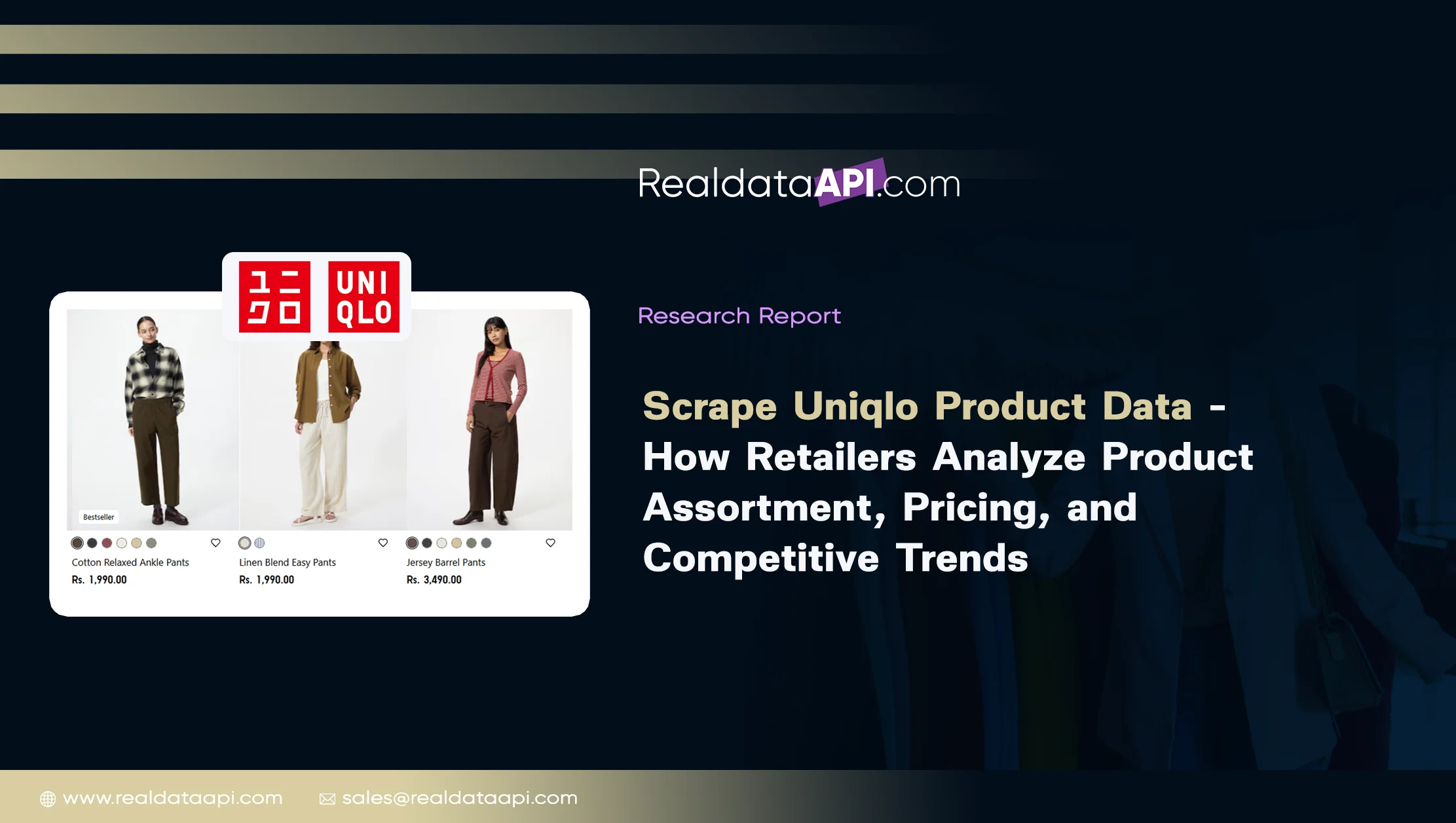
Quick Summary
- Scrape Uniqlo Product Data can help retailers analyze visible product attributes, prices, categories, discounts, and assortment changes for competitive intelligence and merchandising research.
- Uniqlo Fashion Data Scraping can transform online fashion information into structured datasets that support price benchmarking, product research, assortment analysis, and historical trend monitoring.
- UNIQLO's global expansion makes structured fashion intelligence increasingly relevant for retailers comparing products, positioning, and pricing across markets.
Introduction
Scrape Uniqlo Product Data to understand how product assortments, prices, discounts, categories, and availability evolve across an international fashion retailer. For retailers and market researchers, a current product catalog provides useful competitive signals, while historical observations can reveal seasonal changes, pricing movements, assortment expansion, and product positioning.
Uniqlo Fashion Data Scraping can organize publicly accessible product information into structured records for analysis. Depending on the source and applicable access conditions, fields may include product names, SKU identifiers, categories, colors, sizes, prices, discounts, product descriptions, ratings, availability, and URLs.
UNIQLO is operated by Fast Retailing, one of the world's largest apparel retail groups. Fast Retailing reported consolidated revenue of ¥3.4005 trillion for fiscal 2025, with UNIQLO International generating ¥1.9102 trillion in revenue and UNIQLO Japan generating ¥1.0260 trillion.
This scale creates an important research opportunity. Retailers do not necessarily need to reproduce an entire catalog. Instead, they can focus on selected categories, comparable products, target markets, price bands, seasonal collections, and competitive attributes.
For pricing managers, the objective may be to identify comparable products and monitor price movements. For merchandising teams, the focus may be assortment breadth and category composition. For market researchers, historical product observations can help identify shifts in fashion positioning.
This report examines how structured product intelligence can support these objectives from 2020 through 2026.
How Can Retailers Identify Pricing Patterns Across Fashion Products?
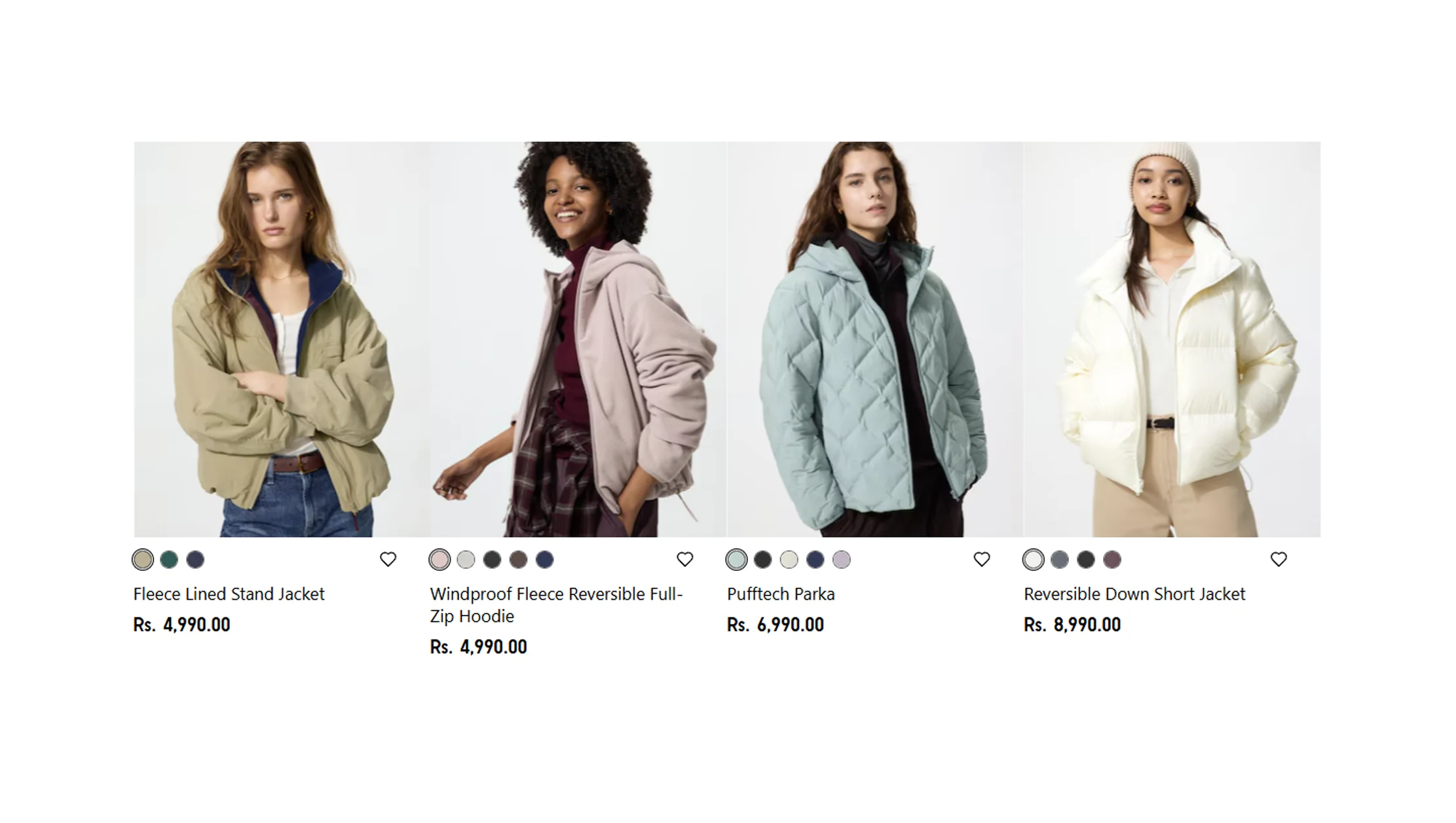
Uniqlo product pricing data extraction provides retailers with structured information for comparing listed prices, promotional prices, discounts, categories, and product positioning.
Pricing research becomes more meaningful when products are matched according to attributes such as category, gender, material, product type, season, and comparable features. Simply comparing two prices without accounting for product differences can lead to inaccurate conclusions.
A useful pricing dataset can contain:
| Data field | Research purpose |
|---|---|
| Product name | Product identification |
| SKU | Product matching |
| Category | Category comparison |
| Original price | Baseline pricing |
| Sale price | Promotional analysis |
| Discount | Promotion measurement |
| Color | Variant analysis |
| Size | Availability comparison |
| Timestamp | Historical tracking |
| Product URL | Source verification |
Real-world retail context
Fast Retailing reported that UNIQLO Japan's revenue reached ¥1.026 trillion in fiscal 2025, up 10.0% year over year. The company attributed growth to strong sales of LifeWear products, higher average purchase prices, and other factors.
| Fast Retailing / UNIQLO metric | FY2024 | FY2025 |
|---|---|---|
| UNIQLO Japan revenue | ¥932.2B | ¥1,026.0B |
| UNIQLO International revenue | ¥1,765.0B | ¥1,910.2B |
| Consolidated revenue | ¥3,103.8B | ¥3,400.5B |
Source: Fast Retailing FY2025 financial results.
2020–2026 perspective
From 2020 onward, fashion retailers increasingly needed digital product visibility as e-commerce became a more important sales channel. During 2021–2022, price comparison became increasingly relevant as consumers could quickly compare alternatives online. In 2023–2024, historical pricing became more valuable for identifying promotional cycles and product positioning. During 2025, Fast Retailing's reported revenue growth demonstrated the continuing scale of UNIQLO's international business. By 2026, structured historical price records can help retailers move beyond one-time price checks toward systematic benchmarking across products, categories, markets, and seasons.
How Can Historical Product Records Strengthen Market Analysis?
An Uniqlo fashion dataset for market analysis can help retailers study assortment structure, pricing bands, product categories, seasonal collections, and changes in the fashion marketplace.
The biggest benefit of maintaining historical records is the ability to compare periods. A current catalog may show which products are available today, but historical data can reveal which categories were introduced, removed, discounted, or expanded over time.
Example analytical framework
| Analysis area | Relevant attributes | Potential insight |
|---|---|---|
| Assortment | Category, product type | Category expansion |
| Pricing | Original/sale price | Price positioning |
| Seasonality | Collection/date | Seasonal assortment |
| Materials | Material composition | Product positioning |
| Variants | Color/size | Product breadth |
| Promotions | Discount/sale status | Promotional strategy |
Fast Retailing's global scale illustrates why market analysis can benefit from structured observations. As of August 31, 2025, the company operated 2,519 UNIQLO stores globally, including 810 stores in Japan and 1,709 international stores.
| Store footprint | August 2024 | August 2025 |
|---|---|---|
| UNIQLO Japan | 797 | 810 |
| UNIQLO International | 1,725 | 1,709 |
| Total | 2,522 | 2,519 |
Source: Fast Retailing FY2025 results.
2020–2026 perspective
The 2020–2026 period highlights the increasing importance of digital retail intelligence. In the early part of the period, retailers were primarily focused on maintaining online visibility and adapting assortments to changing customer behavior. Between 2022 and 2024, competitive research increasingly involved digital catalogs, pricing, promotions, and product attributes. By 2025, UNIQLO's international store network exceeded 1,700 locations, demonstrating the scale of the brand's geographic footprint. In 2026, market researchers can use historical online product observations alongside corporate disclosures to understand assortment and pricing movements at a much more granular level.
The actionable insight is to preserve timestamps. Without timestamps, product records become snapshots; with timestamps, they become evidence of market change.
How Can Fashion Researchers Discover Product and Category Opportunities?
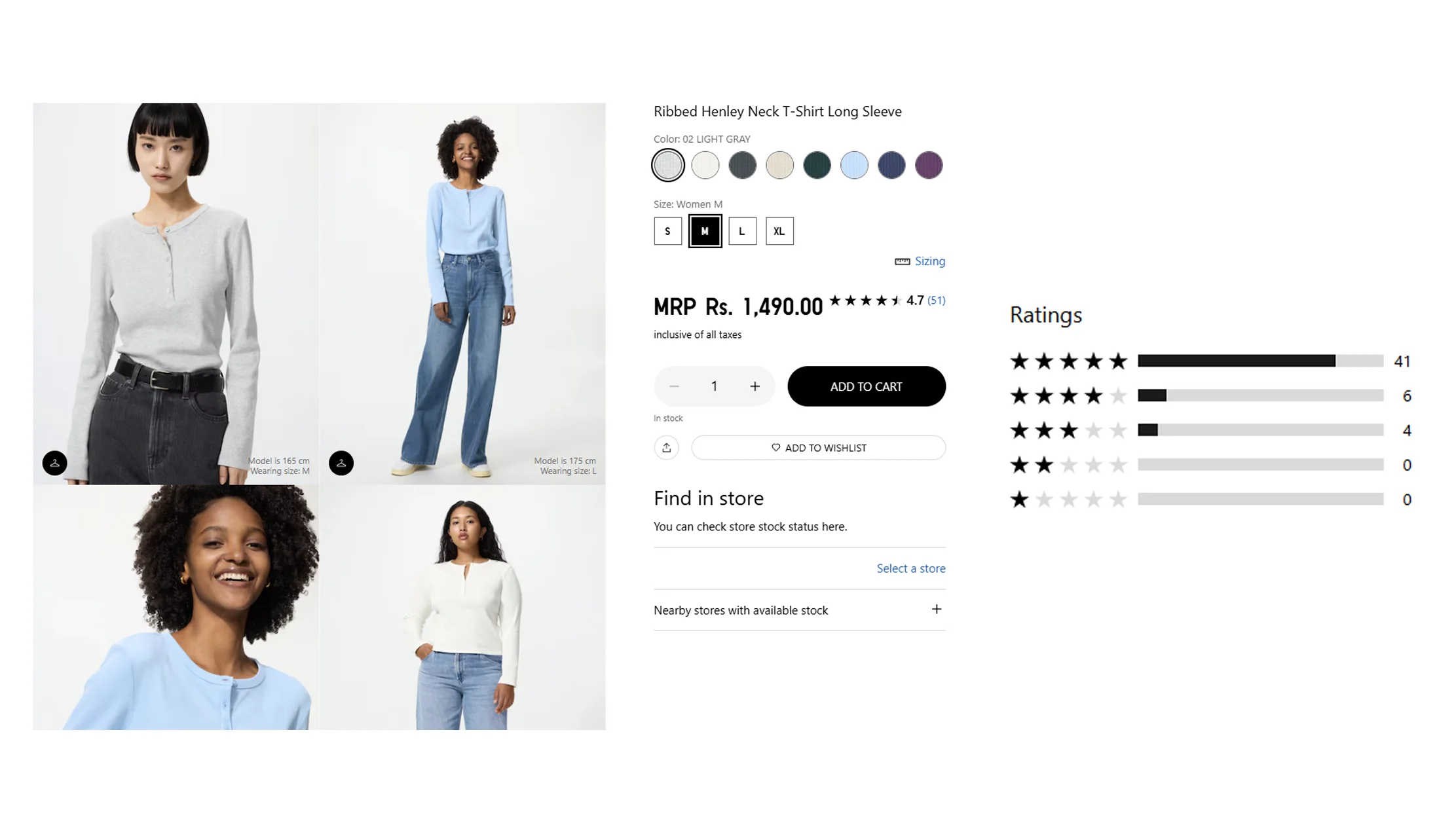
Uniqlo clothing data for market research can support detailed research into apparel categories, product positioning, price ranges, materials, variants, and assortment breadth.
For fashion researchers, product-level information can help answer questions that financial reports cannot answer. Corporate reports can show revenue and store growth, but product data can provide a closer view of what customers actually see online.
Research teams can investigate:
- Which apparel categories have the broadest assortment?
- Which price bands contain the most products?
- How frequently do products receive discounts?
- Which colors or variants appear across product categories?
- Which products remain available across multiple periods?
- How does assortment differ between markets?
Product research structure
| Research variable | Possible application |
|---|---|
| Product category | Category sizing |
| Product type | Assortment mapping |
| Price band | Market positioning |
| Material | Product differentiation |
| Color | Variant analysis |
| Size range | Assortment breadth |
| Discount | Promotion research |
| Availability | Inventory visibility |
A relevant real-world example is UNIQLO's LifeWear positioning. Fast Retailing describes LifeWear as clothing designed around the idea of high-quality, functional, everyday apparel, and the company continues to use product development as a central component of its business strategy.
2020–2026 perspective
Between 2020 and 2021, online apparel catalogs became increasingly important for shoppers researching products remotely. During 2022–2023, market researchers could increasingly compare digital assortments across brands and markets. In 2024–2025, product-level data became particularly useful for studying price architecture, product categories, and promotional behavior. Fast Retailing's FY2025 results reported strong sales of LifeWear products in Japan and overseas markets. By 2026, researchers can combine structured product observations with corporate financial data to create a more complete view of fashion-market positioning.
The strongest research methodology combines product-level observations with historical timestamps, category definitions, geographic context, and consistent product matching.
Turn changing fashion catalogs into structured market intelligence that supports smarter assortment, pricing, and competitive decisions!
Get Insights Now!What Technical Capabilities Are Needed for Large-Scale Fashion Research?
A Uniqlo web scraper for fashion product data can automate the collection of selected product information and reduce repetitive manual catalog research.
However, effective large-scale data collection requires more than extracting HTML pages. Fashion websites can contain dynamic content, multiple variants, changing URLs, regional catalogs, promotional pricing, and frequently updated availability information.
A robust workflow should therefore include:
- Source discovery – Identify relevant product and category pages.
- Field definition – Establish the exact attributes required.
- Product matching – Create consistent identifiers for products and variants.
- Extraction – Collect relevant visible product information.
- Validation – Check missing or anomalous records.
- Normalization – Standardize prices, categories, sizes, and attributes.
- Historical storage – Preserve observations with timestamps.
- Delivery – Send structured data into databases or analytics systems.
Example data-quality framework
| Quality measure | What to check |
|---|---|
| Completeness | Missing product fields |
| Accuracy | Incorrect price or attribute |
| Consistency | Category naming differences |
| Freshness | Age of records |
| Uniqueness | Duplicate products |
| Traceability | Source URL and timestamp |
Fast Retailing's global footprint demonstrates why scalability matters. In FY2025, UNIQLO International operated 1,709 stores across international markets, while the company reported 2,519 UNIQLO stores worldwide at the end of August 2025.
2020–2026 perspective
In 2020, many digital retail research workflows relied heavily on manual collection or periodic exports. From 2021–2022, expanding online catalogs increased the need for automated extraction. During 2023–2024, businesses increasingly required normalized datasets that could feed BI and analytics systems. In 2025, the international scale of UNIQLO reinforced the need to account for geographic differences in product and retail data. By 2026, scalable collection should be designed around data quality, historical continuity, refresh frequency, and downstream analytical requirements.
The technical objective is not simply maximum volume. It is reliable, repeatable collection that produces records analysts can actually compare.
How Can Structured Fashion Information Improve Competitive Intelligence?
A Uniqlo Fashion Dataset can help competitive intelligence teams organize product-level observations and identify changes in assortment, pricing, promotions, and product positioning.
For example, a retailer competing in casual apparel could create a benchmark covering selected product categories. Each observation can be linked to a product identifier and timestamp, allowing analysts to compare changes over weeks, months, or seasons.
Competitive intelligence model
| Signal | Competitive question |
|---|---|
| Product count | How broad is the assortment? |
| Median price | What is the market price position? |
| Sale frequency | How promotional is the category? |
| New products | Which categories are expanding? |
| Removed products | Which products are being rationalized? |
| Materials | How are products differentiated? |
| Variants | How broad is the choice? |
Fast Retailing reported that UNIQLO International revenue grew 11.6% year over year in FY2025 to ¥1.9102 trillion. It also reported that business performance was strong across North America, Europe, and Southeast Asia.
| Metric | FY2025 reported result |
|---|---|
| UNIQLO International revenue | ¥1.9102T |
| YoY growth | 8.5% |
| UNIQLO International stores | 1,709 |
| UNIQLO Japan stores | 810 |
Source: Fast Retailing FY2025 results.
2020–2026 perspective
Between 2020 and 2022, competitive intelligence largely centered on maintaining digital visibility and understanding rapidly changing retail behavior. During 2023–2024, structured product comparisons became more useful for category and pricing analysis. In FY2025, UNIQLO International generated ¥1.9102 trillion in revenue, demonstrating the scale of its international business. In 2026, retailers can use product-level historical observations to investigate how competitors modify product ranges, price architecture, promotions, and assortment across different markets.
A useful competitive dashboard should therefore track changes rather than only current values.
How Can Product-Level Trend Analysis Support Retail Decisions?
Uniqlo Fashion Dataset Products, Prices Trend Analysis can help retailers identify historical movements across product categories and price bands.
Trend analysis becomes particularly useful when product records are collected consistently. Analysts can calculate metrics such as average price, median price, discount rate, category count, new-product rate, and product-retention rate.
Example trend metrics
| Metric | Calculation concept | Business use |
|---|---|---|
| Average price | Total prices ÷ products | Overall price movement |
| Median price | Middle observed price | Reduces outlier impact |
| Discount rate | Discounted products ÷ total | Promotion intensity |
| New-product rate | New products ÷ catalog | Assortment expansion |
| Retention rate | Continuing products ÷ prior catalog | Product longevity |
| Category share | Category products ÷ total | Assortment structure |
These metrics can be segmented by market, category, gender, season, product type, or price band.
Fast Retailing's FY2025 results offer an important real-world benchmark: consolidated revenue increased 9.6% to ¥3.4005 trillion, while operating profit increased 12.4% to ¥564.3 billion.
2020–2026 perspective
From 2020 to 2021, digital product visibility became increasingly important for fashion businesses. During 2022–2023, historical product and price comparisons helped researchers understand changes in online assortment. In 2024, trend analysis increasingly benefited from combining product observations with broader market indicators. In FY2025, Fast Retailing reported record consolidated revenue of ¥3.4005 trillion, reflecting the continuing growth and scale of its global retail operations. By 2026, retailers can use multi-year product observations to identify recurring seasonal patterns, pricing movements, assortment changes, and competitive opportunities.
The key is consistency. If product fields or category definitions change between collection periods, trend analysis becomes less reliable. Standardization should therefore be treated as a core part of the research methodology.
Why Choose Real Data API?
Real Data API can support businesses that need structured fashion and retail information for research, benchmarking, monitoring, and analytics.
Fashion Data Scraping can be incorporated into a broader workflow that converts online fashion information into organized records suitable for analysis.
A research-focused data pipeline should provide:
- Structured product fields for consistent analysis.
- Historical observations for trend measurement.
- Price and promotion tracking for competitive benchmarking.
- Category-level organization for assortment analysis.
- Data validation to identify missing or inconsistent records.
- Scalable processing for large product catalogs.
- Analytics-ready delivery for databases, dashboards, and research systems.
For retailers, the most important consideration is whether the resulting dataset answers a specific business question.
A pricing team may need product-level price history. A merchandising team may require category and assortment information. A market researcher may need geographic comparisons and historical snapshots. A competitive intelligence team may need recurring observations of selected products.
Real Data API can help organizations design their collection strategy around those requirements rather than collecting unnecessary information.
The research process should also define the appropriate refresh frequency. Highly dynamic pricing research may require frequent observations, while seasonal assortment research can operate on a broader schedule.
Finally, organizations should retain source references and timestamps where appropriate. This creates traceability and allows analysts to validate important changes before acting on them.
Conclusion
Scrape Uniqlo Product Data to create a structured foundation for researching product assortment, pricing, discounts, availability, and competitive trends across fashion retail.
The research value comes from combining product-level observations with timestamps, consistent identifiers, category structures, and historical records. This allows retailers to move beyond one-time catalog checks and identify meaningful changes across products, categories, price bands, seasons, and markets.
Real-world Fast Retailing results demonstrate the scale behind the brand. In FY2025, consolidated revenue reached ¥3.4005 trillion, while UNIQLO International revenue reached ¥1.9102 trillion. The company operated 2,519 UNIQLO stores globally at the end of August 2025.
These figures do not by themselves reveal individual product-level changes. That is where structured product research becomes valuable. Retailers can combine corporate-level indicators with detailed catalog observations to develop a more granular understanding of competitive positioning.
For 2026 and beyond, the strongest approach is to build a repeatable research pipeline: define the business questions, identify relevant product fields, collect observations consistently, validate and normalize the records, preserve historical snapshots, and connect the dataset with analytics.
Want to build a reliable fashion product intelligence workflow? Connect with Real Data API to create structured, scalable product data collection for pricing, assortment, and competitive research!
FAQs
1. What can businesses learn when they Scrape Uniqlo Product Data?
Businesses can analyze product categories, prices, discounts, variants, availability, assortment changes, and historical product movements to support fashion retail benchmarking and competitive intelligence.
2. Why is Uniqlo Fashion Data Scraping useful for retailers?
It can provide structured product observations that help retailers compare assortment breadth, pricing, promotions, product attributes, and category positioning across relevant fashion markets.
3. How does Uniqlo product pricing data extraction support pricing research?
It enables researchers to organize product prices, promotional prices, discounts, categories, and timestamps, creating a consistent foundation for historical price benchmarking and analysis.
4. What is the benefit of an Uniqlo fashion dataset for market analysis?
It can help analysts evaluate assortment composition, category expansion, price bands, promotional patterns, and product changes over time using structured historical observations.
5. How can Real Data API support fashion product research?
Real Data API can help businesses build structured workflows for collecting, validating, organizing, and analyzing fashion product information for competitive intelligence, market research, and pricing studies.
Latest posts
How to Use Amazon API integration for e-commerce analytics to Track Competitor Prices and Improve Product Performance
How IKEA API for retail market intelligence Helps Retailers Solve Product Data Inconsistency and Pricing Challenges
How Instagram API integration for business analytics Helps Brands Track Engagement and Measure Social Media Performance
How OTT Dataset Updates for Entertainment Analytics Help Streaming Platforms Fix Outdated Content Insights



.png)


